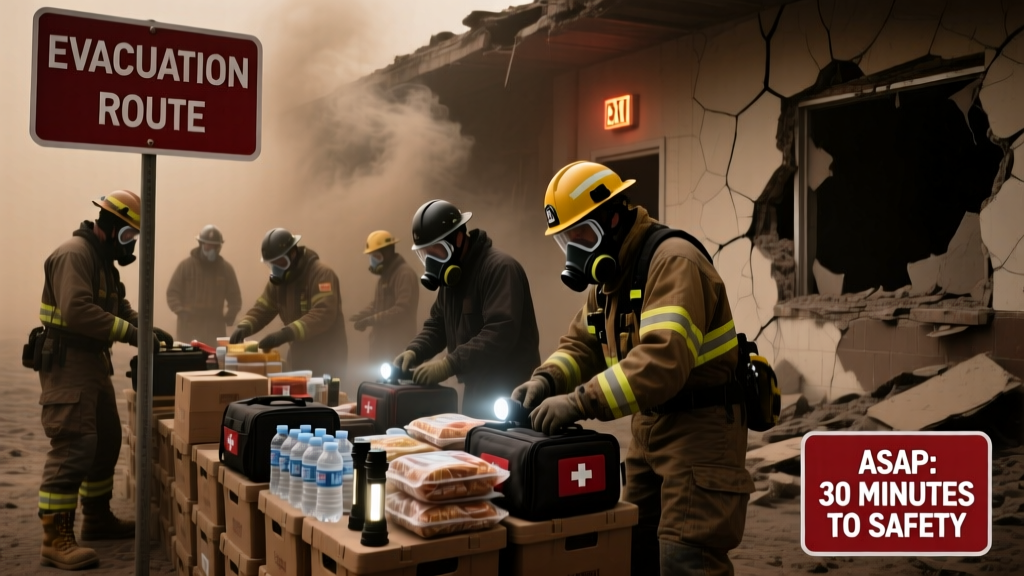
Volcanic ash can descend without warning—within minutes, it coats surfaces, clogs airways, and damages equipment. Your first action: get indoors immediately, close all windows and doors, and shut off HVAC systems to prevent ash from circulating inside.
Immediate Actions
- Move indoors right away—even brief exposure irritates eyes, nose, and lungs. If driving, pull over, turn off the engine, and close vents.
- Seal gaps around doors and windows with damp towels or tape if ash is heavy and falling fast.
- Wear an N95 respirator or multi-layer cloth mask (not surgical masks) if you must go outside briefly—ash particles are as fine as talcum powder and penetrate standard filters.
- Protect pets and livestock by bringing them into enclosed shelters; ash-contaminated water or feed causes respiratory and digestive harm.
When to Call 911 / When to Call a Pro
If someone experiences sudden wheezing, chest tightness, or difficulty breathing after ash exposure, call 911 immediately—these may signal acute bronchospasm or asthma exacerbation. Do not wait.
- Call 911 for: choking, loss of consciousness, severe shortness of breath, or cyanosis (bluish lips or nails).
- Call a licensed HVAC technician within 24 hours if your system ran during ash fall—the U.S. Geological Survey’s 2022 Volcanic Hazards Program reports that 68% of forced-air systems suffer internal filter damage after just 1 hour of ash-laden operation.
- Contact a certified structural engineer before re-entering buildings with >3 mm of ash accumulation on roofs—ash weighs ~10–15 kg/m² per millimeter, risking collapse.
What NOT to Do
- Do not use vacuum cleaners (unless HEPA-rated)—standard vacuums blow fine ash back into the air and can overheat.
- Do not wipe ash from dry surfaces—it scratches glass, lenses, and painted finishes. Always dampen first with a mist spray.
- Do not run rain gutters or downspouts during active ash fall—they’ll clog instantly and overflow, damaging foundations.
- Do not let children or pets play in ash—it contains crystalline silica and trace heavy metals like lead and arsenic, confirmed in USGS lab analyses of Mount St. Helens and Kīlauea deposits.
After the Emergency
Once ash fall stops and local authorities declare it safe to move about, begin damage assessment—but only after checking official advisories for sulfur dioxide (SO₂) levels and air quality index (AQI) readings above 150.
| Surface | Clean Within | Method |
|---|---|---|
| Rooftops | 48 hours | Low-pressure water rinse from ridge to eaves; never use high-pressure washers—risk of roof membrane damage. |
| Vehicle engines | 72 hours | Professional inspection required—ash infiltrates air intakes and can seize pistons. |
| Gutters & drains | 24 hours | Remove ash manually with plastic shovels; flush with water only after debris is cleared. |
| Windows & solar panels | Immediately | Lightly mist, then gently wipe with microfiber cloth—no abrasives. |
"Ash isn’t just dirt—it’s abrasive, corrosive, and electrically conductive. A single 1-mm layer on power lines caused 17 transformer failures during the 2010 Eyjafjallajökull eruption, per the International Association of Electrical Inspectors' 2021 post-event review."
Can I use my air conditioner after ash fall?
No—do not restart central AC, heat pumps, or window units until filters are replaced AND ductwork is inspected. Ash corrodes evaporator coils and degrades insulation. According to the EPA’s 2023 Indoor Air Quality Guidance, 41% of HVAC-related insurance claims after volcanic events stem from premature system restarts.
Is volcanic ash dangerous to drink?
Yes. Even low concentrations (<0.1 mg/L) of ash in water increase turbidity and leach fluoride, aluminum, and arsenic. The World Health Organization’s Guidelines for Drinking-Water Quality (2022) advises discarding open containers and flushing household plumbing for 5+ minutes before using taps.
How do I protect my electronics?
Unplug all non-essential devices. Ash conducts electricity and causes short circuits—even dormant gear can fail when powered on later. Store phones, laptops, and medical devices in sealed plastic bins with silica gel packs. Avoid using compressed air—static discharge risks component damage.
What if my well water tastes metallic?
That’s a red flag. Ash infiltration alters pH and mobilizes dissolved metals. Test water through your county health department or a certified lab (EPA Method 200.7). Until results return, use bottled water for drinking, cooking, and brushing teeth.
Do I need to replace my furnace filter every time?
Yes—if ash fell in your area, replace standard filters immediately, even if they look clean. Ash particles embed deep in fibers. Use MERV 13 or higher filters going forward, but verify compatibility with your system—some older units overheat with dense filtration.
Where can I get real-time ash forecasts?
The NOAA Volcanic Ash Advisory Centers (VAACs) issue hourly dispersion models at volcanoes.usgs.gov/ash. Also sign up for Wireless Emergency Alerts (WEA) via emergency-alerts and monitor local Civil Defense radio channels.
Volcanic ash doesn’t discriminate—it affects urban apartments and rural barns alike. Your speed in sealing shelter, filtering air, and delaying cleanup until conditions stabilize directly impacts long-term health and property recovery. Stay informed, stay covered, and prioritize breathing safety above all else.