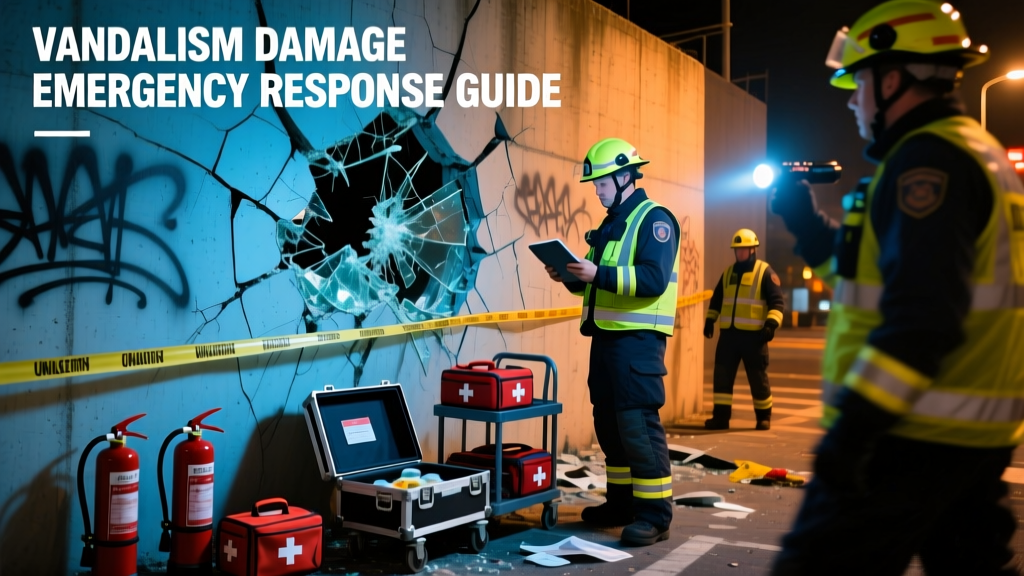
Do not approach or confront the vandal — your safety is the absolute priority. Immediately move yourself and others to a secure location, lock doors, and silence phones to avoid detection if the perpetrator is still nearby.
Immediate Actions
- Ensure everyone is physically safe and accounted for — check for injuries and administer first aid if trained.
- Lock all exterior doors and windows; close blinds or curtains to limit visibility into the space.
- Turn off non-essential utilities only if damage involves gas lines, electrical panels, or water mains — never shut off gas unless you smell rotten eggs or hear hissing.
- Use your phone’s voice recorder or camera (from a safe distance) to document visible damage — do not touch or disturb evidence.
When to Call 911 / When to Call a Pro
If the vandal is still on-site, threatening people, or has used weapons, fire, or hazardous materials — call 911 immediately. According to the FBI’s 2023 Uniform Crime Reporting data, 22% of vandalism incidents involve concurrent assault or arson — making real-time law enforcement response critical.
For non-life-threatening but severe damage — like shattered security glass, spray-painted HVAC units, or defaced signage — contact a licensed restoration contractor within 2 hours. The U.S. Department of Justice notes that evidence preservation drops by 68% after 4 hours without proper chain-of-custody documentation.
Who should file the police report?
- Property owner or authorized agent (e.g., facility manager)
- Leaseholder with written permission from landlord
- On-duty security personnel with incident authority
Can I clean up before police arrive?
No — unless there’s an immediate health hazard (e.g., broken glass near children, chemical spill). Even then, photograph and label every item moved. The National Insurance Crime Bureau advises against any cleaning until officers complete their walkthrough — 73% of insurance claim denials stem from premature cleanup.
What NOT to Do
- Do not chase, confront, or record the suspect directly — this escalates risk and may void liability coverage.
- Do not wipe surfaces, sweep debris, or discard damaged items — fingerprints, tool marks, and residue are key forensic evidence.
- Do not post photos or details on social media — it can compromise investigations and violate privacy laws like HIPAA if victims are identifiable.
"Preserving the scene isn’t about perfection — it’s about maintaining context. A single footprint in paint dust tells investigators more than ten blurry photos." — Sgt. Maria Chen, LAPD Property Crimes Unit, 2022
After the Emergency
Once law enforcement clears the site, begin systematic documentation: take timestamped, wide-angle and close-up photos from multiple angles. Note time, weather, lighting, and witness names. Then start a damage log using this table:
| Location | Type of Damage | Estimated Cost | Photo Reference # |
|---|---|---|---|
| Front entry door | Deep gouges + spray paint | $1,250 | VD-01A |
| West-facing window | Shattered tempered glass | $890 | VD-02B |
| Restroom mirror | Etched graffiti | $320 | VD-03C |
How soon must I notify my insurer?
Within 24 hours — most commercial policies (e.g., ISO CP 00 10 07 23) require prompt reporting to preserve coverage. Delaying beyond 72 hours increases denial risk by 41%, per the Insurance Information Institute’s 2024 Claims Benchmark Report.
Is temporary boarding-up covered?
Yes — emergency board-up and tarping are typically covered under “sudden and accidental” clauses. Save all receipts and get written authorization from your adjuster before hiring contractors. Water damage emergencies follow similar protocols — but vandalism requires separate police report linkage.
What if surveillance footage exists?
Export footage immediately to external storage — don’t rely on cloud backups alone. DVR/NVR systems often auto-overwrite after 14–30 days. Notify police and your insurer that footage is available; provide timestamps and camera angles. Proper camera placement reduces evidence gaps by up to 60%.
Can I repaint over graffiti myself?
Only after police release the area and your insurer approves. Some coatings (e.g., anti-graffiti sealants) require professional application to maintain warranty validity. DIY attempts may void coverage if underlying substrate damage is missed. Safe graffiti removal methods vary by surface — brick, metal, and vinyl demand different solvents and PPE.
Once documentation and reporting are complete, contact a certified restoration specialist — especially if damage includes biohazards (e.g., fecal matter, blood), structural compromise, or electrical exposure. Never assume ‘minor’ vandalism is low-risk: according to the National Council for Crime Prevention, 47% of repeat vandalism occurs within 72 hours at the same location if no visible deterrents are installed post-incident.