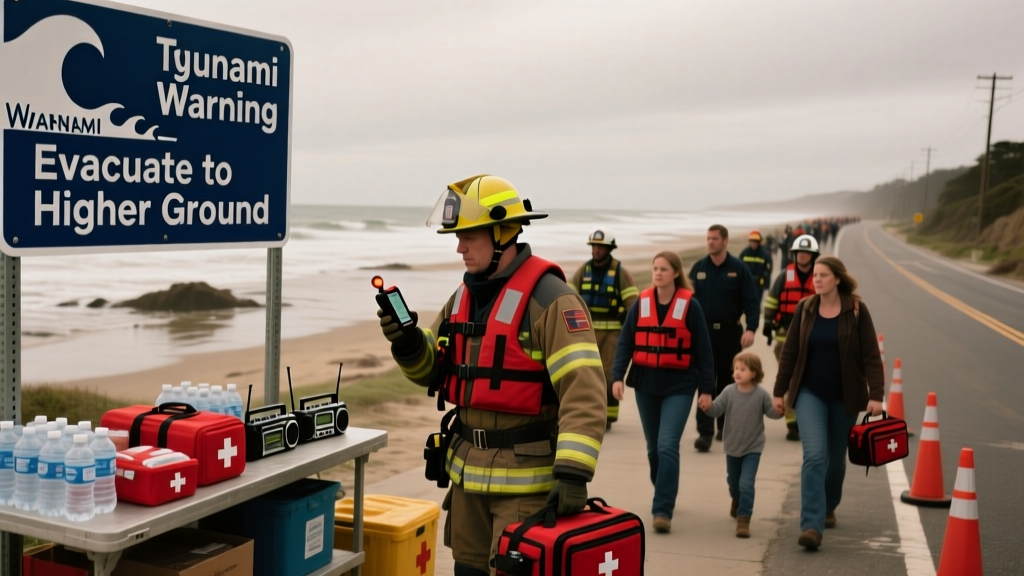
Drop everything and move inland or to high ground immediately — do not wait for visible waves or official confirmation. Tsunamis can strike within minutes of an earthquake offshore, and the first wave is rarely the largest.
Immediate Actions
These steps must happen in under 60 seconds if you’re in a coastal zone or low-lying area:
- Grab your 72-hour go-bag only if it’s within arm’s reach — never delay evacuation to search for supplies.
- Walk or run — do not drive — to higher ground at least 100 feet above sea level or 2 miles inland. If on foot, aim for ridges or steep hills; avoid river valleys and floodplains.
- Alert others as you go — shout, knock on doors, use a whistle — but don’t stop moving.
- Once safe, stay put until officials issue an all-clear via NOAA Weather Radio, local emergency alerts, or official social media (e.g., @NWSPacific). Tsunami waves can arrive hours apart.
When to Call 911 / When to Call a Pro
Call 911 only for life-threatening emergencies — such as someone trapped, injured, or missing in floodwater. Do not call 911 to ask if a warning is real, request evacuation routes, or report non-urgent damage.
- Call 911 if: Someone is unconscious, bleeding heavily, or pinned under debris in rising water.
- Call a licensed structural engineer (not 911) if: You return home and see cracked foundations, leaning walls, or sagging floors — these indicate unsafe conditions.
- Contact your local emergency management office (find via FEMA’s directory) for shelter locations, road closures, or water safety updates.
What NOT to Do
Mistakes during tsunami warnings cost lives — even experienced residents make them. Avoid these errors:
- Do NOT go to the beach to watch the waves — over 80% of U.S. tsunami fatalities since 1946 involved people observing from shore (NOAA Tsunami Program, 2022).
- Do NOT assume one wave means it’s over — multiple surges can occur over 12+ hours.
- Do NOT re-enter flooded buildings — seawater corrodes wiring and weakens concrete; electrocution and collapse risks remain high for days.
- Do NOT drink tap water until authorities confirm it’s safe — saltwater intrusion and sewage contamination are common.
After the Emergency
Wait for the official all-clear before returning. Even then, hazards persist:
| Task | Timeframe | Key Caution |
|---|---|---|
| Check for gas leaks | Immediately upon re-entry | Smell for rotten eggs; if detected, evacuate and call utility company — do NOT flip switches or use phones indoors. |
| Document damage | Within 24 hours | Photograph structural cracks, mold, and water lines — insurers require timestamped evidence. |
| Test well water | Before drinking or cooking | U.S. EPA recommends lab testing for coliform bacteria and nitrates — DIY kits miss critical contaminants. |
Wear N95 masks, rubber boots, and gloves when cleaning — mold spores and chemical residues become airborne quickly in damp environments.
How far inland should I go if no elevation map is available?
If you can’t identify 100-foot elevation, head to the highest nearby building (minimum 3 stories) or follow marked tsunami evacuation routes — look for blue signs with a wave icon and upward arrow. In unfamiliar areas, trust local residents’ knowledge: ask “Where did you go last time?” — community memory is often more accurate than phone apps during power outages.
Is a car safer than walking during evacuation?
No — traffic jams, downed power lines, and flooded roads make vehicles dangerous. A 2021 study in Natural Hazards Review found that 63% of vehicle-related tsunami deaths occurred because drivers stalled in rising water. Walking or biking gives you control and flexibility to detour around hazards.
What if I’m in a high-rise building near the coast?
Move vertically: go to the 4th floor or higher *immediately*. Do not wait for instructions. Modern high-rises built to FEMA P-361 standards can withstand tsunami surge forces — but only if you’re above the expected inundation level (typically 3rd floor or lower in most Pacific Coast zones).
Can tsunamis happen without earthquakes?
Yes — though rare. Underwater landslides, volcanic eruptions, or meteor impacts can trigger them. The 1998 Papua New Guinea tsunami killed 2,200 people and was caused by a landslide — not an earthquake. That’s why NOAA issues warnings based on real-time sea-level sensors, not just seismic data.
How long should I wait before returning home?
Minimum 24–48 hours after the last wave — and only after local officials lift the evacuation order. The U.S. Tsunami Warning Centers monitor ocean buoys for up to 72 hours post-event because delayed surges have occurred (e.g., 2011 Japan event had damaging waves 18 hours after the quake).
Will my phone work during a tsunami warning?
Not reliably. Cell towers fail during power loss or physical damage. NOAA Weather Radio (model: Midland WR400) and FM radio stations like KIRO 97.3 FM (Seattle) broadcast emergency alerts without cell service. Keep a hand-crank radio in your go-bag.
“Tsunami survival isn’t about luck — it’s about seconds. People who moved within 90 seconds of the first alert in the 2011 Tohoku event had a 92% survival rate. Those who waited 5 minutes dropped to 37%.” — Dr. Lori Dengler, Cal Poly Humboldt Tsunami Expert, 2023
Recovery begins with safety — not speed. Check on neighbors, especially elderly or disabled individuals. Report downed power lines to your utility company, not 911. And remember: your calm action today helps keep your community whole tomorrow.