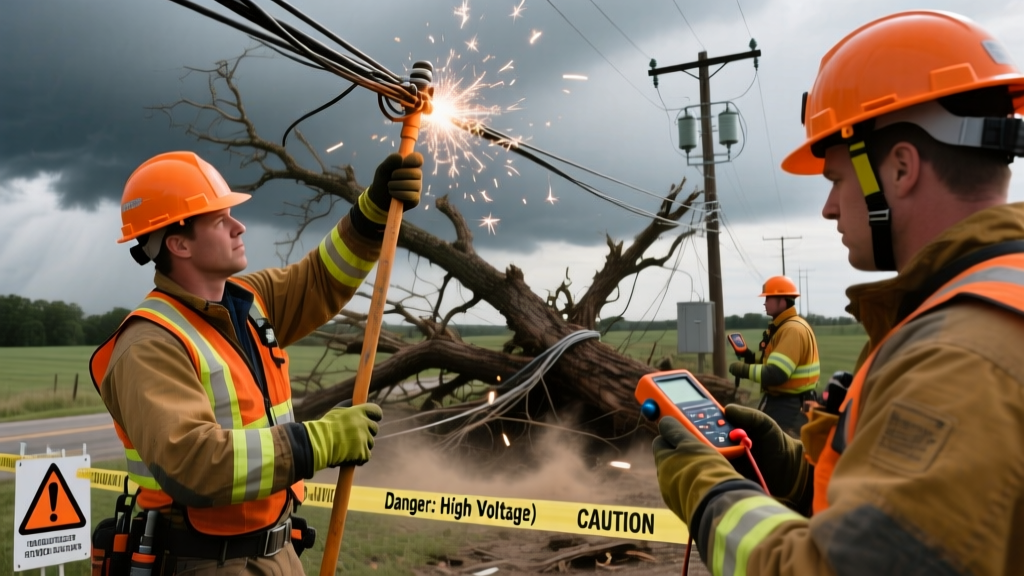
Stay back—minimum 35 feet—and assume every downed line is live and lethal. Do not approach, touch, or attempt removal. Call 911 immediately if the line is sparking, arcing, or contacting your home, vehicle, or pool.
Immediate Actions
- Evacuate the area—keep people and pets at least 35 feet away (the U.S. Department of Energy recommends this minimum safe distance for downed lines).
- Do NOT drive over or near downed lines—even if they appear dead. Tires can conduct electricity across wet pavement.
- If a line falls on your car, stay inside unless fire or explosion risk forces you out. If forced to exit, jump clear without touching car and ground simultaneously; shuffle away with feet together.
- Alert neighbors verbally—do not use phones or radios near the site, as radio frequencies can trigger arc flashes in rare cases (per IEEE Std 1684-2021).
When to Call 911 / When to Call a Pro
Call 911 first if:
- The line is actively sparking, smoking, or burning;
- It’s contacting a structure, vehicle, fence, or standing water;
- Someone has been shocked or injured;
- You smell ozone or hear buzzing/humming near the line.
After 911 dispatches emergency responders, contact your utility company directly using their 24/7 outage line. Do not wait for them to call you back—reporting triggers priority response. According to the Edison Electric Institute’s 2023 Grid Reliability Report, 68% of storm-related outages involving downed trees require utility crews with insulated bucket trucks and lockout-tagout protocols before any work begins.
What NOT to Do
- Never use chainsaws, ladders, or pruning tools near downed lines—even if they look inert.
- Don’t try to move branches with brooms, poles, or ropes. Carbonized wood and wet bark conduct electricity unpredictably.
- Avoid using garden hoses or sprinklers nearby—water dramatically increases electrocution risk.
- Don’t assume rubber-soled shoes or gloves offer protection. Standard footwear provides zero insulation against 7,200+ volts typical on distribution lines.
"A downed power line can energize the ground up to 35 feet outward in a voltage gradient—step potential kills more people than direct contact." — National Fire Protection Association (NFPA 70E, 2024 Edition)
After the Emergency
Once utility crews declare the line de-energized and grounded, begin damage assessment:
- Photograph all damage—including tree position, line sag, scorch marks, and nearby structures—for insurance claims.
- Document timestamps: when the tree fell, when 911 was called, when utility arrived, and when power was restored.
- Contact a certified arborist for hazardous tree removal; most insurers require licensed professionals for liability coverage.
- Have a licensed electrician inspect your home’s service panel and grounding system—even if lights came back on. Surges from line contact can degrade breakers silently.
| Scenario | Avg. Dispatch Time | Avg. Clearance Time |
|---|---|---|
| Line on road, no fire | 22 minutes | 1.8 hours |
| Line on house, no injury | 14 minutes | 3.4 hours |
| Line in pond/pool | 9 minutes | 4.7 hours |
Can I cut the tree myself after the power is off?
No—only after the utility confirms de-energization *and* grounds the line onsite. Even then, hire an ISA-certified arborist. Unstable limbs, hidden decay, and proximity to remaining infrastructure pose serious risks. See our guide on how to hire a certified arborist.
What if the line is on my neighbor’s property?
You’re still responsible for reporting it—regardless of location. Utility companies respond based on hazard level, not property lines. Notify your neighbor immediately, but do not cross onto their land to assess or act.
Will my homeowner’s insurance cover cleanup?
Most policies cover tree removal *only if* the fallen tree damaged a covered structure (roof, fence, garage). If it just landed in your yard, removal is typically your responsibility. Review your policy’s ‘debris removal’ sublimit—often capped at $500–$1,000 (III, 2023 Home Insurance Claims Study).
How do I know if my underground wiring is affected?
You won’t—until outlets stop working or GFCIs trip repeatedly. Underground feeder cables near the strike zone may have insulation breaches invisible to the eye. An electrician must perform a megohmmeter test to verify integrity before re-energizing circuits.
Should I file a claim if there’s no visible damage?
Yes—if the line contacted your home’s meter base, mast, or grounding rod. Voltage surges can fry smart meters, HVAC controls, and networked appliances days later. Document everything and notify your insurer within 72 hours.
Can I use a generator during the outage?
Only if installed with a proper transfer switch. Backfeeding via outlet or inlet risks electrocuting utility workers restoring lines—and violates NEC Article 702. Over 12% of lineman injuries in 2023 involved unauthorized generator backfeed (BLS Occupational Injury Report, 2024).
Wait for official clearance before resuming normal activity. Treat every downed line as live until verified otherwise by trained personnel—and remember: electricity seeks the path of least resistance, not logic. Your vigilance protects not just your household, but everyone downstream on that circuit.