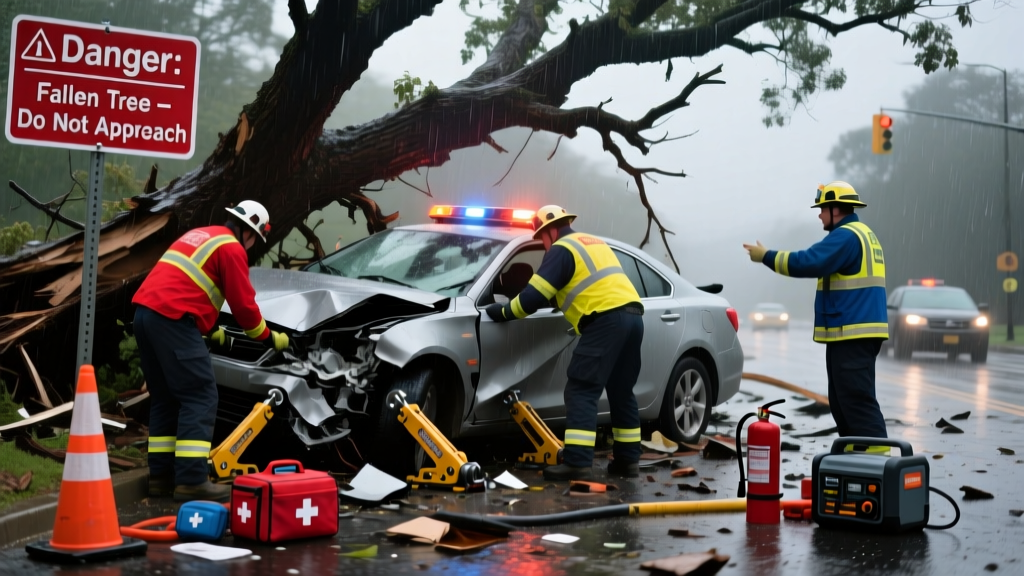
If a tree just fell on your car—stop, stay still, and do not exit unless you’re certain it’s safe. Your first priority is assessing whether the vehicle is stable, power lines are nearby, or injuries require urgent medical help.
Immediate Actions
- Stay inside the vehicle if it’s intact and no hazards (e.g., downed power lines, fire, or smoke) are present—glass may be compromised, but the frame often offers better protection than stepping into unstable debris.
- Turn off the engine immediately and engage hazard lights—even if the battery is dead, many modern cars retain emergency lighting for 10–15 minutes.
- Check for injuries: assess yourself and passengers using the ABCs—Airway, Breathing, Circulation. If anyone is unresponsive or bleeding severely, begin first aid only if trained and safe to do so.
- Call 911 *before* moving—if there’s any suspicion of spinal injury, internal trauma, or entrapment, wait for EMS-trained responders.
When to Call 911 / When to Call a Pro
Call 911 immediately if:
- A person is trapped, unconscious, or bleeding heavily;
- Downed power lines are touching the car or within 30 feet;
- Smoke, fuel leak, or fire is visible;
- The car is partially buried or tilted precariously (risk of secondary collapse).
Call a certified arborist or storm-damage contractor (not a general handyman) if:
- The car is undamaged externally, no one is hurt, and the tree is fully resting without pressure on doors/windows;
- You need structural assessment before attempting removal—some branches may still be under tension;
- You’re filing an insurance claim and require documented cause-of-fall analysis (e.g., decay, root failure).
What NOT to Do
- Do NOT try to lift or cut the tree yourself—even small limbs can weigh hundreds of pounds and shift unpredictably.
- Do NOT start the engine or use interior lights if you smell gasoline or see fluid pooling—sparks could ignite vapors.
- Do NOT assume the tree is dead or safe to touch; lightning-struck or diseased trees may snap without warning.
- Do NOT delay documenting damage—even if the car looks fine, hidden frame stress or airbag sensor damage may not appear until later.
After the Emergency
Once cleared by first responders or professionals, begin damage documentation and next steps:
| Task | Deadline | Why It Matters |
|---|---|---|
| Photograph all angles (tree, car, surroundings) | Within 1 hour | Insurance requires proof of cause and condition pre-removal |
| Get arborist report on tree health | Within 72 hours | Proves negligence (if on neighbor’s property) or natural cause |
| File auto insurance claim (comprehensive) | Within 5 business days | Most policies require prompt reporting to avoid denial |
| Request police/fire incident report | Within 48 hours | Official record supports liability and coverage disputes |
According to the Insurance Institute for Business & Home Safety's 2023 Storm Damage Report, 68% of tree-on-vehicle claims are denied due to incomplete photo evidence or delayed reporting.
"Never underestimate how much force a falling limb exerts—even a 6-inch-diameter oak branch can hit with over 2,000 pounds of force at 30 mph wind speeds." — Dr. Sarah Lin, Urban Forestry Extension, University of Georgia, 2022
Is my car totaled if a tree crushed the roof?
Rooftop compression >1.5 inches or pillar deformation usually triggers total loss determination—but get a written estimate from a certified collision center like our network of I-CAR-trained shops. Frame scanners detect hidden stress fractures invisible to the eye.
Can I drive the car after the tree is removed?
No—even if it starts and appears drivable, suspension alignment, brake line kinks, and airbag control module corruption are common. Have it towed to a shop that performs pre-repair diagnostics, such as this 12-point safety scan.
Who pays if the tree came from my neighbor’s yard?
In most states, the tree owner isn’t liable unless they ignored obvious signs of decay (e.g., hollow trunk, fungal growth, prior leaning). Document with photos and get an arborist’s written opinion—then file under your own comprehensive policy first. Learn more in our guide on neighbor tree liability laws by state.
Will my insurance cover tree removal from the car?
Yes—if you have comprehensive coverage, it includes debris removal up to $500–$1,000 (varies by carrier). But insurers won’t pay for removing the *entire* tree from the yard—only what’s directly obstructing the vehicle or causing ongoing damage.
How soon can I wash or detail the car?
Wait until a technician confirms no hidden moisture is trapped in wiring harnesses or under carpeting—especially near airbag sensors. Moisture-induced short circuits can disable safety systems weeks later. See our post-storm cleaning protocol for moisture-safe methods.
What if the tree damaged my garage too?
Separate claims apply: auto insurance covers the car; homeowners insurance covers attached structures like garages. File both—but don’t let the auto adjuster inspect the garage; that’s outside their scope. Use a licensed home inspector for structural evaluation.
Tree-on-car incidents spike 40% during hurricane season and winter ice storms—so keep emergency contacts saved, your insurance ID card in the glovebox, and a window-breaking tool mounted inside the door panel. Act fast, document thoroughly, and never compromise on professional assessment.