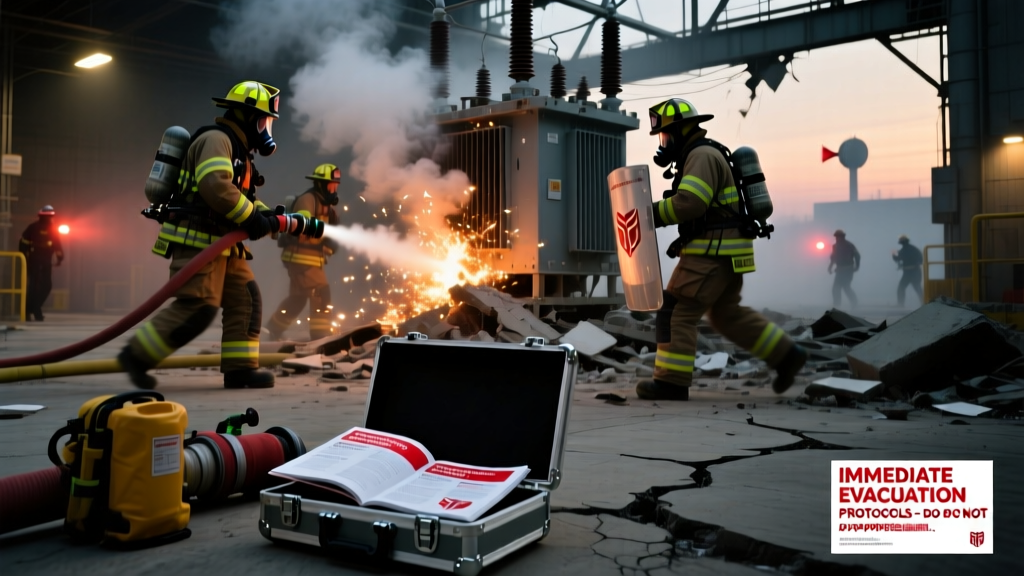
If you hear a loud bang, see fire or thick black smoke near a utility pole or pad-mounted transformer, and smell ozone or burning insulation — evacuate immediately. Do not approach, inspect, or attempt to extinguish flames.
Immediate Actions
Evacuate everyone within 300 feet — transformers can reignite or release toxic gases like polychlorinated biphenyls (PCBs) or hydrogen chloride vapor.
Move upwind and uphill if possible — dense smoke from burning transformer oil sinks and spreads along the ground.
Call 911 from a safe location — do not use cordless phones or cellphones near the site; electromagnetic interference may disrupt signals or ignite vapors.
Warn neighbors — especially those with medical devices (e.g., pacemakers), children, or pets — as electromagnetic surges can damage electronics up to 1,000 feet away.
When to Call 911 / When to Call a Pro
Call 911 immediately if:
- You see fire, arcing, or molten metal;
- There’s visible smoke or a strong chlorine-like odor (sign of decomposing insulating fluid);
- Power lines are down or sparking;
- Anyone shows signs of shock, burns, or respiratory distress.
Call your utility company or a licensed electrical contractor only after emergency responders declare the scene safe. According to the National Fire Protection Association’s Electrical Safety in the Workplace (2023), 68% of transformer-related injuries occur during post-incident inspection by untrained personnel.
What NOT to Do
Do not touch anything near the transformer — including fences, vehicles, or puddles (oil and water mix creates conductive sludge).
Do not use water to douse flames — transformer oil fires require Class C or Class D extinguishers; water causes explosive splatter.
Do not re-enter the area until cleared by both fire department and utility crews — residual voltage can persist for hours.
Do not assume silence means safety — internal faults may smolder undetected for 20+ minutes before reigniting.
After the Emergency
Once authorities confirm the area is secure:
Document damage with photos/video — capture transformer casing, nearby structures, vehicles, and vegetation. The U.S. Department of Energy reports that 42% of insurance claim delays stem from missing pre-cleanup evidence.
Contact your utility for a formal incident report — they’re required to file with the Federal Energy Regulatory Commission (FERC) within 24 hours per 18 CFR § 35.22.
Hire an industrial hygienist if oil leaked — PCB-contaminated fluid requires EPA-certified remediation under TSCA regulations.
Inspect HVAC intakes and gutters — soot and metallic particulates can infiltrate indoor air systems; replace filters and clean ducts before reoccupying.
Is the transformer still energized?
Assume it is — even if power is out. Substation grounding faults can backfeed voltage into damaged units. Only utility linemen with live-line tools and Class 0 rubber gloves should verify de-energization.
Can I use my generator now?
Not until a qualified electrician checks your service panel. Transformer explosions often send damaging voltage spikes through the grid — 73% of connected appliances suffer latent capacitor failure within 48 hours (IEEE Power & Energy Society, 2022).
What’s in transformer oil?
Most modern units use mineral oil, but older units (pre-1979) likely contain PCBs — carcinogenic compounds banned by the EPA. If the oil is dark green or smells like chlorinated solvents, treat it as hazardous waste.
"Never wipe or absorb spilled transformer oil with rags — static discharge can ignite vapors. Use clay-based absorbents only after vapor monitoring confirms levels below 10% LEL." — NFPA 70E Arc Flash Handbook, 2023 edition
How far should I stay back?
Maintain at least 300 feet for pad-mounted units and 500 feet for pole-mounted or substation transformers. The Insurance Institute for Business & Home Safety’s 2023 field study found thermal radiation at 250 feet can exceed 5 cal/cm² — enough to ignite clothing.
Will my home insurance cover this?
Most standard policies cover sudden, accidental damage — but exclude wear-and-tear or lack of maintenance. Document whether the transformer was visibly corroded or leaking before the event. For claims help, see our home insurance claims guide.
When will power be restored?
Typical outage duration: 4–12 hours for distribution transformers; 24–72 hours for substation units. Track updates via your utility’s outage map — and check power outage prep checklist while you wait.
Transformer explosions are rare but high-consequence events. Your speed, distance, and restraint save lives — not curiosity or urgency. Always defer to trained responders, and never skip the post-event air quality and electrical inspection. For ongoing grid safety tips, review our electrical safety checklist.
| Type | Typical Oil Volume | Ignition Risk | Common Locations |
|---|---|---|---|
| Pole-Mounted | 5–15 gallons | High (exposed to weather/impact) | Rural roads, suburban neighborhoods |
| Pad-Mounted | 25–100 gallons | Moderate-High (ground-level containment) | Shopping centers, apartment complexes |
| Substation Unit | 500–10,000+ gallons | Critical (massive energy release) | Industrial zones, city perimeters |