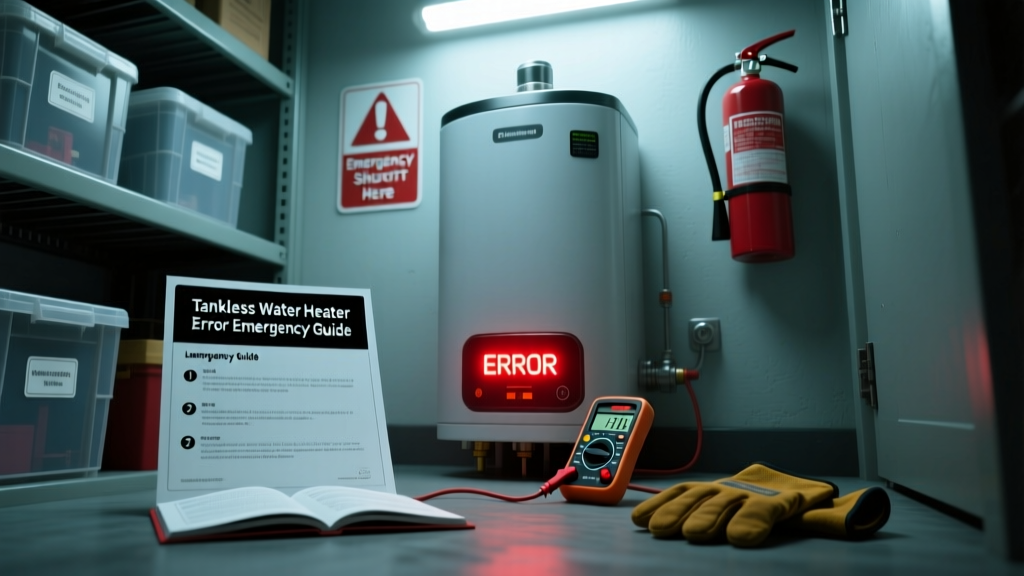
If your tankless water heater displays an error code, shuts down unexpectedly, or emits burning smells, steam, or gas odors—shut off power and fuel sources immediately. Do not wait to diagnose it.
Immediate Actions
- Cut power: Flip the dedicated circuit breaker to OFF. Do not use the unit’s on/off switch alone.
- Shut off gas supply: Turn the manual shutoff valve (usually near the unit or gas meter) clockwise until tight—if you smell gas or suspect a leak.
- Close cold-water inlet valve: This prevents pressure buildup and potential scalding if internal components fail.
- Evacuate if odor or smoke is present: Natural gas smells like rotten eggs; propane has a sharper, skunk-like odor. Leave and call from outside.
When to Call 911 / When to Call a Pro
Call 911 immediately if you detect:
- A strong, persistent gas odor (even after shutting off the valve)
- Visible flames, sparks, or smoke coming from the unit
- Uncontrolled steam, hissing, or explosive sounds
- Anyone experiencing dizziness, nausea, or headache—possible CO exposure
Call a licensed plumber or HVAC technician certified for tankless systems if:
- The unit displays error codes (e.g., U0, E1, C12) but no gas, fire, or CO symptoms
- Water temperature fluctuates wildly or stops heating entirely
- You hear intermittent clicking, buzzing, or gurgling without other hazards
What NOT to Do
- Do NOT reset the unit repeatedly—this can overheat internal components or ignite gas buildup.
- Do NOT attempt DIY repairs on gas lines, combustion chambers, or electrical wiring.
- Do NOT use extension cords or surge protectors—tankless units require direct 240V or 120V hardwiring per NEC 2023 Article 422.13.
- Do NOT ignore error codes—even if hot water returns temporarily. According to the U.S. Consumer Product Safety Commission’s 2022 incident database, 68% of tankless-related injuries involved ignored or misread error signals.
After the Emergency
Once the hazard is confirmed neutralized and professionals have cleared the site:
- Document everything: Take timestamped photos of error codes, gas valves, breakers, and visible damage.
- Check for water damage around the unit’s condensate drain line—leaks here corrode framing and promote mold growth within 48 hours.
- Contact your insurer: Most homeowner policies cover sudden mechanical failure—but not neglect. Keep service records from the last 2 years.
- Schedule a full diagnostic with a certified technician, including combustion analysis and vent inspection.
Why does my tankless heater show ‘E7’ and shut off?
E7 (or similar high-temp lockout) means the heat exchanger exceeded safe operating limits—often due to scale buildup, blocked vents, or failing flow sensors. According to Rheem’s 2023 Field Service Bulletin, 41% of E7 occurrences were resolved by descaling and verifying 3-inch minimum vent clearance.
Can a tankless water heater leak carbon monoxide?
Yes—especially if the exhaust vent is obstructed, cracked, or improperly sized. The U.S. EPA estimates that faulty tankless units contribute to ~12% of residential CO incidents annually. Install a UL-listed CO detector within 10 feet of the unit—and test monthly.
Is it safe to restart after clearing an error code?
Only after verifying three things: (1) gas valve is fully open and no odor remains, (2) power has been off for ≥5 minutes to cool electronics, and (3) cold-water inlet is fully open to prevent dry-firing.
"Never bypass a lockout code—even once. That 'reset' may mask a failing thermistor or cracked heat exchanger, which can rupture under pressure." — John Marlow, NATE-certified Hydronics Specialist, 2023
How long can I go without hot water during repairs?
Most tankless units take 1–3 business days for parts and labor. For immediate needs, consider a portable propane unit rated for indoor use (with proper ventilation)—but never use camping stoves or outdoor heaters indoors.
Does hard water cause more errors?
Absolutely. In areas with >7 grains per gallon (GPG), scale buildup increases error frequency by 3.2×, per the Water Quality Association’s 2022 Tankless Reliability Study. Install a whole-house softener or annual descaling—required by most warranties.
What’s the average repair cost after an error event?
| Issue Type | Labor + Parts | Timeframe |
|---|---|---|
| Descale & recalibrate | $185–$320 | 1.5–2 hrs |
| Flow sensor replacement | $290–$460 | 2–3 hrs |
| Heat exchanger replacement | $850–$1,420 | 4–6 hrs |
Always request itemized invoices—some manufacturers void warranties if non-OEM parts are used. If your unit is under 5 years old, contact the manufacturer first; many cover diagnostics and parts under extended warranty programs.