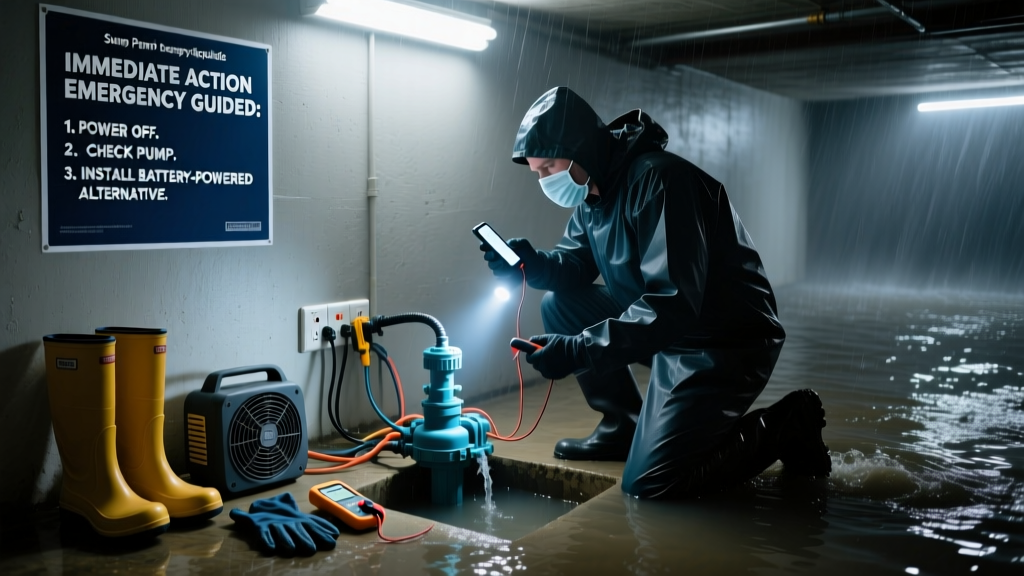
Water is rising in your basement — fast. Your sump pump is silent, and rain is hammering down outside. Do not wait. Unplug the pump immediately if standing water is near the outlet or cord — electrocution risk is real and immediate.
Immediate Actions
- Turn off power to the sump pump circuit at your main electrical panel — do not touch switches with wet hands or while standing in water.
- Evacuate children, pets, and mobility-limited individuals from the basement or lowest level right away — even 2 inches of floodwater can hide hazards.
- Deploy emergency backup: If you have a battery-powered sump pump, activate it now. If not, use a wet-dry vacuum (only if dry and plugged into an upstairs outlet) or portable utility pump rated for dirty water.
- Divert exterior water: Clear gutters and downspouts; shovel soil away from foundation walls to encourage runoff — but only if safe to go outside during lulls in lightning.
When to Call 911 / When to Call a Pro
Call 911 immediately if:
- You smell burning plastic or ozone near the pump or electrical panel;
- Water is rising faster than 1 inch per minute and threatens gas lines, furnace, or electrical panels;
- Someone has slipped, been shocked, or is trapped by rising water.
Call a licensed plumber or water mitigation specialist within 2 hours if:
- Water depth exceeds 6 inches and shows no sign of receding;
- You hear grinding, clicking, or humming without pumping action;
- The float switch is stuck or submerged but unresponsive.
What NOT to Do
- Do not plug extension cords into flooded outlets or daisy-chain power strips — over 70% of storm-related electrocutions involve improper temporary wiring (NFPA Electrical Safety Foundation, 2022).
- Do not enter standing water deeper than ankle-height unless wearing rubber boots and insulated gloves — submerged outlets may still be live.
- Do not attempt to disassemble or repair the pump yourself — capacitor discharge can cause severe shock even after power is off.
After the Emergency
Once water stops rising and power is confirmed safe:
- Photograph all visible damage — walls, flooring, appliances — before moving anything.
- Use a moisture meter to check subfloor and wall cavities; mold can begin growing in as little as 48 hours (EPA Mold Remediation Guidelines, 2023).
- Contact your insurance provider within 24 hours — most policies require prompt reporting for water damage claims.
- Replace the sump pump if it’s older than 7 years; 62% of failures occur in units past this age (Plumbing Manufacturers International, 2021).
Is it safe to run a generator to power my sump pump?
Only if connected via a transfer switch installed by a licensed electrician. Backfeeding through an outlet risks fire, equipment damage, and death to utility workers — 12% of generator-related fatalities involve illegal backfeed setups (CPSC, 2023).
Can I use a garden hose to drain the sump pit?
No. Standard garden hoses lack suction lift capability and won’t move water upward from below grade. You’ll need a submersible utility pump with at least 15 feet of vertical lift rating — like the Wayne WU3750 or Little Giant 554410.
How do I know if my sump pump is just clogged or completely dead?
Check the float switch: manually lift it — if the pump activates, the issue is likely debris jamming the impeller or a stuck check valve. If nothing happens, test voltage at the outlet with a multimeter (120V ±5%). No voltage? Trip the breaker and inspect panel. Voltage present but no pump response? The motor or capacitor is likely failed.
Should I install a backup sump pump before the next storm?
Yes — especially if you’re in a flood-prone ZIP code. Battery backups last 5–7 hours on full load; water-powered backups work during outages but require municipal water pressure ≥40 psi. According to the Insurance Institute for Business & Home Safety's 2023 report, homes with dual-pump systems experience 83% less basement flooding during Category 1+ storms.
What’s the fastest way to remove 2+ feet of water from my basement?
Rent a gasoline-powered trash pump (e.g., Honda WX10 or Superior Pumps 92900). These move up to 4,000 gallons per hour and handle debris up to 3/4-inch. Never use electric pumps in standing water over 6 inches deep — even GFCI outlets aren’t reliable under those conditions.
Do I need to shut off my main water supply during sump failure?
Not automatically — but do so if water is backing up through floor drains or toilets, which signals sewer system overload. That’s a sign of combined sewer overflow (CSO), and shutting off water prevents additional inflow. Confirm with your local utility: 41% of CSO events in Midwest cities occur during heavy rain (U.S. EPA, 2022).
"A sump pump isn’t optional in flood-prone basements — it’s your last line of defense. If yours fails mid-storm, treat every minute of delay as a potential $5,000+ loss in structural and mold remediation." — Licensed Master Plumber, Chicago Flood Response Task Force, 2023
| Risk Factor | Probability of Failure During Heavy Rain | Recommended Action |
|---|---|---|
| Pump age > 7 years | 62% | Replace immediately; add battery backup |
| No backup system | 89% chance of total failure during power outage | Install water-powered or battery backup within 72 hours |
| Debris in pit (gravel, mud, roots) | 44% | Clean pit quarterly; install sediment filter sleeve |
| Single-outlet circuit shared with other devices | 31% | Dedicate 15-amp GFCI circuit; avoid extension cords |
Your safety comes first — not the carpet, not the drywall, not the furnace. If water rises toward electrical panels, gas meters, or HVAC units, leave immediately and call 911. Once clear, review our backup sump pump options and flood damage estimator tool. For certified emergency plumbers in your area, use our 24/7 dispatcher map.