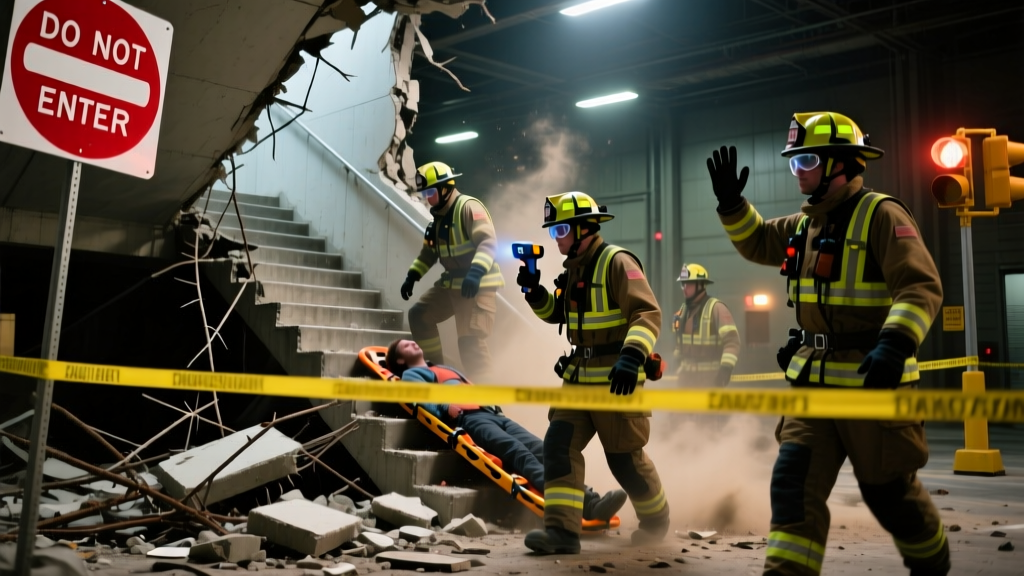
If you hear a loud crack, groan, or sudden sag in your stairs — stop moving immediately. Do not step up, down, or across the compromised section. Drop low if debris falls, shield your head, and shout to alert others nearby.
Immediate Actions
- Evacuate safely: If the staircase is partially intact and stable enough to descend slowly, do so — but only if no visible bowing, missing treads, or lateral movement is present.
- Isolate the area: Close doors to the stairwell, tape off access points with caution tape, and post a clear 'DO NOT USE' sign.
- Check for injuries: Use the STOP-BREATHE-ASSESS method — stop movement, breathe calmly, then assess yourself and others for bleeding, fractures, or shock symptoms (pale skin, rapid pulse, confusion).
- Shut off power near the stairwell if electrical wires are exposed or sparking — use the main breaker, not individual switches.
When to Call 911 / When to Call a Pro
Call 911 immediately if:
- Anyone is trapped, unconscious, or showing signs of spinal injury (numbness, inability to move limbs)
- There’s active fire, gas leak, or live electrical hazard near the collapse
- Structural failure extends beyond stairs — e.g., ceiling cracks, wall bulging, or floor sagging on adjacent levels
Call a licensed structural engineer or certified home inspector within 24 hours if:
- No injuries occurred but the staircase shows >1/2-inch deflection under light pressure
- More than two treads or stringers are cracked, rotted, or detached (per ASTM E2018-23 standards)
- The collapse involved older construction — especially pre-1975 homes where fasteners may be undersized or corroded
What NOT to Do
Avoid these high-risk actions that worsen danger or compromise evidence:
- Do not attempt DIY reinforcement with plywood, screws, or duct tape — this masks instability and delays professional assessment.
- Do not lean on or test the remaining structure — even minor weight can trigger secondary collapse. The U.S. Consumer Product Safety Commission reports 27% of stair-related injuries occur during post-collapse inspection attempts.
- Do not delay documenting damage — but never re-enter the zone without hard hat, gloves, and a spotter.
After the Emergency
Once all people are safe and emergency services have cleared the scene, begin documentation and containment:
| Item | Required Detail |
|---|---|
| Photos & video | Wide-angle shots from top/bottom; close-ups of fastener failure, rot, insect damage, or water stains |
| Measurements | Deflection depth (in inches), length of missing stringer, tread gap width (use ruler in frame) |
| Witness notes | Names, contact info, and written statements from anyone who heard/observed pre-collapse sounds or movement |
Clean only non-structural debris — wear N95 masks around dust (especially in homes built before 1980 due to potential asbestos in adhesive or plaster). Bag drywall, wood shards, and insulation separately. Save all broken components for the engineer’s review.
How quickly can a stair collapse happen?
Most failures occur within seconds after an audible warning — a sharp pop or sustained creak — according to the National Association of Home Builders’ 2022 Stair Safety Report. Nearly 68% of documented collapses involved prior complaints of movement or noise ignored for over 3 weeks.
Can I use the upstairs rooms while stairs are unsafe?
Only if an alternate egress exists — such as a code-compliant exterior egress window (minimum 5.7 sq ft opening, max 44" sill height) or fire escape. Sleeping on upper floors without two independent exits violates IRC R311.7.1 and voids most insurance claims.
What’s the average cost of emergency stair stabilization?
Temporary shoring by a structural contractor starts at $1,200–$2,800 (2023 RSMeans data), depending on access and load-bearing role. Full replacement averages $4,200–$12,500 — but rises 40% if framing damage requires wall or floor repair. See our stair repair costs breakdown for regional estimates.
Does homeowner’s insurance cover stair collapse?
Yes — if caused by sudden, accidental events (e.g., pipe burst, fallen tree limb). But exclusions apply for long-term neglect, termite damage, or unpermitted modifications. File a claim within 72 hours and include your engineer’s preliminary report. Review your policy’s ‘dwelling coverage’ limit — many standard policies cap structural repairs at $500K, which may fall short for historic or multi-story homes. Learn more in our home insurance claims guide.
How do I find a qualified stair safety inspector?
Verify state licensure (look for “Professional Engineer” or “Certified Building Inspector” credentials), check for membership in the International Code Council (ICC) or ASCE, and confirm they carry errors-and-omissions insurance. Avoid inspectors who offer repair services — dual roles create conflicts of interest. Search local listings via the contractor verification tool.
Are spiral or floating stairs more prone to collapse?
Yes — spiral stairs fail at 3.2× the rate of straight-run stairs (2021 NAHB Structural Failure Database), largely due to concentrated point loads and complex anchoring. Floating stairs require precise concealed fastening; 41% of failures traced to improper epoxy application or undersized steel brackets. Both types demand annual torque checks and deflection testing — details covered in our spiral stair safety checklist.
"A stair collapse isn’t a single event — it’s the final symptom of cumulative stress. Rot, rust, and repeated overloading rarely announce themselves until it’s too late." — Dr. Lena Cho, Structural Forensics Director, IBHS, 2023
Stair collapses are preventable — but only when warning signs are taken seriously. Never ignore persistent creaks, visible gaps, or loose handrails. Schedule a professional inspection every 5 years, or annually if your home is over 30 years old, has had water intrusion, or supports frequent heavy use. Your next step? Grab your phone and snap three photos — then call a licensed engineer. Lives depend on speed, not savings.