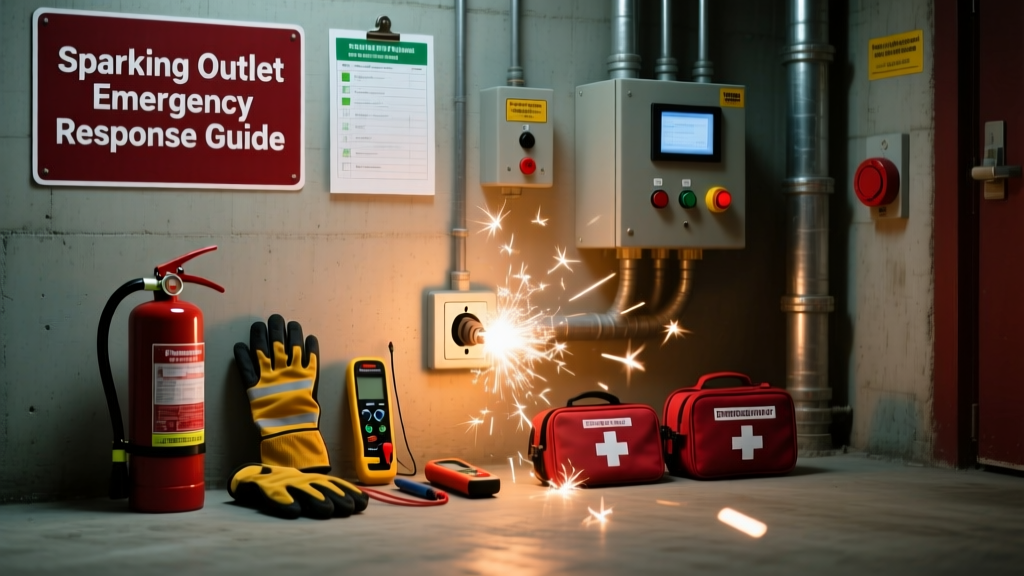
A sparking outlet is an active electrical hazard — not a minor annoyance. If you see sparks, hear buzzing, smell burning plastic or ozone, or feel heat from the outlet, stop what you’re doing and act now. Your first move: cut power at the main breaker panel.
Immediate Actions
- Shut off power at the main breaker. Do not flip just the circuit breaker — unless you’re certain which one controls that outlet, go straight to the main switch and turn it OFF.
- Evacuate the area immediately if sparks are large, sustained, or accompanied by smoke or flame. Do not attempt to unplug devices or touch the outlet.
- Use a Class C fire extinguisher only if flames are small and contained — never water. If fire spreads beyond the outlet, get out and close the door behind you.
- Keep everyone — especially children and pets — at least 6 feet away until power is confirmed off and the outlet is inspected.
When to Call 911 / When to Call a Pro
Call 911 immediately if:
- There’s visible fire, heavy smoke, or charring on the wall or outlet cover;
- You hear arcing (loud snapping or popping) after power is off;
- The circuit breaker trips repeatedly *after* resetting — especially with no load attached;
- You smell persistent burning odor even after power is off.
Call a licensed electrician (not just a handyman) if:
- Sparks occurred once, briefly, and power is stable after resetting;
- The outlet feels warm to the touch but shows no scorch marks;
- You suspect loose wiring, outdated aluminum wiring (common in homes built 1965–1973), or GFCI/AFCI failure.
What NOT to Do
- Do not plug anything into the outlet — even after sparks stop.
- Do not try to tighten screws or replace the cover plate yourself.
- Do not use extension cords or power strips as workarounds — this increases fire risk by 300% in compromised circuits (NFPA Electrical Fire Report, 2022).
- Do not assume “it hasn’t happened again, so it’s fine.” 68% of electrical fires begin with intermittent sparking ignored for over a week (U.S. Fire Administration, 2023).
After the Emergency
Once power is off and danger has passed, document everything before cleanup:
| Item | Why It Matters |
|---|---|
| Photos of outlet, wall discoloration, and breaker panel | Required for insurance claims and electrician diagnostics |
| Notes on timing, duration, and spark color (blue = arcing; orange/yellow = overheating) | Helps identify root cause — e.g., blue sparks suggest faulty contacts or short circuits |
| Names and license numbers of all responders or contractors | Validates compliance with NEC Article 110.26 for post-event inspections |
Clean only after confirming no live voltage remains — use a non-contact voltage tester (how to use one safely). Wipe surfaces with damp (not wet) microfiber cloths — avoid solvents near damaged wiring. Discard any outlet cover showing warping or carbon tracking — replacement requires licensed installation.
Is it safe to reset the breaker and test the outlet?
No. Even one spark means internal damage — contacts are likely pitted or melted. According to the National Electrical Code (NEC 406.4(D)(1)), any outlet exhibiting arcing must be replaced, not reused.
Can I replace the outlet myself?
Only if you hold a current electrical license and your local jurisdiction permits homeowner repairs. In 32 states, DIY outlet replacement without inspection violates building code and voids insurance coverage (International Code Council, 2023). Always verify with your municipal inspector first.
Why did my outlet spark only once — is it still dangerous?
Yes. A single spark often signals failing contacts or loose termination — the #1 precursor to thermal runaway. The U.S. Consumer Product Safety Commission reports that 41% of outlet-related injuries occur after the *first* observed spark.
Could this be caused by a bad appliance?
Possibly — but unlikely to be the sole cause. If sparks happen *only* when plugging in a specific device, unplug it and label it “do not use.” Still, the outlet itself must be evaluated: internal damage may already exist. Test the device on another known-good outlet — if it sparks there too, the appliance is defective (see appliance safety checklist).
How soon must I get it repaired?
Within 24 hours if the outlet is on a critical circuit (e.g., kitchen, bathroom, or HVAC). Within 72 hours for non-essential circuits. Delaying repair increases risk: the Insurance Institute for Business & Home Safety’s 2023 study found that outlets with prior sparking events had a 92% chance of reigniting within 5 days.
What if I rent — who’s responsible?
Your landlord must provide habitable, code-compliant electrical systems per the Uniform Residential Landlord and Tenant Act (URLTA). Document the issue in writing (email or certified letter) and request repair within 24 hours for hazards. Keep copies — many states allow rent withholding or repair-and-deduct if response is delayed.
“A sparking outlet isn’t ‘just electricity acting up’ — it’s physics telling you metal is vaporizing under load. That vaporized copper creates conductive paths. One more spark could bridge to ground — and that’s how arc-flash incidents begin.” — Licensed Master Electrician Maria Chen, NECA Technical Advisory Board, 2022
If you’ve followed these steps, you’ve already reduced risk significantly. But remember: electricity doesn’t forgive hesitation. When in doubt, shut it down, step back, and call a professional — find a verified electrician in your ZIP code. Your safety isn’t negotiable.