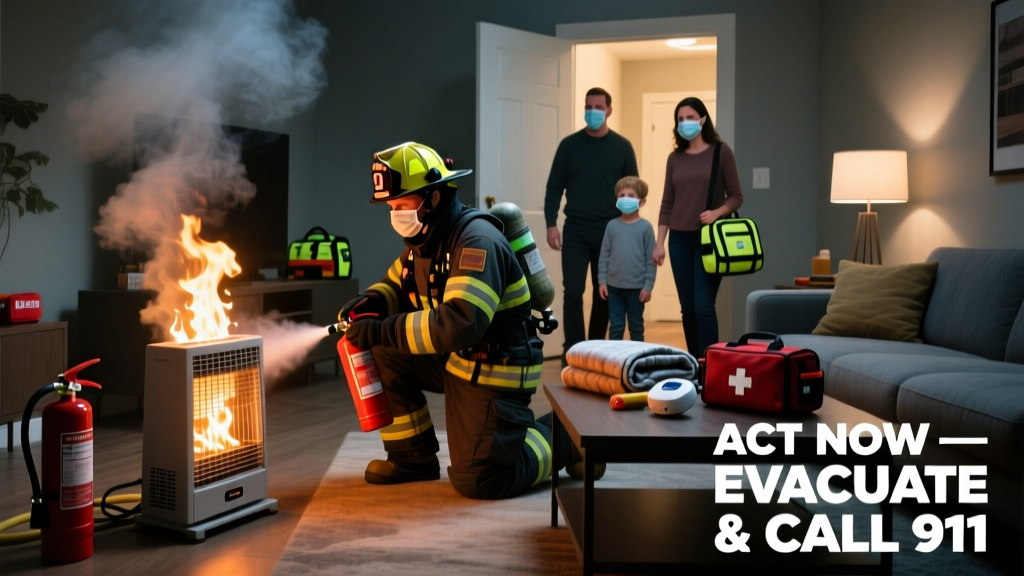
Act now—space heater fires ignite in under 30 seconds and spread rapidly. If flames are visible or smoke is thick and black, evacuate immediately and close the door behind you.
Immediate Actions
- Evacuate everyone—including pets—without delay. Do not stop to gather belongings.
- If the fire is smaller than a wastebasket AND you have a Class C fire extinguisher nearby, aim at the base of flames while backing toward an exit.
- Close doors behind you as you leave to slow oxygen flow and contain smoke.
- Once outside, go to your pre-identified meeting spot and account for all household members.
When to Call 911 / When to Call a Pro
Call 911 immediately if:
- Flames exceed knee height or involve walls, ceilings, or furniture;
- Smoke is dense, acrid, or gray/black (indicating synthetic material burning);
- You hear popping, cracking, or rumbling from walls or floors.
Call a licensed fire restoration contractor after fire department clearance for:
- Smoke odor removal in HVAC ducts and insulation;
- Electrical system inspection—space heater overloads cause 46% of related electrical fires (NFPA, 2023);
- Structural assessment if drywall is discolored, warped, or blistered.
What NOT to Do
These actions escalate risk and endanger lives:
- Never use water on an electrical or grease-fed heater fire—it conducts electricity and may cause explosion.
- Don’t open windows or doors to “vent smoke”—this feeds oxygen and accelerates flashover.
- Avoid re-entry even if flames appear out—carbon monoxide and hidden embers remain lethal for hours.
"In 2022, space heaters caused 1,700 home fires and 85 civilian deaths—more than any other heating equipment. Most occurred within 3 feet of combustibles." — U.S. Fire Administration, Heating Equipment Fires Report 2023
After the Emergency
Once cleared by firefighters, begin documentation and mitigation:
| Item | Purpose | Deadline |
|---|---|---|
| Photos/video of damage | Insurance claim evidence | Within 24 hours |
| Fire department report number | Required for claims & permits | Before leaving station |
| List of damaged electronics | Identify surge-damaged devices | Within 48 hours |
| Utility shutoff confirmation | Prevent electrocution during cleanup | Before entering |
Clean only non-porous surfaces with damp cloths and mild detergent. Discard soaked carpets, upholstered furniture, and insulation exposed to smoke—soot particles embed deeply and off-gas toxins.
Can I plug my space heater into an extension cord?
No. Space heaters draw 1,500 watts minimum—most extension cords overheat and ignite. According to UL’s 2022 Safety Testing Standards, only heaters labeled "UL Listed for Use with Extension Cords" may be used with heavy-duty 12-gauge cords—and even then, only temporarily.
How far should a space heater be from furniture or curtains?
Minimum 3 feet in all directions—including walls, bedding, and rugs. The NFPA reports 72% of space heater fires start when units contact or are placed too near combustibles.
Is it safe to leave a space heater on overnight?
No. Unattended operation accounts for 82% of fatal space heater fires (U.S. CPSC, 2023). Even models with tip-over shutoff or overheat protection fail under dust buildup or carpet compression.
What type of fire extinguisher should I keep nearby?
A multipurpose ABC extinguisher rated 2-A:10-B:C or higher. Keep it mounted within 3 seconds’ reach of the heater—but never block the exit path to access it.
Do I need to replace my smoke alarms after a space heater fire?
Yes—even if they sounded. Soot and thermal stress degrade sensors. Replace all units within 72 hours, and test monthly thereafter. Ionization alarms respond faster to flaming fires; photoelectric better for smoldering—use dual-sensor models like those recommended in our smoke alarm comparison guide.
How do I prevent future space heater fires?
Install hardwired electric baseboard or wall heaters instead of plug-in units. If using portable heaters, choose models with automatic shut-off, cool-touch casings, and thermostat control—and always plug directly into grounded outlets. Review our heater safety checklist before each heating season.
Space heater fires move faster than most people expect. Your safest option isn’t speed—it’s preparation. Install working smoke alarms on every level, practice escape drills twice yearly, and store your fire evacuation plan where everyone can see it. Prevention starts long before the first spark.