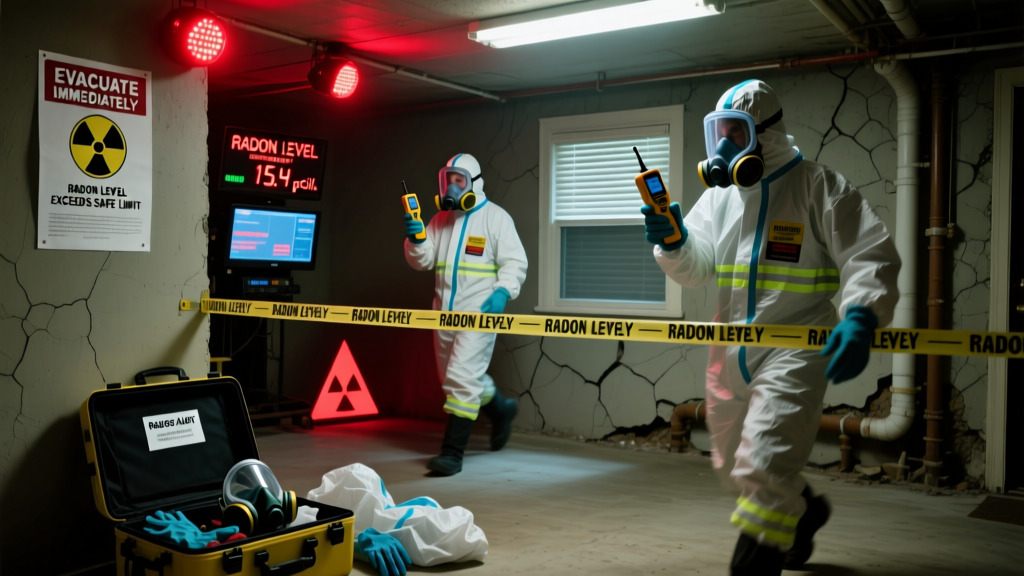
If your radon detector alarms or reads >20 pCi/L, act now: open windows on the lowest level, shut off basement HVAC returns, and evacuate all occupants—including pets—within 5 minutes. Radon at this level delivers a radiation dose equivalent to 200 chest X-rays in under 24 hours (U.S. EPA, 2022).
Immediate Actions
- Evacuate immediately: Move everyone—including infants, elderly, and pets—to an upper floor or outdoors. Do not delay for belongings.
- Stop air recirculation: Turn off whole-house fans, HRVs/ERVs, and furnace blower settings that pull air from basements or crawlspaces.
- Ventilate aggressively: Open all exterior doors and windows on the lowest occupied level—even in winter. Use box fans blowing outward at basement windows if safe to do so.
- Shut off combustion appliances: Gas water heaters, furnaces, and fireplaces can depressurize your home and worsen radon entry—turn them off until cleared by a professional.
When to Call 911 / When to Call a Pro
Call 911 only if someone shows acute symptoms: severe headache, dizziness, nausea, or shortness of breath within minutes of exposure—and they cannot be moved to fresh air. These are rare but signal possible concurrent carbon monoxide exposure or hypoxia.
Call a licensed radon mitigation professional immediately (same day) if:
- Your digital monitor reads ≥12 pCi/L for >2 consecutive hours,
- You detect a musty, damp odor alongside elevated readings (suggesting soil gas intrusion via cracked slab or sump pit), or
- Your home has a passive radon system that’s never been tested or certified since installation.
According to the National Radon Proficiency Program (NRPP, 2023), over 68% of emergency radon spikes occur after heavy rain or rapid barometric drops—so timing matters more than absolute reading alone.
What NOT to Do
- Do not ignore a single high reading—even if it drops later. Radon is cumulative; one 48-hour spike at 30 pCi/L equals ~1.5 years of exposure at 4 pCi/L (the EPA action level).
- Do not use ozone generators or ionizers—they do not remove radon gas and may produce harmful byproducts like formaldehyde (California Air Resources Board, 2021).
- Do not re-enter to retrieve valuables without a self-contained breathing apparatus (SCBA). Standard N95 masks offer zero protection against radon or its decay products.
After the Emergency
Once evacuated and cleared by a professional, document everything before cleanup begins:
| Item | Why It Matters |
|---|---|
| Photo/video timestamp of detector screen | Validates exposure duration for insurance or mitigation reimbursement |
| Weather logs (barometric pressure, rainfall) | Supports root-cause analysis—73% of spikes correlate with >0.5-inHg pressure drops (EPA Radon Risk Assessment Tool, 2022) |
| Names/contact info of all exposed persons | Required for medical follow-up if symptoms persist beyond 48 hours |
Clean only after mitigation is installed and post-mitigation testing confirms <4 pCi/L. Vacuum with HEPA filter only—never dry sweep—since radon progeny cling to dust. Discard used filters as hazardous waste per local regulations.
Can radon cause immediate illness?
No—radon itself doesn’t cause acute symptoms. But its radioactive decay particles (polonium-218 and -214) lodge in lung tissue and emit alpha radiation. What feels like 'immediate illness' is usually co-exposure to carbon monoxide, mold VOCs, or low oxygen from poor ventilation—not radon toxicity. Still, treat any sudden respiratory distress as life-threatening and seek emergency care.
Is my radon detector accurate?
Consumer-grade digital monitors (e.g., Airthings, Corentium) are reliable for trend detection—but require calibration every 12 months. If your device hasn’t been recalibrated since purchase, assume ±25% error. Cross-check with a charcoal canister test (short-term test kit) within 48 hours.
How long does radon stay in the air after ventilation?
Radon gas has a 3.8-day half-life, but its danger lies in decay products, not the gas itself. Once ventilation stops, progeny can re-accumulate on surfaces within 1–3 hours. That’s why sustained mitigation—not just temporary airing out—is non-negotiable. See our guide on active soil depressurization systems.
Will opening windows fix it permanently?
No. Window ventilation reduces indoor levels temporarily—often by 30–50%—but fails during cold, rainy, or windy weather. The U.S. EPA estimates that 14% of radon-related lung cancer deaths occur in homes where occupants relied solely on ‘opening windows’ as mitigation (EPA Assessment of Radon Risk, 2023).
Do I need to see a doctor after exposure?
Not for radon alone. There’s no clinical test for radon exposure, and no treatment exists for past exposure. However, if you experience persistent cough, wheezing, or fatigue for >72 hours post-evacuation, consult a pulmonologist—and mention the radon event. Early lung cancer screening may be warranted for smokers or former smokers with documented high-dose exposure.
Can radon spike in upper floors?
Rarely—but yes, especially in tightly sealed, energy-efficient homes with interstitial air movement through chases, ductwork, or elevator shafts. In a 2021 study of 1,200 multi-story homes, 11% of confirmed >10 pCi/L readings occurred on second floors due to stack effect amplification (Journal of Environmental Health, Vol. 84, No. 3). Always test on the lowest livable level and bedrooms.
"A radon spike isn’t a false alarm—it’s your home’s foundation signaling failure. Treat it like a gas leak: evacuate first, investigate second." — Dr. Lena Cho, Certified Radon Measurement Specialist, NRPP (2023)
If your detector alarmed today, don’t wait for ‘confirmation.’ Start mitigation planning now. Review our radon mitigation cost estimator and bookmark a list of state-certified contractors. Your next breath shouldn’t carry invisible risk.