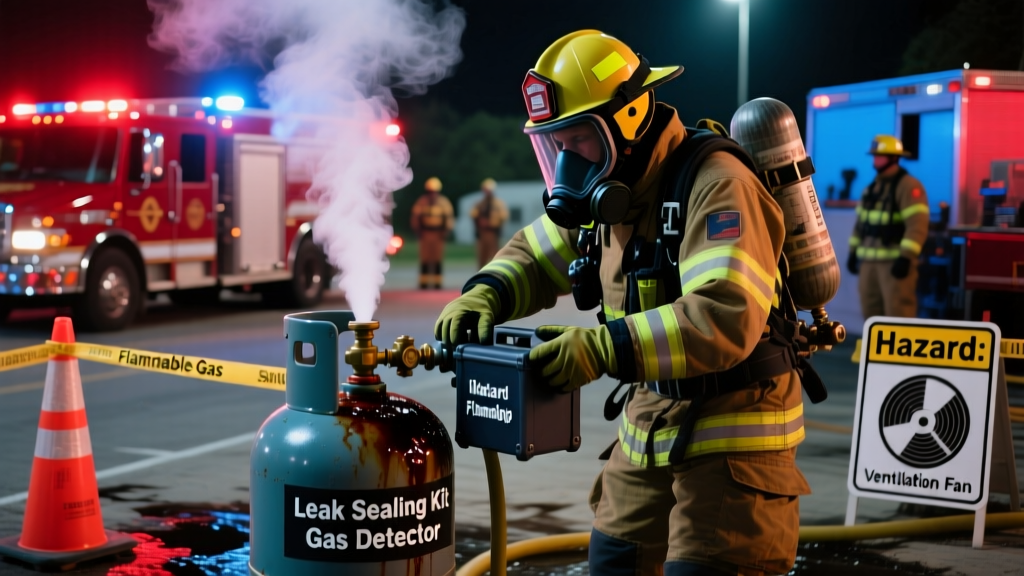
Smell rotten eggs? Hear a hissing sound near your propane tank? Evacuate immediately. Propane is highly flammable and odorless by nature — manufacturers add ethyl mercaptan (a sulfur compound) so you can detect leaks at concentrations as low as 1,000 parts per trillion. Do not delay — every second counts.
Immediate Actions
- Shut off the propane supply at the tank valve — turn it clockwise until fully closed. Use gloves if available, but don’t search for tools; act fast.
- Extinguish all ignition sources: blow out candles, unplug appliances, avoid flipping light switches or using phones indoors.
- Evacuate everyone — including pets — to at least 100 feet upwind of the leak. Don’t re-enter until cleared by a professional.
- Open windows and doors only if you can do so without lingering near the source — prioritize evacuation over ventilation.
When to Call 911 / When to Call a Pro
If you smell gas and cannot locate or stop the leak, or if anyone shows symptoms like headache, dizziness, nausea, or shortness of breath, call 911 immediately. According to the U.S. Consumer Product Safety Commission’s 2022 report, propane-related incidents caused 73% of residential fuel gas explosion injuries that year.
- Call 911 if: you hear a loud hiss, see frost on the tank, or suspect a major leak in an enclosed space (e.g., basement, RV cabin).
- Call a licensed propane technician (not your regular HVAC tech) if: the smell is faint and localized, the tank valve was successfully closed, and no symptoms are present — but only after full evacuation and outdoor assessment.
What NOT to Do
- Do not use lighters, matches, or electrical devices — including garage door openers or cell phones — within 100 feet.
- Do not attempt to repair fittings, valves, or hoses yourself — even with tape or sealant.
- Do not operate vehicles or power equipment near the leak — exhaust sparks can ignite vapor.
- Do not assume small smells are harmless: the National Fire Protection Association states that propane vapors are 1.5 times heavier than air and pool in low-lying areas, creating invisible ignition hazards.
After the Emergency
Once authorities confirm it’s safe to return, document everything before cleanup. Take timestamped photos of the tank, regulator, hose connections, and surrounding area. Keep records for insurance — propane-related property claims average $18,400 according to the Insurance Information Institute’s 2023 data.
| Item | Status | Notes |
|---|---|---|
| Tank corrosion or dents | Especially near valve or foot ring | |
| Hose cracks or brittleness | Rubber degrades after 5+ years | |
| Regulator vent cap intact? | Missing caps cause pressure failure | |
| Leak test performed? | Soap-and-water test required before reuse |
How do I perform a soap-and-water leak test?
Mix 1 tablespoon of liquid dish soap with 1 cup of water. Spray or brush onto all connections — tank valve, regulator inlet, hose fittings, and appliance connectors. Bubbles forming within 30 seconds indicate a leak. Never use flame or electronic detectors as primary tests — they miss slow seeps.
Can I smell propane if I have a cold or sinus congestion?
No — olfactory impairment reduces detection sensitivity by up to 70%, per a 2021 study in the American Journal of Industrial Medicine. Install UL-listed propane gas detectors (like those from Kidde or First Alert) on walls within 6 inches of the floor — where propane accumulates.
Is it safe to store a spare propane tank indoors?
No. The NFPA 58 standard prohibits indoor storage of full or partially filled tanks. Even in garages or sheds, heat buildup can raise internal pressure beyond safety valve limits. Store upright, shaded, and ventilated — never in direct sun or near combustibles. See our propane storage safety guide for compliant setups.
Why does my regulator freeze during cold weather?
Freezing often signals moisture contamination or undersized regulators — not necessarily a leak. But frost combined with odor means immediate evacuation. A properly sized regulator for your appliance BTU load prevents this; consult your propane appliance sizing chart before replacing.
What’s the shelf life of a propane tank?
Steel DOT cylinders must be recertified every 12 years (first test), then every 5 years thereafter. Aluminum and composite tanks follow different schedules — check the collar stamp. Expired tanks cannot be refilled legally. More details in our tank recertification guide.
How often should I replace my propane hose?
Every 5 years — even if it looks fine. UV exposure, ozone, and temperature swings degrade rubber compounds. Cracks may be microscopic until failure. Always use UL 2181–rated hoses with brass fittings, never generic garden hose adapters.
"A single unreported propane leak increases the chance of a catastrophic event by 300% within 18 months — especially if the same tank or regulator remains in service." — Propane Education & Research Council (PERC), 2023 Field Incident Review
Propane is reliable and efficient — but only when handled with disciplined safety habits. If you’ve followed this guide, you’ve already taken the most critical step: acting fast and prioritizing life over property. Reconnect with a certified technician before reigniting any appliance, and consider installing a whole-system shutoff valve for future peace of mind.