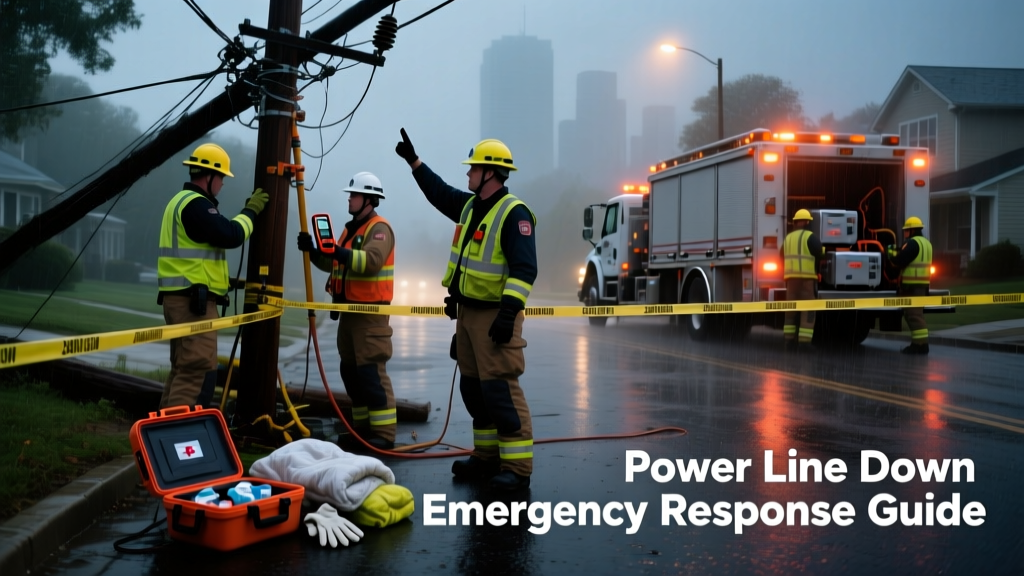
If you see a downed power line, assume it’s live and lethal—even if it’s not sparking or humming. Your first move: stop, stay back at least 35 feet, and warn others to do the same. Do not approach, touch, or drive over it.
Immediate Actions
- Stop moving immediately—do not take another step toward the line.
- Shout a clear warning to others nearby: “Downed power line—stay back!”
- Call 911 from a safe location (e.g., inside your home or vehicle).
- If you’re in a vehicle that contacts a downed line, stay inside unless fire or explosion forces you out—then jump clear without touching the vehicle and ground simultaneously, land with feet together, and shuffle away in small steps.
When to Call 911 / When to Call a Pro
Call 911 immediately if:
- The line is sparking, arcing, or smoking;
- It’s lying across a road, sidewalk, or pool;
- It’s entangled with a tree, fence, or structure;
- Someone has touched it or is near it and unresponsive.
After calling 911, contact your local utility company—their emergency line is usually listed on your bill or website. According to the U.S. Department of Energy’s 2022 Grid Resilience Report, 68% of outage-related injuries occur during the first hour after a line falls, making rapid reporting critical.
What NOT to Do
- Never touch the line—or anything (fence, puddle, car, branch) touching it.
- Don’t try to move it with wood, rubber, or ‘non-conductive’ tools—most aren’t rated for high-voltage lines.
- Don’t drive over a downed line—even if it looks dead. Tires can conduct electricity under certain conditions.
- Don’t assume a line is safe because it’s silent, dark, or insulated. Overhead distribution lines often carry 7,200 volts or more.
“A downed line doesn’t need to be sparking to kill. Even contact with wet grass or gravel within 10 feet can electrocute you.” — National Electrical Safety Code (NESC), 2023 Edition, Section 220.4
After the Emergency
Once utility crews declare the area safe:
- Document damage with photos and notes—include timestamps and distances from the line.
- Inspect your home’s electrical panel for tripped breakers or scorch marks.
- Test GFCI outlets and smoke detectors—power surges from nearby faults can disable them.
- Contact your insurer before cleaning up; some policies cover surge-related appliance damage (electrical surge damage claims require prompt reporting).
Is it safe to go outside to check?
No. Wait until the utility company confirms de-energization in writing or via official notification. Lines may be re-energized remotely without warning—even if they’ve been down for hours.
What if the line fell on my car?
Stay inside with windows up and doors closed. Call 911 and your utility. If fire forces you out, jump clear without touching car and ground at once, then hop or shuffle away with feet together—never stride.
Can I use my phone near a downed line?
Yes—if you’re at least 35 feet away. Cell phones don’t attract electricity, but avoid using them while standing in water or holding metal objects near the hazard zone.
How long does it take for crews to respond?
Most utilities aim for 60–90 minutes for life-threatening reports. Priority goes to lines on roads, near schools, or involving fire. You’ll get a case number—track status via your utility’s outage map.
Do I need an electrician after the line is cleared?
Yes—if your home lost power, experienced flickering, or you smell burning near outlets. A licensed electrician should inspect your service entrance and grounding system. Per the National Fire Protection Association’s 2023 Electrical Safety Survey, 22% of post-storm fires begin in damaged service panels overlooked after line restoration.
What about pets or livestock?
Keep animals indoors or in a dry, enclosed area far from the hazard zone. Livestock are especially vulnerable—electricity travels easily through wet soil and manure. Contact a vet if an animal shows muscle tremors, lethargy, or burns after proximity to a downed line.
| Voltage Class | Typical Hazard Radius | Avg. Crew Dispatch Time* |
|---|---|---|
| Distribution (4–35 kV) | 35 ft minimum | 72 min |
| Subtransmission (69–138 kV) | 60 ft minimum | 58 min |
| Transmission (230+ kV) | 100 ft minimum | 44 min |
*Source: Edison Electric Institute Utility Response Benchmarking Report, 2023
Always prioritize distance over curiosity. A downed line isn’t just an inconvenience—it’s a hidden threat with zero margin for error. Share this guide with neighbors, post it on community boards, and bookmark our printable electrical emergency checklist for quick reference.