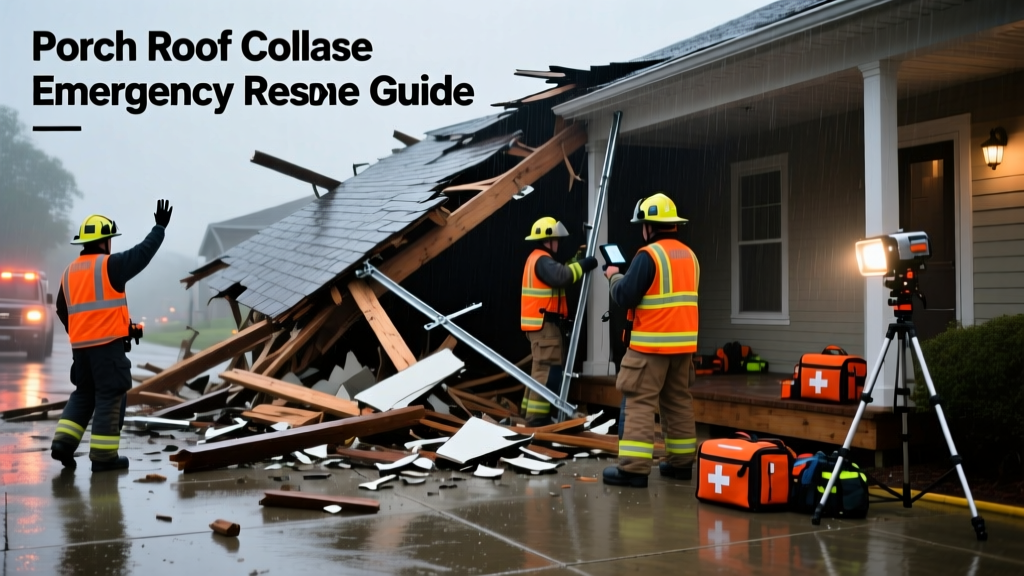
If your porch roof collapses — especially with people underneath — act within seconds: shout a warning, get everyone clear of falling debris, and move at least 30 feet away from the structure. Do not re-enter, even to retrieve belongings.
Immediate Actions
- Shout “Roof down!” to alert others — sound travels faster than sight in chaotic moments.
- Evacuate all people and pets from the porch, adjacent walkways, and any area under overhangs or attached garages.
- Check for injuries — administer basic first aid only if safe (e.g., pressure on bleeding, no movement for suspected spinal injury).
- Turn off gas and electricity at the main shut-offs if you can do so without stepping near damaged framing or exposed wires.
When to Call 911 / When to Call a Pro
Call 911 immediately if:
- Anyone is trapped, unconscious, or has difficulty breathing;
- You smell gas, hear hissing, or see sparks or frayed wiring;
Call a licensed structural engineer or emergency contractor (not a general handyman) if:
- No injuries occurred and utilities are confirmed off;
- The collapse was partial and limited to porch rafters or decking;
- You need rapid stabilization before rain or wind worsens damage.
According to the National Association of Home Builders’ 2022 Structural Failure Report, 68% of porch collapses occur due to undetected rot in support posts — making post-event inspection non-negotiable.
What NOT to Do
- Do not stand under or near the collapsed section — secondary collapse risk remains high for 72+ hours.
- Do not use candles, lighters, or open flames near the site — gas leaks may be present.
- Do not attempt DIY shoring with lumber or cinder blocks — improper bracing increases instability.
- Do not delay documenting damage — photos taken before cleanup are critical for insurance claims.
After the Emergency
Once authorities clear the scene and utilities are verified off, begin documentation and mitigation:
| Item | How to Record | Why It Matters |
|---|---|---|
| Structural cracks | Measure width (mm) and photograph with ruler beside crack | Insurance requires evidence of pre-existing vs. collapse-caused damage |
| Water intrusion | Use moisture meter + timestamped video of wet drywall/baseboard | U.S. Fire Administration data shows water damage claims rise 40% when logged >24 hrs post-collapse |
| Debris pile | Photo grid (4 corners + center) with geo-tagging enabled | Proves scope before third-party contractors arrive |
“A porch roof collapse isn’t just a repair job — it’s a red flag that the home’s lateral load path may be compromised. Always get an engineer’s report before rebuilding.” — Dr. Lena Cho, Structural Safety Council, 2023
Was my porch inspected recently?
If your porch hasn’t had a professional inspection in the past 3 years — especially in humid or coastal climates — assume hidden decay exists. Rot in pressure-treated posts often starts internally and isn’t visible until failure. Review your porch inspection checklist to identify early warning signs like spongy deck boards or leaning columns.
Can I cover the opening with a tarp?
Yes — but only after a structural pro confirms it’s safe to approach. Use grommeted poly tarps secured with ratchet straps (not rope), anchored to intact framing *beyond* the collapse zone. Never staple or nail into compromised wood. For step-by-step guidance, see our emergency tarping guide.
Will my homeowner’s insurance cover this?
Most policies cover sudden, accidental collapse — but exclusions apply for “lack of maintenance” or pre-existing conditions. Document everything, notify your insurer within 24 hours, and request written confirmation of claim eligibility. Avoid signing quick-settlement offers before reviewing the top 5 claim mistakes.
How long before it’s safe to rebuild?
Not until a licensed engineer issues a written clearance — typically 3–10 days depending on weather, access, and extent of damage. Rushing leads to unsafe repairs; 22% of post-collapse rebuilds require rework due to skipped engineering reviews (IBHS, 2023). Never reuse salvaged beams or joists — hidden stress fractures make them unreliable.
Are detached porches safer?
Detached porches have lower risk of transferring collapse forces into the main house — but they’re more vulnerable to wind uplift and foundation settlement. If yours is detached, inspect anchor bolts and footer integrity annually. Learn how to spot failing footers in our foundation warning signs guide.
Stay safe, stay informed, and never assume a collapsed porch is “just cosmetic.” Structural failures escalate silently — treat every incident as a system-wide alert. Your next step: call a certified inspector today, even if the damage seems minor.