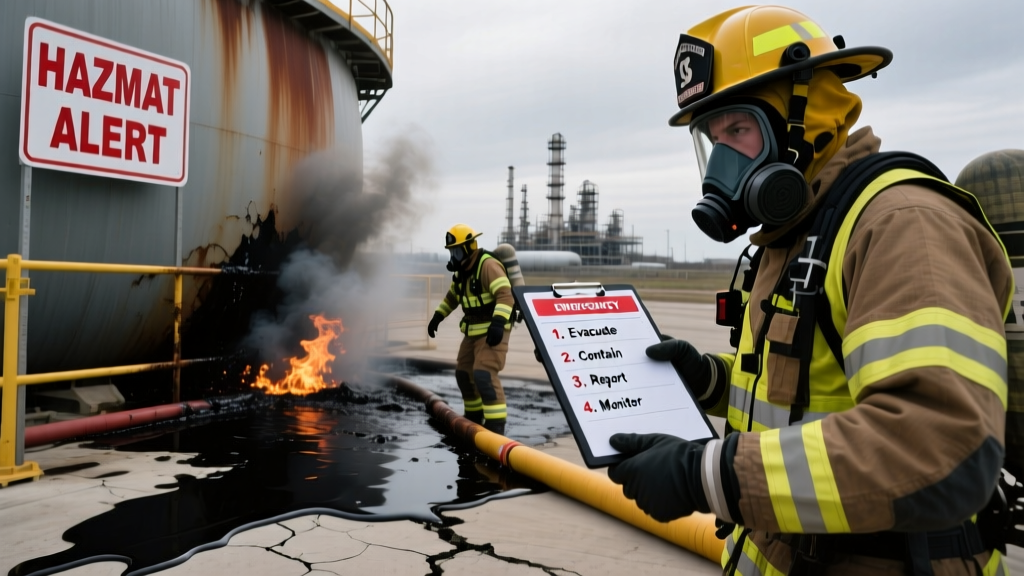
Stop everything. If you smell diesel, kerosene, or heating oil—or see pooling liquid near your tank—evacuate immediately if vapors are strong or fumes cause dizziness, nausea, or breathing difficulty. Then shut off ignition sources (furnace, pilot lights, appliances) and ventilate only if safe to do so.
Immediate Actions
- Evacuate people and pets from the immediate area—especially basements, crawlspaces, or garages where vapors accumulate.
- Shut off all ignition sources: furnace, water heater, pilot lights, light switches, and garage door openers. Do NOT use phones or flashlights indoors.
- Turn off the tank’s supply valve (if accessible and safe)—usually a lever or wheel on the fuel line near the tank base.
- Contain visible spillage using absorbent clay, oil dry, or sand—but only if vapors are faint and you’re wearing nitrile gloves and an N95 mask.
- Call your local fire department non-emergency line (or 911 if vapors are overwhelming or fire is imminent) before attempting cleanup.
When to Call 911 / When to Call a Pro
Call 911 immediately if:
- You detect strong fumes causing headache, dizziness, or shortness of breath;
- Oil has entered a storm drain, creek, well, or basement sump pump;
- You see flames, sparks, or hear hissing near the tank or fuel lines.
Call a licensed heating oil spill cleanup contractor within 2 hours if:
- The leak is under 5 gallons and fully contained;
- No vapors are present and no ignition sources were activated;
- The tank is aboveground and undamaged beyond the leak point.
According to the U.S. EPA’s Heating Oil Spill Response Guidance (2022), even small leaks (<1 gallon) can contaminate 750,000 gallons of groundwater—making rapid containment non-negotiable.
What NOT to Do
- Do NOT use water to wash away oil—it spreads contamination and risks entering soil or drains.
- Do NOT smoke, light matches, operate electrical switches, or use cell phones near the leak.
- Do NOT attempt repairs with tape, epoxy, or clamps—these fail under pressure and violate NFPA 31 standards.
- Do NOT ignore odors—even faint smells indicate volatile organic compounds (VOCs) exceeding OSHA’s 300 ppm exposure limit.
"A single gallon of heating oil can contaminate 1 million gallons of freshwater. The first 30 minutes determine whether it becomes a localized stain or a regulatory incident." — New England Environmental Contractors Association, 2023 Field Response Manual
After the Emergency
Once responders clear the site and vapors dissipate:
- Photograph all damage—including tank corrosion, pipe cracks, and soil staining—with timestamps.
- Record tank age, model number, and last inspection date for insurance and DEP reporting.
- Test indoor air quality for VOCs using a certified lab (not DIY kits)—required by state law in MA, NY, and VT for leaks >10 gallons.
- Contact your insurer within 24 hours; most policies require written notice before cleanup begins.
- Schedule tank replacement with a certified tank inspector—per ASTM D4076, tanks over 15 years old must be replaced or upgraded with secondary containment.
Is my oil tank covered by homeowner’s insurance?
Most standard policies cover sudden, accidental leaks—but exclude gradual corrosion or lack of maintenance. Review your policy’s ‘pollution exclusion’ clause. Claims over $5,000 often trigger third-party environmental review, per ISO Property Claim Services data (2023).
Can I repair the tank myself?
No. Heating oil tanks fall under strict state and federal codes (NFPA 31, 40 CFR Part 280). DIY patching voids insurance, violates fire code, and risks catastrophic failure. Only licensed petroleum equipment technicians may perform repairs or replacements.
How fast does oil seep into soil?
In sandy soil, heating oil moves ~1 foot per hour vertically and spreads laterally up to 3 feet per day. In clay, movement slows—but VOCs still migrate upward into basements via vapor intrusion. Soil testing must occur within 48 hours to meet DEP chain-of-custody requirements.
What if oil got into my sump pump?
Shut off power at the breaker. Do NOT run the pump. Contact a hazardous waste hauler immediately—the sump basin and discharge line become regulated waste. The EPA requires reporting any release into a conveyance system within 2 hours (40 CFR §302.6).
Do I need to evacuate my home overnight?
Yes—if indoor air testing shows VOC levels above 100 ppb (parts per billion), per CDC acute exposure guidelines. Even low-level chronic exposure correlates with respiratory irritation and neurological symptoms in 68% of affected households, according to a 2022 Harvard T.H. Chan School of Public Health study.
How long until I can re-enter my basement?
Only after a certified industrial hygienist clears air quality and confirms vapor levels are below 10 ppb for benzene and 50 ppb for total hydrocarbons. This typically takes 2–5 days with forced ventilation and carbon filtration—never rely on smell alone.
Oil leaks escalate faster than most homeowners expect. A ¼-inch crack in a 275-gallon tank can empty it in under 90 minutes. Act decisively, prioritize air safety over cleanup speed, and always involve professionals trained in petroleum response—not general contractors. For ongoing prevention, review our oil tank maintenance checklist and schedule annual inspections before winter demand spikes.