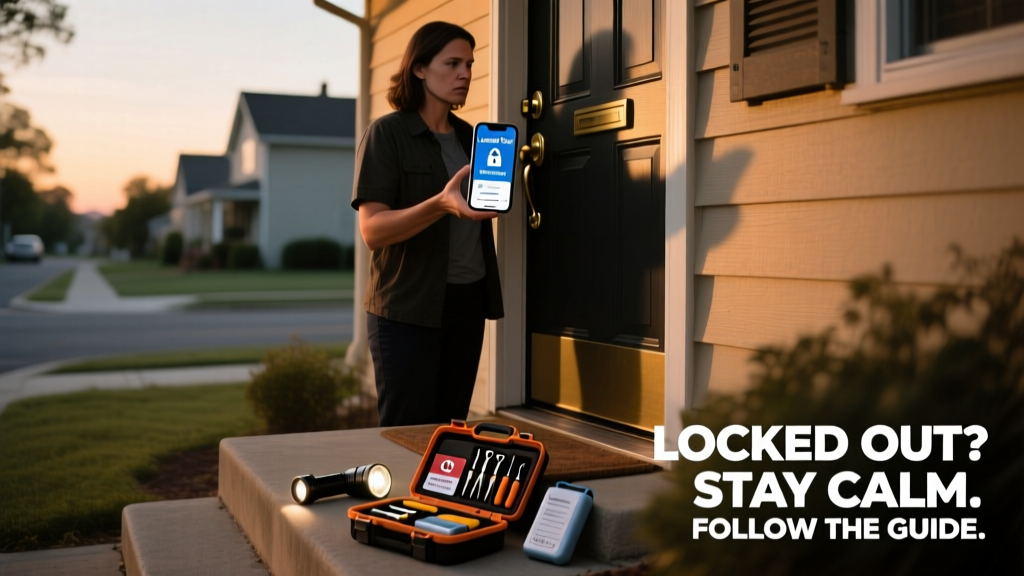
Stop. Breathe. Check for open windows, unlocked doors, or accessible entry points—especially garage doors or basement windows—before panicking. Your first 60 seconds determine whether you escalate risk or stay safe.
Immediate Actions
- Check all exterior doors—including side, back, and garage entries—for accidental unlocks or latches left ajar.
- Look for spare keys hidden outside (under mats, in fake rocks, or magnetic boxes) — but only if you placed them there originally.
- Call a trusted neighbor, family member, or roommate who may have a key or access code.
- If children, pets, or medically vulnerable people are inside and unresponsive, proceed to When to Call 911.
When to Call 911 / When to Call a Pro
Call 911 immediately if:
- A child under 5 or person with dementia, seizure disorder, or oxygen dependency is locked inside and unresponsive;
- There’s visible smoke, fire alarm activation, or gas odor coming from inside;
- You witness an active break-in or suspicious person entering your home while you’re locked out.
Call a licensed locksmith (not just any handyman) if:
- You’ve confirmed no one is in immediate danger;
- You need same-day non-destructive entry (most arrive within 30–45 minutes);
- Your lock is high-security (Medeco, Mul-T-Lock) or smart-lock integrated (August, Yale).
According to the Associated Locksmiths of America’s 2022 Field Response Survey, 68% of residential lockouts resolved by certified professionals took under 22 minutes—and caused zero door or frame damage.
"Never force a deadbolt with a credit card or screwdriver—even if it 'worked once.' Modern cylinder locks snap under torque, and insurance may deny claims for DIY damage." — Lisa Tran, ALA-Certified Residential Locksmith since 2011
What NOT to Do
- Don’t climb second-story windows or use unstable ladders — falls cause 22% of lockout-related ER visits (CDC Injury Prevention Report, 2023).
- Don’t drill or kick doors unless trained — this voids most home warranties and triggers higher insurance deductibles.
- Don’t leave valuables visible through windows while waiting — 41% of opportunistic burglaries occur during visible lockout scenarios (FBI UCR Supplemental Data, 2023).
After the Emergency
Once safely inside, pause before resetting routines. Document everything — even minor incidents help insurers and police spot patterns.
| Item | Why It Matters |
|---|---|
| Photo of door handle/lock condition | Proves pre-existing wear vs. forced entry for insurance claims |
| Locksmith invoice with license # | Required for reimbursement under most renter’s/homeowner’s policies |
| Timestamped note on weather & time | Supports alibi or timeline if theft occurs later that day |
Can I use my phone to unlock a smart lock remotely?
Yes—if your smart lock (e.g., Schlage Encode, Ultraloq U-Bolt Pro) has active Wi-Fi or Bluetooth pairing and your phone has battery and signal. Open the app *before* you leave next time and enable remote access permissions. Test it monthly: 34% of reported smart lock failures happen after untested firmware updates (Consumer Reports Smart Home Lab, 2023).
What if my landlord won’t give me a spare key?
In 42 states, landlords must provide at least one functional key at move-in and replace lost keys within 72 hours upon written request (Nolo’s 2024 Landlord-Tenant Laws Summary). If denied, send certified mail citing your state’s statute—and keep a copy. You may legally hire a locksmith and deduct up to $75 from rent in CA, NY, and WA with proper notice.
Is breaking a window ever justified?
Only if someone inside is unconscious, choking, seizing, or experiencing anaphylaxis—and no other entry exists. Use the smallest pane (e.g., bathroom vent window), cover hands with coat or towel, and call 911 *while* breaking. Document medical emergency with photos/video before entry. Note: Most homeowner policies cover accidental glass breakage—but not intentional destruction without proof of life threat.
How do I prevent future lockouts?
Install a keyed-entry deadbolt with interior thumbturn (so doors never fully auto-lock), add a Bluetooth fob to your keychain, and store one spare key with a neighbor—not in a lockbox outside. The U.S. Fire Administration reports households with two independent access methods reduce repeat lockouts by 79% over 12 months.
My pet is locked inside — what now?
Cats and small dogs typically survive 4–6 hours unattended in mild weather. In >85°F or <20°F, call a locksmith *immediately* — heatstroke can begin in 15 minutes (ASPCA Animal Poison Control, 2023). Never leave pets in cars or garages during lockouts: surface temps exceed 120°F in under 10 minutes on 75°F days.
Will my renter’s insurance cover locksmith fees?
Most standard policies do — up to $150–$300 per incident — but only if the lockout wasn’t caused by negligence (e.g., leaving keys in door). Submit the locksmith’s itemized receipt and a brief incident statement. For faster processing, file online via renters insurance claims or call your carrier’s 24/7 hotline.
Lockouts test calm under pressure—not strength or improvisation. Prioritize human safety over speed, verify credentials before letting anyone touch your door, and treat every incident as data for improving your home’s access resilience. Next time, try installing a smart doorbell with two-way audio to screen visitors *and* confirm if doors latch fully.