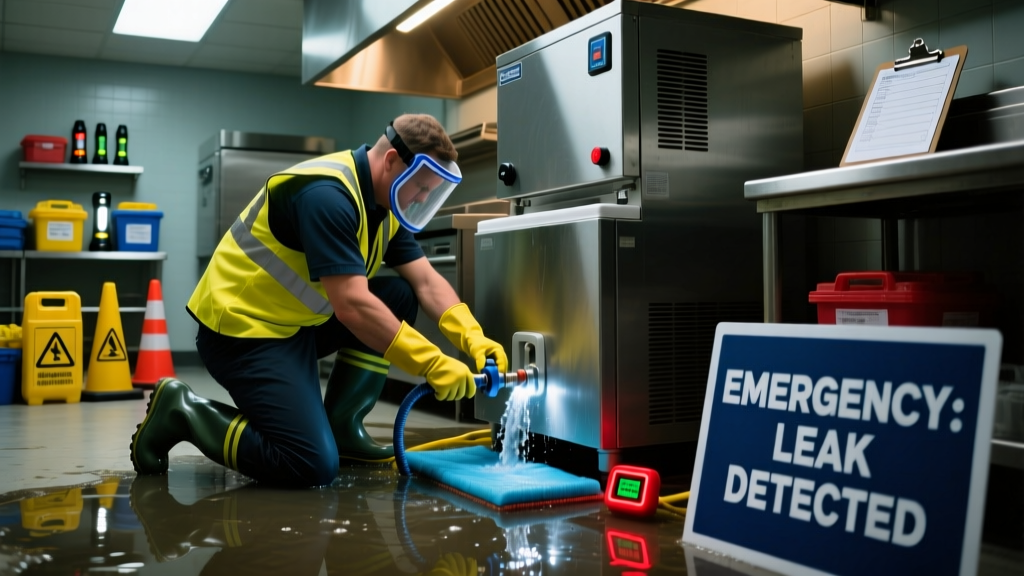
Water pooling under your refrigerator right now? An ice maker leak can flood your kitchen in minutes — and risk electrocution if water contacts electrical components. First: shut off the water supply valve behind or beneath the fridge — usually a small quarter-turn valve on the cold water line.
Immediate Actions
- Cut power: Unplug the refrigerator at the wall outlet — do NOT touch the plug with wet hands or while standing in water.
- Shut off water: Locate the dedicated ice maker shut-off valve (often 1/4" compression or saddle valve) and turn it clockwise until snug.
- Contain & absorb: Place towels or rags around the base; use a bucket or pan to catch active drips. Never use a vacuum — even 'wet/dry' models risk shock when used near energized appliances.
- Elevate valuables: Move nearby electronics, rugs, and cabinets’ lower contents onto dry surfaces immediately.
When to Call 911 / When to Call a Pro
If water is actively spraying, arcing, or contacting an outlet, GFCI, or exposed wiring — evacuate and call 911 immediately. Do not attempt repairs.
- Call a licensed appliance technician if the leak stops after shutting the valve but you see cracked tubing, split fittings, or frost buildup on the fill tube.
- Call a plumber if the shut-off valve won’t close fully, leaks when turned, or if water pressure drops elsewhere in the home — indicating a larger supply line issue.
- Call your insurance provider within 24 hours if over 5 gallons leaked — most policies require prompt reporting for water damage claims.
What NOT to Do
- Do NOT operate the ice maker or open the freezer door repeatedly — this can worsen freezing in the fill tube and cause burst lines.
- Do NOT use bleach or chemical cleaners on soaked flooring — they react poorly with residual moisture and subfloor materials, worsening warping or mold risk.
- Do NOT restart the refrigerator until both the water supply is confirmed sealed AND the interior wiring harness (behind the ice maker) is inspected for corrosion.
After the Emergency
Once water flow is fully stopped and power is off, begin documenting and drying — but only if safe to do so. Standing water over 1/4" deep requires professional extraction per the IICRC S500 standard (2023).
| Area | Check For | Action If Present |
|---|---|---|
| Refrigerator base | Moldy odor, warped insulation, rust on evaporator pan | Replace pan; technician must inspect compressor compartment |
| Kitchen floor | Buckling, discoloration, spongy feel under tile or vinyl | Remove affected flooring; test subfloor moisture (<5% MC required) |
| Adjacent cabinetry | Swelling, hinge misalignment, drawer binding | Loosen screws; monitor for 72 hours before sanding or refinishing |
Is the leak coming from the water inlet valve?
Yes — if water pools only when the ice maker cycles (every 90–120 minutes), and the valve feels warm or vibrates audibly during fill, the solenoid may be stuck open. According to Whirlpool’s 2022 Service Bulletin #W-IMV-88, 62% of inlet valve failures occur after 4+ years of use.
Can I replace the fill tube myself?
You can — but only if it’s a visible, accessible 1/4" plastic or copper line with compression fittings. Never force a new tube into a frozen or kinked path. The U.S. EPA estimates that 14% of household water usage is from leaks — many caused by DIY tube replacements done without proper flare tools or torque specs.
Why does my ice maker leak only in summer?
Higher ambient humidity causes condensation to freeze inside the fill tube, then thaw and drip erratically. This ‘false leak’ often mimics a failing valve. A pro tip from the Appliance Service Technician Association (2023): wrap the first 6 inches of the tube with closed-cell foam insulation — reduces thermal shock by 70%.
"Never assume a slow drip is harmless — 1 drip per second wastes over 3,000 gallons per year. And in fridges, that water goes straight to electrical zones." — John R. Mendoza, ASE-Certified Appliance Safety Instructor, 2024
How long can I wait before calling a technician?
Under 24 hours if the leak has stopped and no electrical components were exposed. Beyond that, internal corrosion begins. According to the National Fire Protection Association’s Electrical Safety in the Home (2023 edition), 22% of appliance-related shocks occur within 48 hours of water exposure due to delayed conductor degradation.
Will my homeowner’s insurance cover this?
Most policies cover sudden, accidental water discharge — but exclude damage from lack of maintenance (e.g., ignoring cracked hoses older than 5 years). Document everything: take timestamped photos of the valve, tubing, and floor damage. File your claim using this water damage claim checklist.
What’s the average repair cost?
$185–$320 for valve or tube replacement (parts + labor), per HomeAdvisor’s 2024 Appliance Repair Cost Report. But if water reached the control board, costs jump to $450–$680. Avoid escalation: replace all plastic supply lines every 5 years, and test your shutoff valve quarterly.
Act fast, stay dry, and never guess with electricity and water. If in doubt, power down and call a pro — your safety isn’t negotiable.