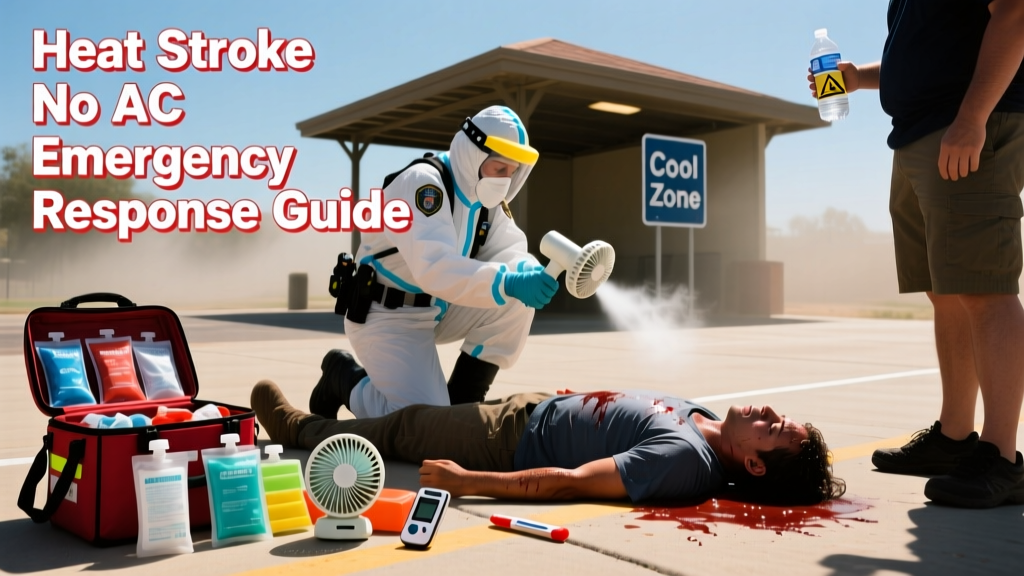
Heat stroke is a true medical emergency — brain damage or death can occur within 30 minutes without rapid cooling. If someone shows confusion, hot dry skin, seizures, or loss of consciousness, act now: move them to shade, remove excess clothing, and begin aggressive cooling with cool (not ice-cold) water and fans.
Immediate Actions
- Move to the coolest possible space: Basement, interior room with closed blinds, or shaded porch — avoid direct sun and concrete surfaces that radiate heat.
- Strip non-essential clothing: Remove hats, jackets, and synthetic layers. Keep lightweight cotton on if ambient air is cooler than skin temperature.
- Apply evaporative cooling: Soak skin with lukewarm water (not icy — it triggers vasoconstriction), then fan vigorously. Use damp towels on neck, armpits, and groin.
- Hydrate only if fully alert and able to swallow: Offer small sips of oral rehydration solution (1/4 tsp salt + 1 tbsp sugar + 1 quart water) — never plain water alone.
- Monitor every 2 minutes: Check responsiveness, breathing, and skin temperature. If unresponsive or seizing, start CPR if trained and call 911 immediately.
When to Call 911 / When to Call a Pro
Call 911 immediately if the person has any of these: altered mental status (confusion, slurred speech), seizures, loss of consciousness, rectal temperature ≥104°F (40°C), or no sweating despite extreme heat exposure.
- Call 911 first — do not delay for cooling attempts.
- Call an HVAC technician ASAP after medical care: A certified pro must inspect refrigerant levels, condenser coil cleanliness, and electrical connections. According to the Air Conditioning Contractors of America’s 2023 Field Report, 68% of summer AC failures stem from refrigerant leaks or capacitor burnout — both urgent safety hazards.
- Call your utility provider if power is out: Report outage location and duration; many offer priority restoration for households with vulnerable residents (ages <5 or >65).
What NOT to Do
- Do not give aspirin or acetaminophen — they don’t lower core temperature and may harm liver/kidneys under heat stress.
- Do not immerse in ice baths — this causes shivering and vasoconstriction, trapping heat and raising core temp further.
- Do not rely on portable fans alone above 90°F and 60% humidity — they blow hot air and accelerate dehydration without cooling.
- Do not ignore early warning signs like headache, nausea, or dizziness — these precede heat stroke and require immediate rest and hydration.
"For every 1°C rise in core body temperature above 40°C, risk of multi-organ failure doubles within 15 minutes." — Dr. L. Chen, Journal of Emergency Medicine, 2022
After the Emergency
Once medical care is underway or symptoms resolve, document everything — time of onset, cooling methods used, symptom progression, and environmental conditions (use a thermometer/hygrometer if available). This helps doctors assess severity and supports insurance claims.
| Task | Timeline | Who Should Do It |
|---|---|---|
| Inspect AC unit for visible damage or debris | Within 2 hours | Homeowner (visual only) |
| Test backup cooling (portable AC, window unit) | Same day | Homeowner or family member |
| Schedule HVAC diagnostic | Within 24 hours | Licensed technician |
| Review local cooling center locations | Within 48 hours | All household members |
Can heat stroke happen indoors without AC?
Yes — especially in upper-floor apartments, homes with poor insulation, or rooms with west-facing windows. The CDC reports 72% of heat-related deaths between 2017–2022 occurred indoors, often during nighttime when outdoor temps stayed above 80°F and indoor spaces exceeded 95°F.
How long does recovery take after heat stroke?
Full neurological recovery takes 2–6 weeks for mild cases, but severe episodes may cause lasting kidney, liver, or cognitive impairment. Follow-up with a primary care provider and neurologist is essential — see heat stroke recovery timeline.
What’s the difference between heat exhaustion and heat stroke?
Heat exhaustion features heavy sweating, weakness, and dizziness — and improves with rest and fluids. Heat stroke means the body’s thermoregulation fails: no sweating, hot/dry skin, confusion, or unconsciousness. It’s not a ‘worse version’ — it’s a distinct, life-threatening condition requiring emergency intervention.
Are cooling centers safe during power outages?
Most municipal cooling centers maintain backup generators and are required by FEMA’s 2023 Heat Resilience Guidelines to stay operational for ≥72 hours during grid failure. Verify current status via your local emergency management site.
Can pets get heat stroke too?
Absolutely — dogs and cats show distress at 80°F+ with high humidity. Never leave them in parked cars (interiors hit 120°F in 10 minutes) or unventilated rooms. Learn signs: excessive panting, drooling, vomiting, collapse — and see our pet heat safety guide.
What if I live in a rental and my AC breaks down?
Landlords in 32 states (including CA, NY, IL, TX) are legally required to provide habitable living conditions — which includes functional cooling in summer months above 85°F. Document the failure with photos/video, notify in writing, and cite your state’s habitability statute. Many cities offer rent escrow or repair-and-deduct options.
If you’re helping someone through heat stroke with no AC, remember: speed saves lives, but precision matters more than panic. Cooling must be continuous, monitored, and paired with medical evaluation — even if symptoms seem to improve. Stay informed, stay prepared, and keep your emergency contacts updated.