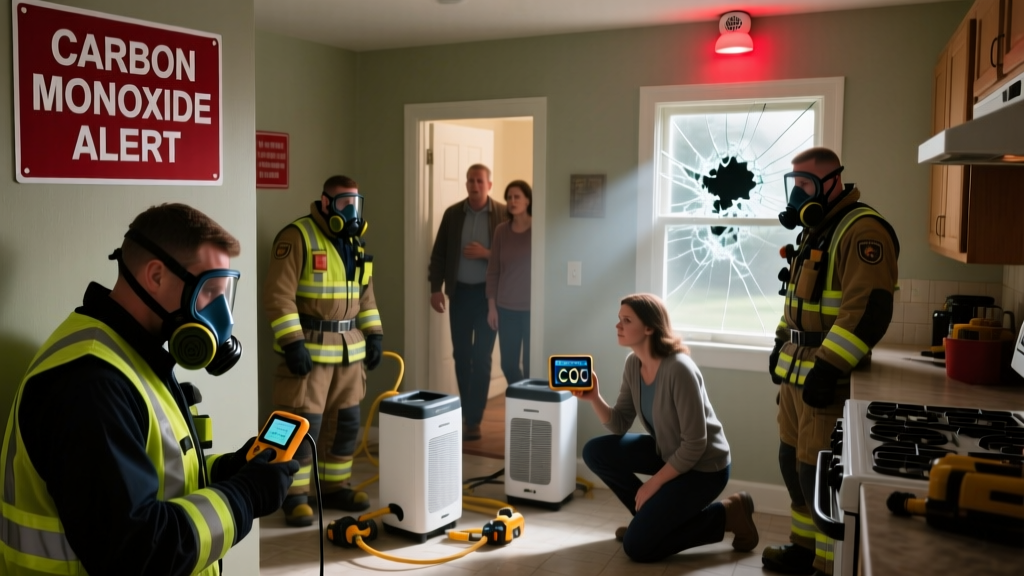
If you suspect carbon monoxide (CO) from a generator — get everyone outdoors immediately. Do not wait for symptoms to worsen. CO is odorless, colorless, and can cause unconsciousness or death in minutes.
Immediate Actions
- Evacuate everyone — including pets — to fresh air outside. Move at least 50 feet away from the building and generator location.
- Do NOT re-enter until emergency responders declare the space safe. CO lingers and accumulates quickly indoors.
- Call for help from outside or a neighbor’s home — never use a landline or cell phone inside a potentially contaminated area.
- Turn off the generator only if you can do so safely *without re-entering* the hazard zone — e.g., via remote switch or by someone already outside.
When to Call 911 / When to Call a Pro
Call 911 immediately if anyone shows symptoms: headache, dizziness, nausea, confusion, shortness of breath, or loss of consciousness. According to the CDC, over 400 Americans die annually from unintentional CO poisoning — and generators cause ~60% of non-fire-related CO deaths in homes (CDC, 2022).
- Call 911 now if: Anyone is unconscious, seizing, or struggling to breathe.
- Call a licensed HVAC technician or gas utility pro if: You need CO detector verification, ventilation inspection, or generator placement assessment after the incident.
What NOT to Do
- Never run a generator inside a garage, basement, crawlspace, or shed — even with doors or windows open.
- Never ignore CO alarm chirps or digital readings — treat every alert as real and urgent.
- Never use charcoal grills, camp stoves, or gas ovens for heating indoors — these also produce lethal CO.
- Never assume symptoms are "just the flu" — CO poisoning mimics viral illness but escalates rapidly without fresh air.
"A portable generator running just 20 feet from an open window can raise indoor CO levels to 1,200 ppm in under 3 minutes — well above the 35 ppm OSHA 8-hour exposure limit." — National Institute for Occupational Safety and Health (NIOSH), 2021 Generator Safety Bulletin
After the Emergency
Once cleared by responders, document everything: take timestamped photos of generator placement, CO detector model and reading, and any visible damage. File claims with your insurer within 48 hours — most policies cover CO-related property damage but require prompt reporting.
| Detector Alert Type | Immediate Action | Follow-Up Required? |
|---|---|---|
| Steady beep (alarm) | Evacuate, call 911 | Yes — professional calibration and home inspection |
| Chirping every 30 sec | Check battery; replace if low | No — unless chirping persists after battery change |
| Digital display >70 ppm | Evacuate and call 911 | Yes — HVAC and generator safety audit required |
Can CO poisoning cause long-term health effects?
Yes. Survivors of moderate-to-severe CO exposure may develop delayed neurological symptoms — memory loss, depression, or movement disorders — weeks later. The American College of Emergency Physicians recommends neuropsychological evaluation for anyone hospitalized for CO poisoning (ACEP Clinical Policy, 2023).
How far should a generator be placed from windows and doors?
Minimum 20 feet — and downwind — from all openings. The U.S. Consumer Product Safety Commission (CPSC) reports that 72% of generator-related CO incidents occurred when units were placed within 10 feet of a door or window (CPSC, 2023 Annual Report).
Do battery-powered CO detectors work during power outages?
Yes — but only if they have sealed lithium batteries rated for 10-year life. Avoid models with replaceable alkaline batteries unless you test and swap them monthly. See our CO detector buying guide for UL-certified recommendations.
Is it safe to run a generator in the rain?
No — unless protected by a manufacturer-approved canopy designed for ventilation and weather resistance. Rain + generator = electrical hazard AND increased risk of CO buildup if airflow is blocked. Always consult your generator safety checklist before operation.
Will opening windows reduce CO risk enough to run a generator indoors?
No. Opening windows does not prevent dangerous CO accumulation. A study published in the Journal of Occupational and Environmental Hygiene (2022) measured CO concentrations exceeding 1,000 ppm in garages with two open overhead doors and side windows — proving passive ventilation is ineffective.
How often should I test my CO detectors?
Test monthly using the built-in button. Replace units every 5–7 years — sensors degrade. Check expiration dates on the back; many people overlook this. For integrated systems, verify alarms sync with your smart home hub — see our smart home safety audit.
Prevention starts before the storm hits. Install CO detectors on every level of your home — especially near sleeping areas — and inspect generator placement annually. Never let convenience override air safety: one mispositioned generator can poison an entire household in under five minutes.