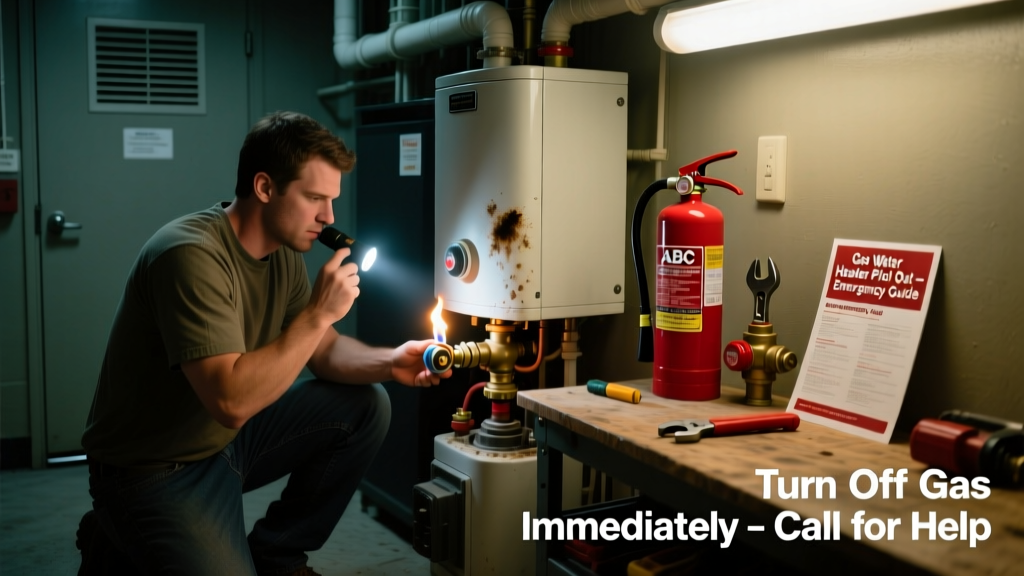
If your gas water heater pilot light is out, assume gas may be leaking. Do not light matches, flip switches, or use phones near the unit. Step away immediately and ventilate the area by opening windows and doors.
Immediate Actions
- Turn off the gas supply valve at the water heater (it’s a lever perpendicular to the pipe — turn it 90° to shut off).
- Open windows and exterior doors in the utility room or basement to disperse any accumulated gas.
- Do not operate electrical switches, doorbells, garage door openers, or cell phones within 15 feet of the unit.
- Leave the area and move to fresh air outdoors — even if you smell nothing. Natural gas is odorless; mercaptan (the sulfur-like additive) can fade or go unnoticed in low concentrations.
When to Call 911 / When to Call a Pro
Call 911 immediately if:
- You smell gas (rotten eggs) and cannot locate or shut off the source;
- You feel dizziness, nausea, headache, or confusion — signs of carbon monoxide exposure;
Call a licensed HVAC technician or plumber if:
- The gas valve is off, ventilation is complete, no symptoms are present, and you’ve confirmed no leak with soapy water (see gas leak detection);
- You’ve followed manufacturer re-ignition steps twice and the pilot won’t stay lit;
- The thermocouple is corroded or bent (visible after removing access panel).
What NOT to Do
- Do not attempt to relight the pilot without first verifying gas flow is fully shut off and the area is ventilated for at least 10 minutes.
- Do not use candles, lighters, or incense anywhere near the heater — even after airing out.
- Do not ignore repeated pilot failures — they often signal failing thermocouples, clogged orifices, or draft issues that increase CO risk.
- Do not delay replacement if your unit is over 12 years old. The U.S. Department of Energy estimates 40% of gas water heaters older than 12 years have degraded safety controls (2022 Appliance Safety Report).
After the Emergency
Once cleared by a professional or emergency responders:
- Document damage with timestamped photos — especially rust, soot, or warped components — for insurance claims.
- Test your carbon monoxide detector: replace batteries if older than 6 months; units expire after 5–7 years (per UL 2034 standard).
- Check for water pooling beneath the tank — a pilot outage can mask slow leaks from internal corrosion.
"A pilot light that won’t stay lit isn’t just inconvenient — it’s often the first warning sign of a failing gas control valve or blocked vent. Ignoring it doubles the risk of incomplete combustion and CO buildup." — National Fire Protection Association, Home Gas Appliance Safety Bulletin, 2023
Why does my pilot keep going out?
Most commonly: a worn thermocouple (replaces for $15–$25), dirty pilot orifice (clogged by dust or spider webs), or downdrafts from poor venting. Drafts from attic fans or nearby exhaust systems can blow out pilots — test by temporarily disabling those devices before relighting.
Can I relight it myself safely?
Yes — only if you’ve confirmed no gas odor, the room is fully ventilated, and your unit’s manual permits it. Follow the exact sequence: turn gas knob to "Pilot," press & hold while lighting with long-reach lighter, hold 60 seconds, then release. If it extinguishes, stop — do not repeat more than twice. See our step-by-step relighting guide.
How long does gas linger after a leak?
Natural gas dissipates quickly outdoors but can pool in basements or crawl spaces for 30+ minutes without active ventilation. The EPA advises waiting at least 15 minutes with cross-ventilation before re-entry — longer if the unit sits in an enclosed utility closet.
Is a pilot outage dangerous if the gas valve is off?
Not inherently — but it means hot water is unavailable, increasing risk of scalding if someone cranks up the thermostat on an electric backup or tankless system. Also, cold tanks can develop sediment buildup faster, accelerating corrosion.
What’s the risk of carbon monoxide?
Gas water heaters produce CO during normal operation — but incomplete combustion (from dirty burners, blocked flues, or weak pilots) spikes output. CO poisoning causes ~430 U.S. deaths annually (CDC, 2023). Install CO detectors within 10 feet of every sleeping area and test monthly.
Should I replace the whole unit?
Consider it if: pilot failures recur after thermocouple/orifice service; the tank shows bulging, rust stains, or weeping; or installation violates current codes (e.g., no temperature/pressure relief valve discharge pipe). Modern units include flame rollout switches and sealed combustion — cutting CO risk by 70% (AHRI 2021 Efficiency Study).
| Cause | DIY Fix Possible? | Professional Needed Within |
|---|---|---|
| Dirty pilot orifice | Yes — with compressed air & needle tool | 72 hours (if recurring) |
| Faulty thermocouple | Yes — $20 part, 20-minute install | 48 hours (if replacement fails) |
| Cracked heat exchanger | No — immediate hazard | Same day |
| Improper venting/draft | Rarely — requires static pressure test | 24 hours |
Never assume a silent heater is safe. A pilot outage is your system’s distress signal — treat it like a smoke alarm chirp: investigate promptly, act decisively, and prioritize air quality over convenience. For ongoing maintenance tips, see our annual maintenance checklist.