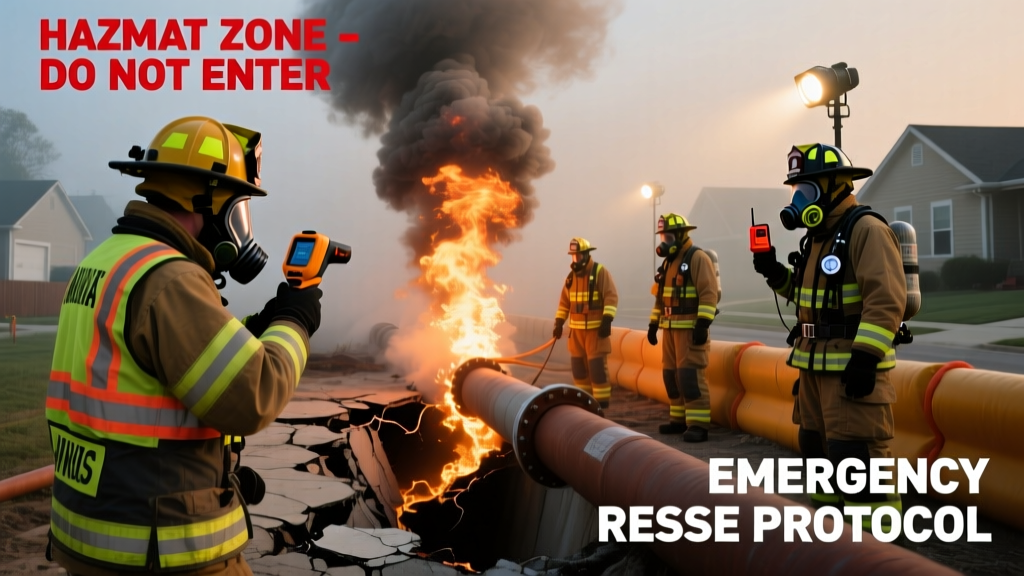
If you smell rotten eggs, hear a hissing sound, or see bubbling soil or dead vegetation near a gas line, assume a rupture has occurred. Leave immediately. Do not flip switches, use phones, or operate vehicles — even a spark can trigger an explosion.
Immediate Actions
- Evacuate everyone — get all people and pets out of the building and at least 300 feet away (the U.S. Department of Transportation recommends 300–500 ft for high-pressure lines).
- Do not ignite anything — no lighters, matches, candles, cigarettes, or electrical devices (including garage door openers).
- Shut off the main gas valve only if it’s safe and accessible — turn the valve handle 90° so it’s perpendicular to the pipe (use a wrench if needed; most residential valves are quarter-turn).
- Call for help from outside — use a cell phone or neighbor’s landline once you’re well clear of the area.
When to Call 911 / When to Call a Pro
Call 911 immediately if:
- You smell gas indoors or outdoors and cannot locate or safely shut off the source,
- You hear loud hissing or roaring near a buried line,
- There’s fire, smoke, or visible damage to piping or appliances.
Call your utility company or a licensed gas fitter after emergency responders clear the scene and confirm no immediate hazard. According to the Pipeline and Hazardous Materials Safety Administration (PHMSA) 2023 Annual Report, 72% of reported gas incidents involved delayed professional assessment after initial evacuation.
What NOT to Do
- Don’t operate light switches, thermostats, doorbells, or plugged-in electronics — static or arcing can ignite gas.
- Don’t start cars, lawnmowers, or generators within 100 feet of the suspected leak.
- Don’t try to repair, tape, or clamp the line yourself — improper fixes increase explosion risk.
- Don’t re-enter the building until cleared by both fire officials and your gas provider.
After the Emergency
Once authorities declare the area safe, begin documenting damage for insurance and regulatory reporting. Take timestamped photos of leaks, damaged piping, appliance disconnections, and soil disturbances. Keep all service records — the National Fire Protection Association (NFPA 54, 2023 edition) requires certified technicians to inspect and pressure-test any repaired or replaced gas line before reactivation.
| Item | Required? | Notes |
|---|---|---|
| Photos/video of leak site & surroundings | Yes | Include timestamps and wide-angle context |
| Utility company incident report number | Yes | Request written confirmation of leak cause |
| Gas technician certification ID & test results | Yes | Mandatory per NFPA 54 Section 8.2.3 |
| Home insurance claim reference | Recommended | File within 48 hours for faster processing |
How long does it take to restore gas service?
Restoration typically takes 24–72 hours after repairs pass inspection. Your utility must conduct a full system pressure test and leak check before restoring flow — delays often occur if corrosion or multiple breaks are found. Never bypass this step; the U.S. Consumer Product Safety Commission reports that 1 in 5 post-repair explosions happen due to premature re-energization.
Can I smell natural gas without a leak?
Yes — but rarely. Natural gas is odorless; utilities add mercaptan (a sulfur compound) to give it that distinctive rotten-egg smell. However, odor fatigue can set in after 15–20 minutes of exposure, making you unable to detect rising concentrations. That’s why electronic gas detectors are recommended for homes with older gas infrastructure — especially near water heaters or furnaces.
"Odor fade" — where mercaptan diminishes in certain soil or pipe conditions — accounts for 11% of undetected leaks in rural distribution systems (PHMSA, 2022 Leak Detection Study).
What’s the difference between a gas line rupture and a small leak?
A rupture involves sudden, high-volume release — often accompanied by audible hissing, ground vibration, or dust plumes. A small leak may only emit faint odor or cause slow pressure drops. Both are dangerous, but ruptures require immediate evacuation and 911 response. Small leaks still demand same-day professional evaluation — the U.S. EPA estimates that 14% of household water usage is from leaks, but gas leaks carry far higher risk per cubic foot released.
Is it safe to open windows during a gas leak?
No — opening windows or doors can create airflow that spreads gas into adjacent rooms or ignites via static discharge. Ventilation should only be done by trained responders using explosion-proof equipment. Your priority is egress, not air circulation.
Do gas detectors replace professional inspections?
No. Detectors (like those meeting UL 1484 standards) provide early warning but don’t assess pipe integrity, corrosion, or regulator function. They’re a supplement — not a substitute — for annual inspections by a licensed plumber or gas fitter. For older homes built before 1990, consider upgrading to CSST (corrugated stainless steel tubing) with proper bonding — ungrounded CSST caused 22% of lightning-related gas fires in the NFPA’s 2021 Residential Gas Incident Analysis.
What if the rupture happened underground on my property?
Contact your utility immediately — they own and maintain the line up to your meter. If the break is on your side of the meter (e.g., in the yard or basement), your homeowner’s policy may cover excavation and repair, but only if performed by a certified gas line repair technician. Never dig near suspected leaks — call 811 first for utility locates, even after a rupture. The Common Ground Alliance reports that 40% of excavation-related gas incidents occur because homeowners skip this step.
Gas line ruptures escalate fast — but decisive action saves lives. Always prioritize distance over diagnosis, silence over switches, and professionals over DIY. For ongoing safety, install battery-powered gas detectors near every gas appliance and review your family’s home evacuation plan quarterly. Stay alert. Stay safe.