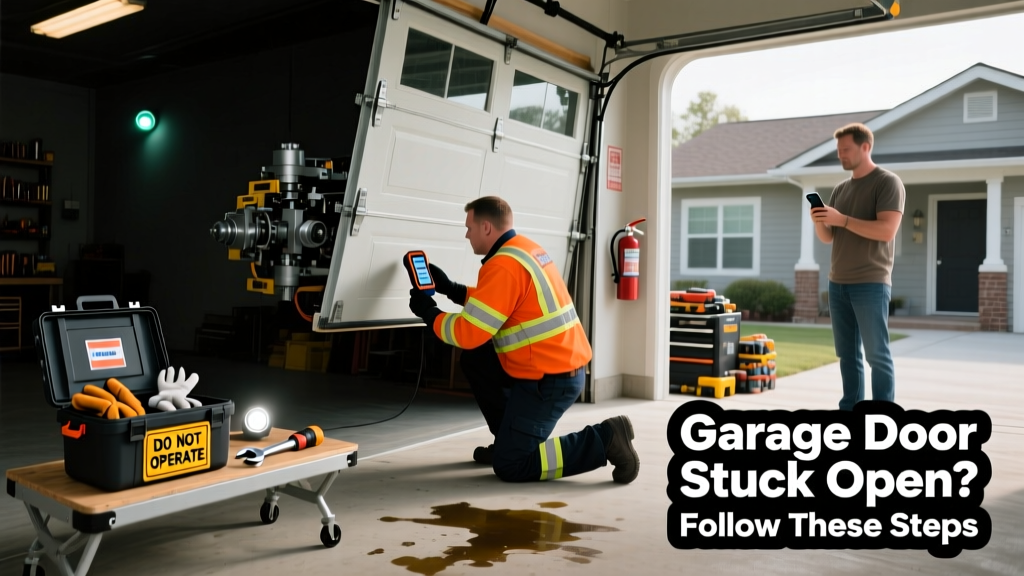
Your garage door is stuck open — that’s a security, weather, and safety hazard right now. Step back, keep children and pets away, and do not attempt to force it closed. Your first move is to disconnect the opener using the manual release cord (usually a red rope hanging near the track) — but only if it’s safe to reach without climbing or stretching.
Immediate Actions
- Secure the area: Close interior garage access doors, lock windows, and activate outdoor lighting or alarms.
- Disconnect the opener: Pull the red manual release cord straight down — you’ll hear a click and feel tension release. Do this only if the door is motionless and fully open (not sagging or off-track).
- Block the door: Slide two 2×4 boards horizontally across the bottom track inside the garage, wedged tightly between floor and door panels. This prevents accidental drop or wind gusts from slamming it.
- Assess for danger: Look for frayed cables, bent tracks, dangling springs, or signs of smoke or burning near the motor. If any are present, evacuate and call 911 immediately.
When to Call 911 / When to Call a Pro
If the door is jammed with a vehicle underneath, someone trapped, or showing signs of electrical arcing, fire, or spring failure (loud bang, visible coil distortion), dial 911. Do not wait.
For non-life-threatening issues — like remote failure, misaligned sensors, or a door that opens but won’t close — contact a certified garage door technician within 24 hours. According to the Door & Access Systems Manufacturers Association (DASMA), 73% of garage door injuries occur during DIY repairs — never adjust torsion springs yourself.
"Torsion springs store up to 100+ foot-pounds of energy — equivalent to dropping a 50-lb weight from waist height. One slip can fracture bones or cause permanent nerve damage." — DASMA Safety Bulletin, 2022
What NOT to Do
- Do not stand under the door — even if it looks stable. A broken cable can snap without warning.
- Do not use tape, clamps, or bungee cords to hold the door in place — they fail unpredictably.
- Do not try to realign tracks with a hammer or pry bar. Misalignment worsens stress on rollers and springs.
- Do not operate the wall button or remote repeatedly — this strains the motor and may overheat wiring.
After the Emergency
Once the door is safely blocked and secured, document everything: take timestamped photos of the door position, hardware condition, and any damage. Note weather conditions (wind speed, rain, ice) — these affect insurance claims.
| Item | Checkmark if Present | Notes |
|---|---|---|
| Cable fraying or detachment | ☐ | Include photo of both ends |
| Spring coil gaps or bending | ☐ | Measure gap width in mm |
| Sensor lens cracks or misalignment | ☐ | Test with flashlight beam |
| Track dents or bolt loosening | ☐ | Mark location with tape |
Contact your insurer if wind or storm caused the failure — the U.S. Insurance Information Institute reports that 12% of residential wind claims involve garage door damage (2023 data). Save all repair estimates and receipts for reimbursement.
Why did my garage door get stuck open suddenly?
Sudden failure is usually due to snapped lift cables, failed limit switch calibration, or power loss to the opener’s logic board. Less commonly, it’s a broken header bracket or corroded hinge pin — especially in coastal or high-humidity areas. Check your opener’s LED status code (refer to your manufacturer manual) — blinking patterns often indicate specific faults.
Can I manually close the door safely?
Only if it’s a standard sectional door with functional rollers and no visible damage. With the opener disconnected, lift the door slightly to relieve spring tension, then guide it down slowly — one panel at a time — while keeping hands clear of pinch points. Never force it. If resistance exceeds 15 lbs, stop and call a pro.
Is it safe to leave the door open overnight?
No. An open garage door compromises home security — FBI crime statistics show garages are entry points in 34% of residential burglaries (UCR 2022). It also invites pests, moisture, and temperature extremes. Use the 2×4 block method and add a portable motion-sensor light aimed at the opening.
How long can I wait before getting it fixed?
Within 24–48 hours for safety and insurance reasons. Delaying increases risk of further damage: wind can warp panels, rain can rust components, and rodents may nest in exposed mechanisms. The National Garage Door Association recommends professional inspection after any unexplained failure — even if the door ‘starts working again.’
Will my homeowner’s insurance cover repair costs?
Most policies cover sudden, accidental damage (e.g., wind event, cable snap) but exclude wear-and-tear or lack of maintenance. Document the incident thoroughly. For help filing, see our homeowners insurance claims checklist.
What’s the average cost to fix a stuck-open garage door?
Diagnostic fee: $75–$125. Cable replacement: $120–$200. Torsion spring replacement: $180–$350 per spring. Full opener replacement starts at $295. Costs rise 40% for same-day emergency service outside business hours (HomeAdvisor 2024 survey).
Once secured, breathe — you’ve done the most important thing: kept people safe. Now focus on next steps: contacting a technician, documenting damage, and reinforcing home security until repairs are complete. Don’t rush the fix — garage doors demand precision, not speed.