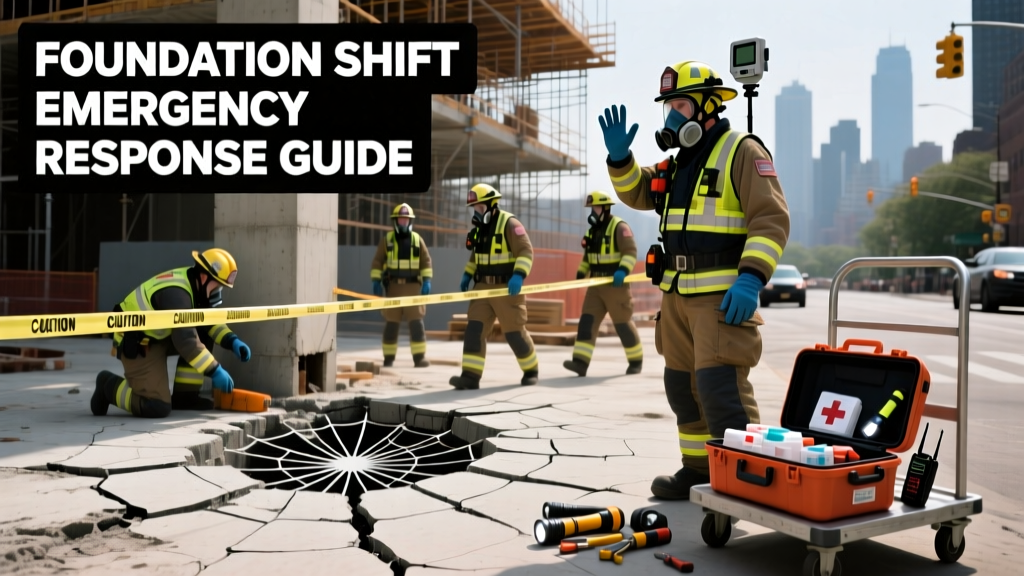
If you hear loud cracking, see doors jam shut, or notice sudden floor sloping—stop what you’re doing. Evacuate immediately if the shift feels active (e.g., grinding noises, visible wall separation, or stairway distortion). Do not wait for confirmation; your safety depends on speed, not diagnosis.
Immediate Actions
- Evacuate all occupants—especially children, elderly, and pets—to a safe outdoor location at least 50 feet from the structure.
- Shut off gas at the main valve only if you can do so safely and without re-entering the building. Do not use light switches, phones, or flames indoors.
- Call 911 from a safe distance if anyone is injured, trapped, or if gas smell is present.
- Do not attempt repairs, prop walls, or move heavy furniture—this risks triggering further movement.
When to Call 911 / When to Call a Pro
Call 911 immediately if:
- You smell natural gas (rotten egg odor) or hear hissing near gas lines;
- There’s a visible gap >½ inch between foundation and floor slab;
- Stairways are buckling, chimneys are leaning >2 inches, or exterior walls are bowing inward.
Call a licensed structural engineer or foundation specialist within 2 hours if:
- Cracks wider than ¼ inch appear in multiple load-bearing walls;
- Doors/windows stick on multiple levels simultaneously;
- Floors slope more than 1 inch per 10 feet (measure with a level and tape).
What NOT to Do
Avoid these high-risk actions:
- Entering the basement or crawl space—soil instability may cause collapse;
- Using power tools or jackhammers near cracked slabs;
- Ignoring small signs: According to the Insurance Institute for Business & Home Safety's 2023 report, 68% of catastrophic foundation failures began with unaddressed hairline cracks.
- Assuming ‘settling’ means ‘safe’—true settling occurs over years, not hours.
After the Emergency
Once cleared to re-enter by authorities or engineers, document everything before cleanup:
- Photograph all cracks, gaps, and distortions with timestamped geotags;
- Sketch a floor plan marking affected zones and measure crack widths with calipers;
- Save utility bills and soil moisture records—drought or flooding often precedes shifts;
- Contact your insurer before hiring contractors; some policies require pre-approval for stabilization work.
Is my home still safe to enter?
No—do not re-enter until cleared by a certified structural engineer or local building official. Even minor shifts can compromise load paths. The U.S. Department of Housing and Urban Development (HUD, 2022) reports that 41% of post-shift injuries occurred during unauthorized re-entry.
Can I fix this myself?
No. DIY jacking, mudjacking, or epoxy injection without engineering oversight violates ICC-ES AC358 standards and may void insurance. Licensed professionals use laser-level surveys and soil borings—not guesswork.
How fast does foundation shift happen?
It varies: slow shifts creep over months (often due to clay soil shrinkage), but emergency shifts occur in minutes—triggered by broken water lines, flash flooding, or seismic tremors. FEMA’s 2021 Hazard Mitigation Grant Program data shows 73% of urgent shifts followed pipe bursts or heavy rainfall within 48 hours.
What’s the difference between settlement and shift?
Settlement is uniform, vertical downward movement—common in new builds. Shift is lateral or rotational movement, causing diagonal cracks, uneven floors, and misaligned windows. It signals compromised bearing capacity, not just time-related compression.
Will my insurance cover this?
Most standard homeowner policies exclude gradual foundation damage—but may cover sudden, accidental causes like burst pipes or sinkhole collapse (if endorsed). Review your policy’s ‘earth movement’ exclusions and file a claim within 72 hours. Learn how to read your foundation coverage clause.
How do I find a qualified foundation specialist?
Verify state licensure, check for membership in the International Concrete Repair Institute (ICRI) or Foundation Repair Association (FRA), and ask for project-specific references—not just testimonials. Avoid firms offering ‘free inspections’ with no engineering credentials. See our contractor vetting checklist.
“A foundation shift isn’t a repair—it’s a structural event requiring forensic analysis. Skipping the engineer step is like treating a heart attack with aspirin alone.” — Dr. Lena Cho, P.E., Structural Engineering Fellow, American Society of Civil Engineers (2023)
Foundation Shift Risk Factors
Understanding triggers helps prioritize response. This table compares common causes by urgency and detectability:
| Cause | Timeframe | Key Warning Signs | Urgency Level |
|---|---|---|---|
| Burst water main under slab | Minutes to hours | Sudden wet spots, gurgling sounds, warm floor areas | Critical (evacuate + 911) |
| Severe drought (clay soil shrinkage) | Weeks to months | Horizontal cracks in brick veneer, door sticking only in summer | High (engineer within 48 hrs) |
| Heavy rainfall + poor drainage | Hours to days | Soil heaving at perimeter, basement seepage, leaning retaining walls | Immediate (evacuate if slope >1°) |
| Earthquake (even minor) | Seconds | Simultaneous cracking on multiple floors, fallen ceiling tiles, shifted cabinets | Critical (evacuate + 911) |
Stay calm—but act decisively. Foundation emergencies rarely escalate slowly once they begin. Your fastest, safest response is always evacuation first, assessment second. Compare crack patterns to identify severity once you’re clear of danger—and never delay professional evaluation. Lives and long-term structural integrity depend on it.