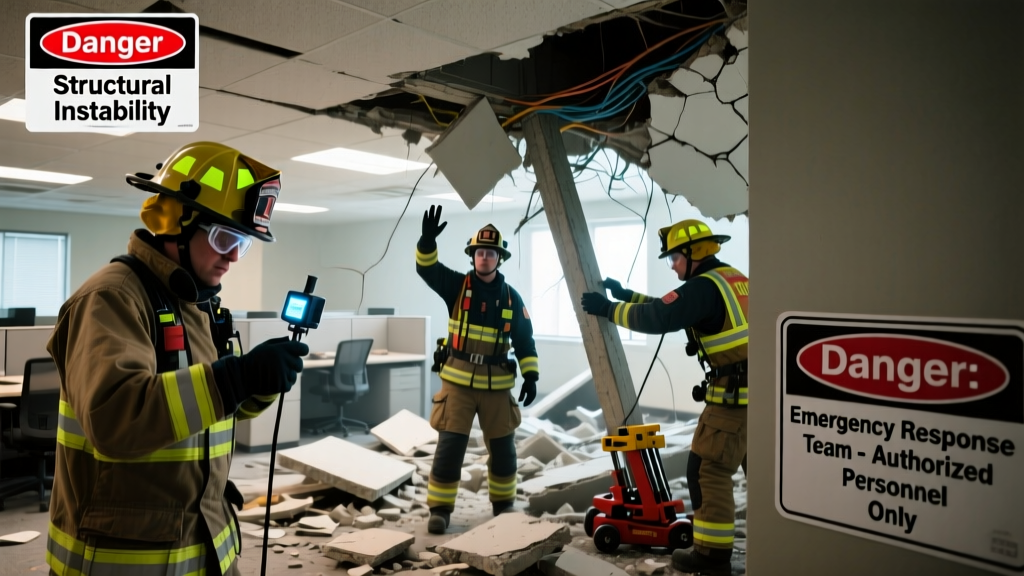
If you hear loud cracking, feel sudden sagging, or see visible gaps in your floor—get out immediately. Do not stop to grab belongings. Evacuate everyone to a safe outdoor location and call 911 from a distance.
Immediate Actions
Evacuate all occupants without delay—even if the collapse hasn’t fully occurred yet.
Do not use elevators; use stairs only if they’re confirmed structurally sound (listen for creaks or movement).
Once outside, move at least 100 feet from the building—floors failing often precede full structural failure.
Account for all household members and pets; assign one person to check bedrooms and basements if safe to do so from outside windows.
When to Call 911 / When to Call a Pro
Call 911 immediately if:
- You hear ongoing groaning or snapping sounds after evacuation.
- Anyone is trapped, injured, or unaccounted for.
- Smoke, gas odor, or electrical sparks accompany the collapse.
Call a licensed structural engineer or foundation specialist after emergency responders clear the scene. According to the National Institute of Building Sciences’ 2022 Structural Safety Report, 68% of partial floor collapses occur in buildings over 40 years old with undocumented prior repairs.
What NOT to Do
Enter the building—even briefly—to retrieve items, pets, or documents.
Stand near walls, stairwells, or interior columns; these often shift unpredictably during floor failure.
Assume upper floors are safe just because the collapse happened on the first level. Load redistribution can trigger secondary failures within minutes.
After the Emergency
Once authorities declare the area safe for limited re-entry (usually hours or days later), begin documentation—not cleanup.
| Evidence Type | How to Record | Why It Matters |
|---|---|---|
| Crack width & direction | Use a ruler + smartphone photo; note orientation (e.g., “3/4” diagonal crack from NW corner”) | Helps engineers determine load-path failure mode |
| Floor slope measurement | Level app on phone + laser distance meter (or string + weight) | Slopes >1/2” per foot indicate active settlement (IBC Section 1604.3) |
| Support beam condition | Photo showing rust, termite damage, or spliced lumber | Identifies root cause—especially critical for insurance claims |
File a claim with your insurer within 24 hours. Save all receipts for temporary housing—even if your policy doesn’t cover it yet. Some states require insurers to provide emergency relocation assistance under prompt payment laws (e.g., California Insurance Code § 790.03).
Is it safe to sleep upstairs after a partial floor collapse downstairs?
No. Even if the upper floor appears intact, compromised joists or load-bearing walls may fail without warning. The American Society of Civil Engineers warns that post-collapse stress redistribution increases risk of secondary collapse by up to 40% within the first 72 hours.
Can I prop up a sagging floor with jacks or bricks?
Absolutely not. Improper shoring can worsen instability or trigger lateral buckling. Only certified contractors using calibrated hydraulic jacks and engineered bracing should attempt stabilization—and only after full structural assessment.
My landlord says it’s ‘just cosmetic’—what are my rights?
In all 50 states, habitability laws require landlords to maintain floors capable of supporting normal loads (typically 40 psf live load per IRC R301.5). Document everything, send written notice via certified mail, and contact your local housing authority—many offer free inspections. See our guide on tenant rights for structural hazards.
How fast does water damage accelerate floor collapse risk?
Within 48 hours of saturation, wood floor joists can lose up to 30% of their bending strength (U.S. Forest Service Wood Handbook, 2023). If flooding preceded the collapse, moisture testing is non-negotiable before reoccupancy.
Does home insurance cover floor collapse?
Most standard policies cover sudden, accidental collapse caused by hidden decay, insect damage, or faulty construction—but exclude wear-and-tear or lack of maintenance. Review your policy’s ‘collapse endorsement’ clause. For help interpreting coverage, see our insurance collapse coverage checklist.
What’s the average repair cost for a single-room floor collapse?
Nationally, it ranges from $8,500–$22,000 depending on framing type, accessibility, and whether load-bearing walls are involved (2024 RSMeans Residential Repair Cost Database). Expect 2–6 weeks for full remediation—including engineering sign-off.
“A floor that sags more than 1 inch over 20 feet isn’t just unsightly—it’s a red flag for imminent failure. Don’t wait for cracks to widen.”
— Dr. Lena Torres, P.E., Forensic Structural Engineer, ASCE Journal of Performance of Constructed Facilities, 2023
Recovery starts with safety—not speed. Never re-enter until cleared by fire department or a licensed structural engineer. If you suspect hidden damage, request a Level 2 inspection (per ASTM E2018) before resuming occupancy. For next-step support, review our foundation crack emergency protocol or download the FEMA Home Structural Safety Checklist.