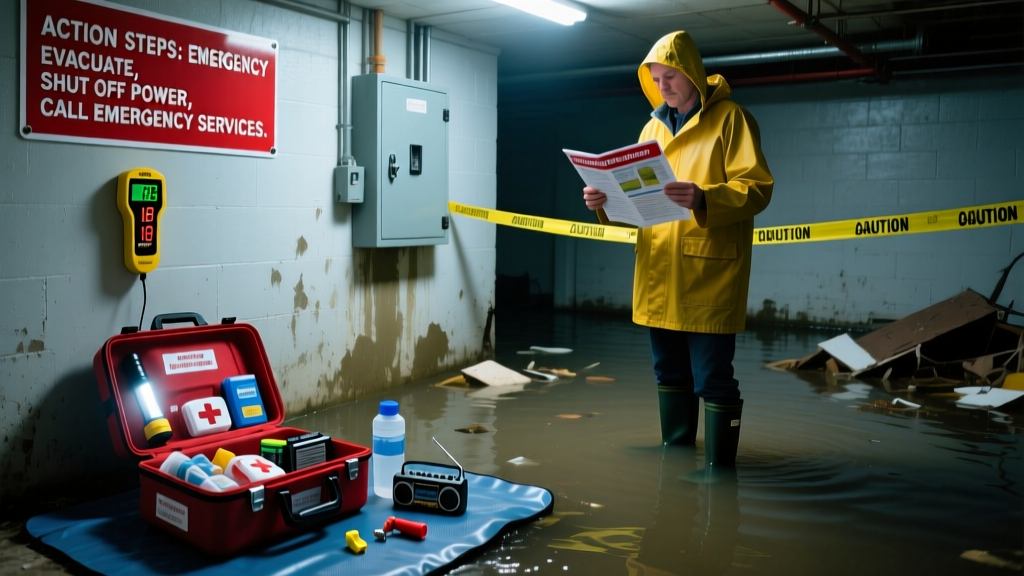
Water rising in your basement is an urgent threat — not just to property, but to life. If water is entering rapidly or electrical outlets are submerged, do not wait. Your first action: get everyone out and stay clear of standing water near outlets, sump pumps, or the main panel.
Immediate Actions
- Evacuate immediately if water is knee-deep or rising fast — especially with children, elderly, or mobility issues.
- Shut off electricity at the main breaker — but only if you can reach it without stepping in water. Never stand on a wet floor to flip a switch.
- Turn off natural gas if you smell rotten eggs (mercaptan) or hear hissing — then leave and call 911 from outside.
- Call your local utility company to report possible gas leaks or downed lines near your home.
When to Call 911 / When to Call a Pro
Call 911 immediately if:
- Someone is trapped or injured by floodwater,
- You smell gas or see sparks near electrical panels,
- Water is rising faster than 1 inch per minute (e.g., from broken municipal line or failed sump pump).
Call a licensed water damage restoration pro within 24 hours if:
- Water depth exceeds 2 inches,
- Flooding lasts longer than 48 hours,
- You suspect sewage contamination (brown/black water, foul odor).
According to the Insurance Institute for Business & Home Safety's 2023 report, homes with water damage remediated within 24–48 hours avoid 70% of mold-related claims.
What NOT to Do
- Do NOT use extension cords, appliances, or light switches while standing in or near floodwater.
- Do NOT enter the basement if the main electrical panel is underwater — even if power appears off.
- Do NOT attempt to pump water out while power is still on or if the exterior ground is saturated (risk of foundation collapse).
- Do NOT drink tap water until cleared by local authorities — flooding often contaminates municipal supply lines.
"Standing floodwater over 6 inches deep carries electrocution risk from hidden live wires — and every additional inch doubles drowning risk for adults over 65." — National Weather Service Flood Safety Guidelines, 2022
After the Emergency
Once it’s safe to re-enter, begin documentation and mitigation — but only after confirming power and gas are off and structural integrity is verified.
| Item | Check For | Action Required |
|---|---|---|
| Walls & Floor | Cracks, bulging, efflorescence (white chalky residue) | Foundation crack repair|
| Electrical Panel | Corrosion, rust, water stains inside cabinet | Licensed electrician inspection|
| Water Heater | Rust at base, warped insulation, gas valve submersion | Replacement required if submerged >6 inches|
| Insulation | Wet fiberglass, soaked cellulose, mold growth | Remove and replace — never dry in place
Photograph everything before cleanup — including timestamps and wide-angle shots showing water level marks on walls. File a claim with your insurer within 72 hours; most policies require prompt reporting to cover contents loss.
Is my flooded basement covered by insurance?
Standard homeowners policies exclude flood damage — including sewer backups and groundwater seepage. You need a separate NFIP or private flood policy. Renters should know their landlord’s policy won’t cover personal belongings. See what’s covered and how to file.
How long does it take to dry out a flooded basement?
Professional drying takes 3–5 days for clean water (Category 1), but up to 10+ days for gray water (e.g., washing machine overflow) or black water (sewage). Moisture meters must read ≤15% moisture content in concrete before rebuilding — rushing leads to hidden mold behind drywall.
Can I clean up sewage-contaminated water myself?
No. The U.S. EPA estimates that 1 in 4 basement floods involve Category 3 (black) water — carrying E. coli, hepatitis A, and leptospirosis. Only certified IICRC technicians with PPE and antimicrobial fogging equipment should handle it.
Why did my sump pump fail during heavy rain?
Common causes include power outage (42% of failures), clogged discharge line (31%), or float switch jamming (19%). Install a battery backup sump pump — they operate for up to 54 hours during outages, per Consumer Reports testing, 2023.
When is it safe to re-enter the basement?
Only after a qualified inspector confirms: (1) electrical system is de-energized and dry, (2) gas lines are pressure-tested, (3) air quality tests show mold spores <500 spores/m³, and (4) structural engineer clears load-bearing walls. Don’t rely on smell alone — invisible mold thrives behind drywall at 40% RH.
Every minute counts when water rises — but rushing unsafe decisions multiplies risk. Prioritize human safety over possessions, document thoroughly, and partner with certified pros for recovery. If your neighborhood floods repeatedly, explore exterior drainage upgrades and backwater valve installation before the next storm hits.