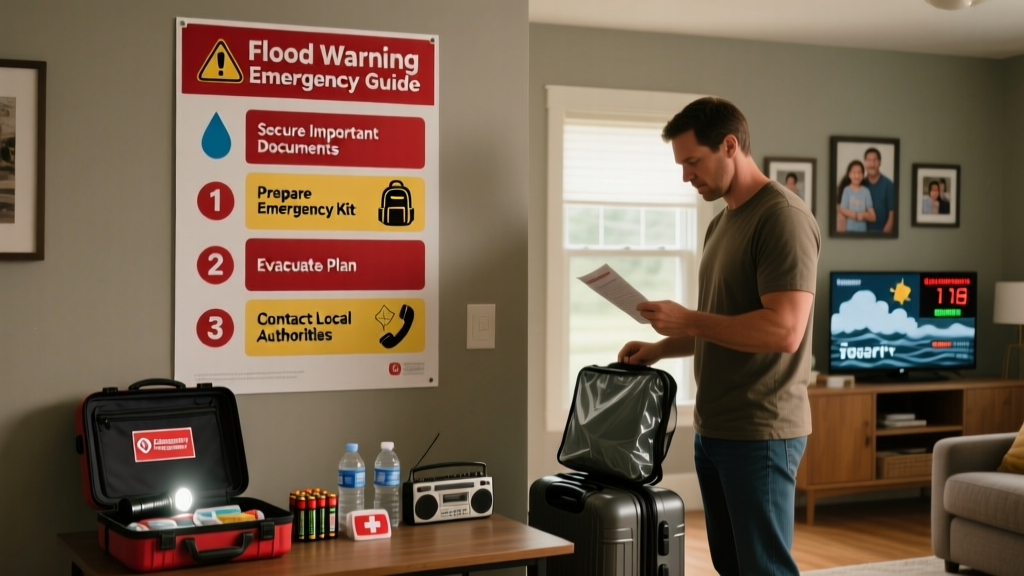
Water is rising — now. If you’ve received a flood warning from the National Weather Service or local emergency management, act within minutes. Your first move: move to higher ground *immediately* if flooding is imminent or already visible near your home.
Immediate Actions
- Turn off electricity at the main breaker *only if dry and safe to reach* — never step in standing water near outlets or panels.
- Gather your emergency kit: medications, ID, phone charger, cash, pet supplies, and one change of dry clothes per person.
- Move valuables and electronics to upper floors — but only if water hasn’t entered the building and stairs are dry and secure.
- Secure outdoor furniture, grills, and trash cans — these become dangerous projectiles in fast-moving floodwater.
- Text or call loved ones to confirm your location and status — avoid voice calls unless urgent (cell networks overload quickly).
When to Call 911 / When to Call a Pro
Floods escalate fast — knowing who to contact, and when, saves lives.
- Call 911 immediately if: someone is trapped, injured, or swept away; water is rising faster than you can evacuate; or you smell gas after floodwater enters your home.
- Call a licensed flood restoration contractor (not 911) if: water has receded but left >1 inch of standing water indoors; drywall or insulation is soaked; or mold risk is high (visible discoloration or musty odor within 24–48 hours).
According to the Federal Emergency Management Agency’s Flood Response Playbook (2023), over 75% of flood-related fatalities occur in vehicles — never drive through flooded roadways, even if water looks shallow.
What NOT to Do
- Do not walk, swim, or drive through floodwater — just 6 inches can knock you down; 12 inches can carry away most cars.
- Do not use generators, grills, or camp stoves indoors or in garages — carbon monoxide poisoning causes ~430 U.S. deaths annually (CDC, 2022).
- Do not drink tap water until authorities issue a boil-water advisory lift — floodwater commonly contaminates municipal systems.
- Do not enter a flooded basement — electrical hazards and structural instability make it extremely high-risk.
"If you can't see the road, you can't see the danger." — National Weather Service Flood Safety Campaign, 2024
After the Emergency
Once water recedes and authorities declare the area safe to re-enter, prioritize health, documentation, and structural integrity.
| Time Since Water Recession | Action Required |
|---|---|
| Within 24 hours | Photograph all damage (walls, floors, appliances, personal items) with timestamps. Open windows/doors for ventilation if weather permits. |
| 24–48 hours | Remove wet rugs, furniture cushions, and drywall baseboards. Discard porous materials soaked >48 hours (carpet padding, insulation, particleboard). |
| 3–5 days | Hire an IICRC-certified water restoration firm for moisture mapping and microbial testing. File insurance claim with photos and receipts. |
Is my home’s electrical system safe to turn back on?
No — never restore power yourself. Licensed electricians must inspect panels, outlets, and wiring for corrosion and short-circuit risk. The U.S. Consumer Product Safety Commission reports that 22% of post-flood electrocutions happen during attempted DIY power restoration.
Can I clean up mold myself?
Only if the affected area is smaller than 10 square feet and the water was clean (e.g., broken pipe). For Category 2 (gray water) or Category 3 (black water, like river or sewage flood), hire professionals — EPA guidelines require HEPA filtration and containment.
How do I know if my well water is safe?
Test it. Floodwater infiltration introduces bacteria, nitrates, and heavy metals. Contact your state’s health department for certified lab testing — do not rely on taste, smell, or clarity. The CDC advises boiling water for one minute before use until test results confirm safety.
Will my homeowner’s insurance cover flood damage?
Standard policies exclude flood damage. You need a separate flood insurance policy through the National Flood Insurance Program (NFIP) or a private carrier. Note: Most policies have a 30-day waiting period — don’t wait for warnings to buy.
What should I do about my HVAC system?
Turn it off at the thermostat and main disconnect. Floodwater in ductwork or condensate pans breeds mold and bacteria. A certified HVAC technician must inspect and clean or replace components — especially the air handler and evaporator coil. According to ASHRAE Standard 180-2022, systems exposed to Category 2+ water require full replacement of insulation and filter housings.
How soon can I rebuild or repair walls and flooring?
Not until moisture readings fall below 15% for wood framing and 2% for concrete slabs — verified with professional meters. Rushing repairs traps moisture, leading to rot and mold recurrence. Use moisture meters and consult a structural engineer before replacing load-bearing walls or subfloors.
If your area is under a flash flood watch or warning, sign up for real-time alerts via Wireless Emergency Alerts (WEA) and download your county’s emergency app. Every minute counts — but preparation cuts response time by up to 60%, per the National Institute of Building Sciences’ 2023 Resilience Report.