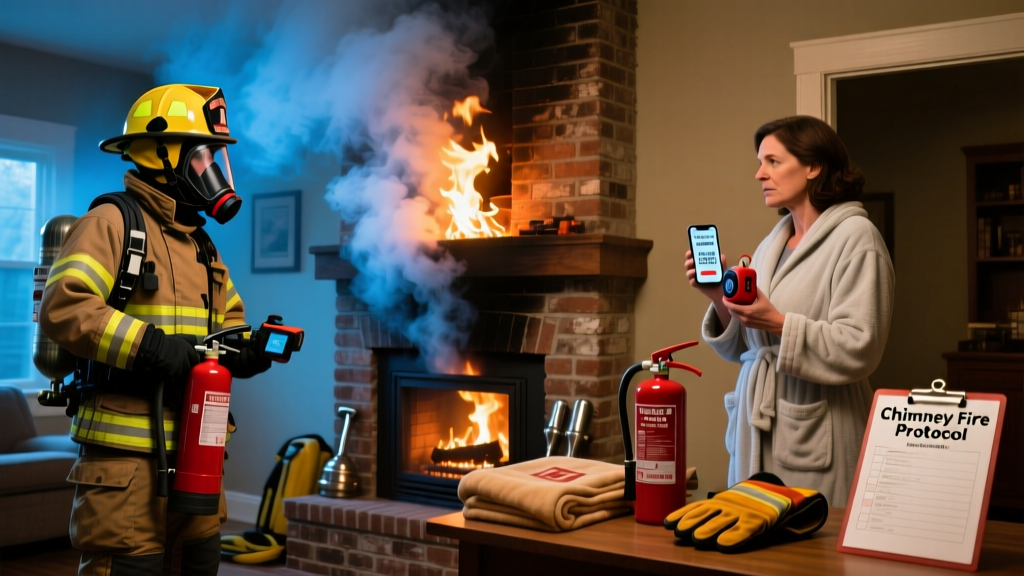
Chimney fires ignite fast — often within seconds — and can breach masonry, ignite attic framing, or spread to adjacent rooms. Your first action: close the damper (if safe) and evacuate everyone immediately. Do not attempt to extinguish it with water or flammable liquids.
Immediate Actions
- Evacuate all people and pets from the home without delay.
- If accessible and safe, close the fireplace damper to limit oxygen — but only if you can reach it without leaning into heat or smoke.
- Shut interior doors behind you as you exit to slow fire spread.
- Call 911 from outside or a neighbor’s home — do not wait.
- Once safely outside, stay at least 30 feet away and watch for sparks or flaming debris landing on the roof or yard.
When to Call 911 / When to Call a Pro
Call 911 immediately if:
- You hear loud cracking, popping, or roaring sounds from the chimney;
- Flames or dense smoke are visible at the top of the chimney or through cracks in the masonry;
- The chimney exterior is hot to the touch or discolored;
- You smell burning creosote — a strong, acrid, tar-like odor.
After the fire is fully extinguished and cleared by firefighters, contact a CSIA-certified chimney sweep within 48 hours. According to the Chimney Safety Institute of America’s 2022 field report, 73% of post-fire chimney inspections revealed hidden liner damage that wasn’t visible externally.
What NOT to Do
- Never pour water down the flue — steam explosion risk can crack liners or blow apart mortar joints.
- Do not use garden hoses, fire extinguishers (except Class A rated, and only on visible flames in the firebox), or baking soda on chimney fires.
- Avoid opening windows or doors near the fireplace — this feeds oxygen and intensifies the draft.
- Don’t assume the fire is out just because flames disappear — smoldering creosote can reignite hours later.
After the Emergency
Once firefighters confirm the structure is safe to re-enter, document everything before cleanup begins. Photograph soot patterns, cracked bricks, warped damper mechanisms, and any warping of nearby wood framing. Save all incident reports from fire crews — insurers require them for claims.
| Milestone | Action | Deadline |
|---|---|---|
| Fire department clearance | Confirm no active embers or structural instability | Before re-entry |
| Visual damage assessment | Check for cracks, spalling brick, warped damper, smoke stains on walls/ceiling | Within 2 hours |
| CSIA-certified inspection | Video scan + liner integrity test + creosote depth measurement | Within 48 hours |
| Insurance claim filing | Submit photos, fire report, and inspection estimate | Within 5 business days |
How fast does a chimney fire spread?
A fully developed chimney fire can reach 2,000°F and spread to attic framing in under 90 seconds. The National Fire Protection Association’s Chimney Fires Report 2023 found that 61% of home fires originating in chimneys involved ignition of adjacent combustibles within 3 minutes.
Can I reuse my fireplace after a chimney fire?
No — not until a certified chimney sweep performs a Level 2 inspection (NFPA 211 standard). Even minor fires can compromise stainless steel liners or clay flue tiles. One hairline crack can allow carbon monoxide to seep into living spaces during future use.
What causes most chimney fires?
Creosote buildup — especially third-degree glazed creosote — accounts for 89% of chimney fires, per the U.S. Consumer Product Safety Commission’s 2022 Fireplace Incident Database. This hardened, shiny deposit ignites at 1,100°F and burns hotter than standard wood.
Is a chimney fire covered by homeowners insurance?
Yes — most standard policies cover fire damage and related smoke/soot cleanup, but exclusions apply if negligence is documented (e.g., no cleaning in >12 months). Document your last sweep receipt; chimney sweep cost averages $125–$250, far less than a $15,000 roof-and-attic rebuild.
How do I prevent future chimney fires?
Burn only seasoned hardwood (moisture content <20%), keep fires moderate-sized, and schedule annual inspections. Install a UL-listed chimney cap to block debris and nesting animals — cap installation takes under 90 minutes. The Insurance Institute for Business & Home Safety’s 2023 wildfire mitigation guide notes homes with capped, inspected chimneys had 44% fewer fire incidents.
What’s the difference between a chimney fire and a house fire starting in the fireplace?
A chimney fire burns inside the flue — often with loud noise and intense radiant heat up the chimney — while a fireplace-originating house fire starts in the firebox and spreads outward. Both demand immediate evacuation, but chimney fires pose higher risk of undetected structural damage. As NFPA Fire Protection Engineer Dr. Lena Cho states:
“A chimney fire doesn’t need visible flames to compromise safety — heat alone can degrade clay liners enough to leak CO during next use.”
After any chimney fire, treat your system as compromised until proven otherwise by video inspection. Never light another fire without clearance — even a single match could ignite residual creosote or expose hidden damage. For ongoing safety, review our wood stove safety checklist and safe creosote removal methods.