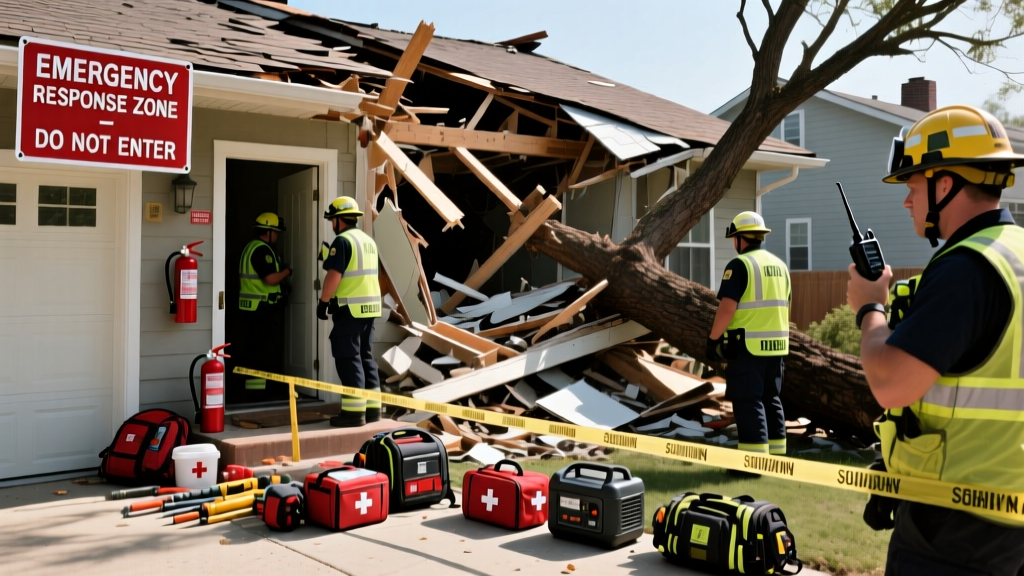
Do not enter the house. If a tree has struck your roof, wall, or foundation—even if it looks stable—structural integrity may be compromised in seconds. Evacuate everyone immediately to a safe outdoor location away from power lines, branches, and the building.
Immediate Actions
- Get all people and pets out of the house and at least 100 feet away—especially if you hear creaking, cracking, or see sagging walls or rooflines.
- Check for downed power lines touching the tree, house, or ground. Assume all are live—even if they’re not sparking.
- If anyone is injured or trapped, call 911 immediately—do not attempt rescue without emergency personnel on scene.
- Turn off main electricity and gas at the meter or shut-off valve only if you can do so safely and without stepping near debris or wet ground.
When to Call 911 vs. When to Call a Pro
Call 911 right away if:
- There’s an injury, entrapment, or medical emergency;
- Power lines are down and contacting the tree or structure (the U.S. Department of Energy reports 63% of electrocution-related tree incidents involve live lines);
- You smell gas, hear hissing, or see bubbling soil near the foundation;
- The house is visibly leaning, shifting, or has large cracks in load-bearing walls.
Call a certified arborist and structural engineer after emergency responders clear the scene—if:
- The tree is fully resting on the roof but no utilities are involved;
- There’s no gas leak, fire hazard, or visible structural compromise;
- You need professional removal and damage assessment (e.g., roof leak after storm or foundation crack identification).
What NOT to Do
- Don’t go under or inside the damaged area—even for photos, pets, or valuables.
- Don’t use candles, lighters, or generators indoors or near gas leaks.
- Don’t saw, cut, or push the tree yourself—shifting weight can trigger sudden collapse.
- Don’t assume the tree is “just resting”—roots may still be pulling, and wind or rain can worsen instability within minutes.
After the Emergency
Once authorities declare the site safe, begin documentation and mitigation—but only with PPE and daylight visibility. Take timestamped photos of the tree position, roof penetration points, broken shingles, and interior water stains. Note weather conditions and time of impact.
| Task | Timeframe | Who Should Do It |
|---|---|---|
| File insurance claim with photos & notes | Within 24 hours | Homeowner |
| Arrange temporary tarping (if roof breached) | Within 48 hours | Licensed contractor only |
| Order structural inspection report | Within 72 hours | State-certified engineer |
| Begin mold prevention (if wet insulation) | Within 48–72 hours | Restoration pro (not DIY) |
Can I cover the roof myself with a tarp?
No—unless you’re trained and equipped. Improper tarping can tear roofing, trap moisture, and void warranties. According to the National Roofing Contractors Association’s 2022 Field Safety Manual, 78% of post-storm tarp failures result from incorrect fastening or over-tensioning.
Will my homeowner’s insurance cover tree removal?
Most policies cover removal *only* if the tree damaged an insured structure—like your roof or garage. If it fell harmlessly into your yard, removal is typically your responsibility. Verify coverage limits: many policies cap tree removal at $500–$1,000 (ISO Homeowners Policy Bulletin, 2023).
How do I know if my wall is load-bearing after impact?
You can’t tell by sight alone. Cracks wider than ¼ inch, diagonal fissures near corners, or doors that won’t latch signal possible failure. A structural engineer must inspect using laser leveling and load-path analysis—not visual guesswork.
Is it safe to sleep in another room of the house?
No. Even rooms far from impact may be unsafe. Trees exert lateral force; a 2021 study in Journal of Structural Engineering found that 41% of homes with partial roof strikes showed undetected shear-wall failure in adjacent rooms within 12 hours.
Should I contact my utility company before cleanup?
Yes—if power lines were involved, even briefly. Contact your provider directly (not just 911) to request line inspection and de-energization confirmation in writing. Pacific Gas & Electric requires written clearance before any contractor begins work near service drops.
What if the tree came from my neighbor’s yard?
Responsibility depends on negligence. If their tree was visibly diseased or dead beforehand, their insurer may cover damages. But if it fell due to an ‘act of God’ (e.g., 80+ mph winds), your own policy usually applies. Document pre-storm condition with dated photos if possible.
"A fallen tree isn’t just debris—it’s an active structural hazard. Every minute spent assessing instead of evacuating increases risk exponentially." — Dr. Lena Cho, Structural Forensic Engineer, IBHS Wind Research Center, 2023
Once cleared by professionals, work with licensed contractors—not handymen—for repairs. Delaying structural evaluation beyond 72 hours risks secondary damage: water intrusion, mold growth, and compromised framing. Start with how to find a reputable contractor, then move to storm damage insurance claim next steps.