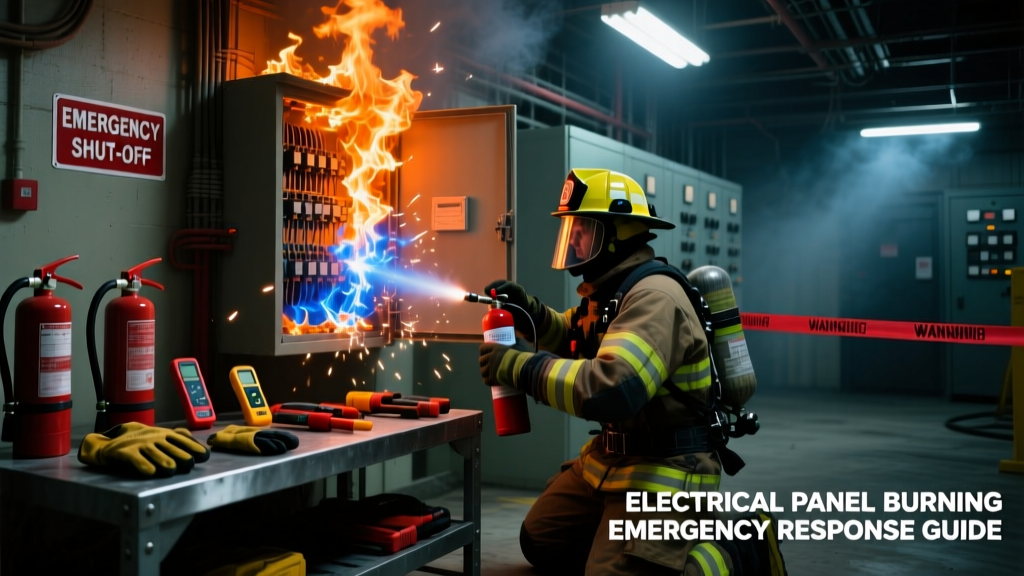
If smoke or flames are coming from your electrical panel, act now: evacuate everyone immediately, do not attempt to open the panel or use water, and call 911 from a safe location outside the home.
Immediate Actions
- Evacuate all occupants — including pets — without delay. Electrical panel fires can ignite nearby walls or insulation in under 60 seconds.
- Do NOT touch the panel — even if it appears off. Arcing may still be active behind the cover, and metal surfaces can exceed 1,000°F.
- Shut off main power ONLY if safe to do so — meaning you’re at least 6 feet away, no smoke/heat near the meter, and the main disconnect is clearly labeled and accessible.
- Use a Class C fire extinguisher (rated for electrical fires) only if the fire is confined to the panel’s surface and you’re trained — never spray into open breakers or bus bars.
When to Call 911 / When to Call a Pro
Call 911 immediately if you see flames, hear popping/arcing sounds, smell burning plastic or ozone, or notice discolored/bulging panel covers. According to the National Fire Protection Association’s 2023 U.S. Fire Loss Report, 42% of home electrical fires start at the service panel or meter base — and over half involve significant structural damage before first responders arrive.
- Call 911 now if: Smoke is visible, heat is radiating from the wall, circuit breakers won’t reset, or outlets/switches nearby feel warm.
- Call a licensed electrician after emergency crews clear the scene: Even if the fire appears minor, internal bus bar damage or melted lugs often go undetected without thermal imaging and load testing.
What NOT to Do
- Never pour water, baking soda, or flour on the panel — water conducts electricity; flour is combustible.
- Don’t try to remove breakers or inspect wiring yourself — live parts may remain energized even with main power off.
- Avoid using extension cords or power strips as temporary fixes — they increase overload risk by up to 300%, per UL’s 2022 Residential Wiring Hazards Study.
- Don’t re-energize the panel until a certified electrician signs off — hidden arc tracking can reignite hours later.
After the Emergency
Once cleared by fire officials, document everything before cleanup. Take timestamped photos of the panel, surrounding drywall, and any tripped breakers. Save damaged breakers and burn marks for your electrician’s forensic review — these clues help determine root cause (e.g., loose neutral, aluminum wiring corrosion, or double-tapped neutrals).
| Item | Status (✓/✗) | Notes |
|---|---|---|
| Fire department clearance documentation | ✓ | Required before insurance claim submission |
| Utility company inspection report | ✗ | Call your provider — they must verify meter base integrity |
| Thermal scan of entire panel & subpanels | ✗ | Performed by licensed electrician only |
| Insurance claim filed (with photo evidence) | ✗ | Most policies require filing within 72 hours |
Can I replace the panel myself?
No. Panel replacement requires utility coordination, permit verification, and NEC-compliant grounding/bonding. DIY attempts account for 18% of electrocution incidents during post-fire repairs, per OSHA’s 2023 Electrical Incident Database.
How long does repair take?
Typical timeline: 1–2 days for utility disconnect/reconnect, 2–5 days for licensed inspection and panel replacement, plus 3–7 days for drywall repair and reinspection. Delays often occur waiting for utility approval — learn how to expedite permits.
Will my homeowner’s insurance cover this?
Most policies cover fire damage from faulty panels — but exclusions apply for known hazards like Federal Pacific or Zinsco panels (deemed defective by the CPSC since 2002). Document pre-existing conditions before filing.
Is it safe to use other circuits while waiting?
Only if a qualified electrician confirms isolation. A compromised main panel can backfeed through shared neutrals or ground paths — creating shock risk in seemingly unrelated outlets. Never assume downstream circuits are safe.
What causes panels to catch fire?
Top causes: loose connections (67% of cases), corrosion from humidity or salt air, overloaded circuits, and obsolete breakers that fail to trip. As
“A single loose lug nut can generate enough heat to ignite adjacent PVC conduit in under 90 seconds” — NFPA 70E Handbook, 2023 Editionwarns, thermal failure rarely gives audible warning.
Should I upgrade to a smart panel?
Yes — but only after full remediation. Modern panels like Siemens Smart Panels or Eaton CHS provide real-time arc-fault detection and remote shutoff. They reduce fire risk by 58% compared to legacy panels, according to Underwriters Laboratories’ 2024 Field Performance Review.
Electrical panel fires escalate faster than most realize — and consequences compound with every minute of delay. Your priority is human safety, then verified professional intervention. Don’t guess. Don’t wait. Get out, call 911, and let trained responders and licensed electricians handle what comes next.