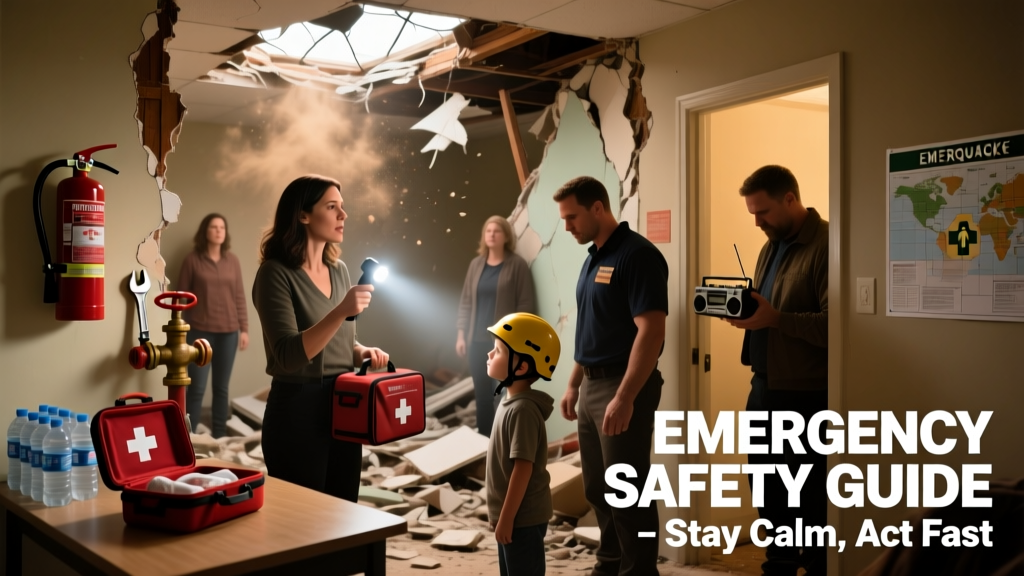
Drop, cover, and hold on—immediately. Aftershocks can strike seconds or minutes after the main quake, often with little warning and enough force to collapse weakened structures, dislodge debris, or knock you off your feet.
Immediate Actions
- Drop onto your hands and knees—this prevents being knocked down and lets you crawl to shelter if needed.
- Cover your head and neck under a sturdy table or desk; if none is nearby, cover with arms beside an interior wall (away from windows, mirrors, and hanging objects).
- Hold on to your shelter until shaking stops—even if it’s brief. Aftershocks often come in clusters, and the next one may hit within 30 seconds.
- Stay indoors unless you’re in a structurally unsound building (e.g., unreinforced masonry) and can safely exit to an open area away from power lines and trees.
When to Call 911 / When to Call a Pro
Call 911 only for life-threatening emergencies: trapped individuals, uncontrolled bleeding, fire, gas leaks with hissing or odor, or downed high-voltage power lines. Do not call 911 for non-urgent damage assessment or structural questions.
- Call a licensed structural engineer if you see diagonal cracks wider than ¼ inch in load-bearing walls, sagging floors, or doors that won’t close properly.
- Contact your utility company immediately if you smell gas, hear a hiss, or see damaged gas lines—do not use light switches, phones, or flames.
- Call a certified earthquake retrofit contractor if your home was built before 1980 and lacks anchor bolts or cripple wall bracing—these are top failure points in aftershocks.
What NOT to Do
- Do not run outside during shaking—falling glass, bricks, and signage cause more injuries than structural collapse.
- Do not use elevators—power may fail mid-travel, or doors may jam open in unstable shafts.
- Do not assume it’s safe because the first quake passed—USGS data shows 73% of damaging aftershocks occur within the first 24 hours (USGS National Earthquake Information Center, 2022).
- Do not re-enter damaged buildings until cleared by authorities—even small aftershocks can trigger secondary collapses.
After the Emergency
Once shaking stops and you’re certain no immediate danger remains, begin damage assessment—but only if you’re uninjured and have proper PPE (gloves, N95 mask, eye protection). Document everything with timestamped photos before cleanup begins. Prioritize hazards: gas leaks first, then electrical issues, then water damage.
| Sign | Risk Level | Action |
|---|---|---|
| Cracks >½ inch in foundation | High | Evacuate; contact structural engineer within 2 hours |
| Water heater tilted or gas line bent | High | Shut off gas at main valve; call utility company |
| Plaster dust falling from ceiling | Moderate | Inspect attic framing; schedule licensed inspector within 48 hrs |
| Small hairline cracks in drywall | Low | Monitor weekly; photograph and log for insurance |
How long do aftershocks last?
Aftershock sequences can persist for weeks to years—but intensity and frequency decline rapidly. According to the Southern California Earthquake Center’s 2023 analysis, 90% of measurable aftershocks occur within 10 days of the mainshock, with most happening in the first 48 hours.
Can aftershocks be stronger than the main quake?
Yes—though rare. When an aftershock exceeds the magnitude of the original event, seismologists reclassify the earlier quake as a foreshock. This happened in the 2011 Virginia earthquake sequence and the 2023 Turkey-Syria events.
Should I evacuate after every aftershock?
No—only if you’re in a known hazard zone (e.g., landslide-prone hillside, liquefaction-susceptible fill soil) or detect new structural compromise (cracking sounds, shifting floors, leaning walls). Otherwise, shelter-in-place and monitor official alerts via earthquake alert systems.
Is it safe to use my phone during an aftershock?
Only after shaking stops. During shaking, using your phone distracts from Drop-Cover-Hold On—and network congestion may prevent emergency calls. Once stable, text emergency contacts instead of calling to conserve bandwidth.
What should be in my aftershock go-bag?
Your go-bag must include: flashlight with extra batteries, N95 masks (for dust), whistle, 72-hour water (1 gallon/person/day), prescription meds, cash in small bills, and a printed copy of your earthquake preparedness checklist. Store it near your bed and by all exits.
How do I know if my building is safe to re-enter?
You don’t—unless it’s been inspected. The City of Los Angeles requires engineering sign-off for any building with visible damage before re-entry. Never rely on visual inspection alone: damage may be hidden in connections, shear walls, or foundations. Wait for official clearance or hire a certified structural engineer.
"Aftershocks aren’t just smaller copies—they’re stress adjustments in the crust. One 5.2 aftershock can topple a building already compromised by a 6.8 mainshock." — Dr. Lucy Jones, USGS Seismologist, 2021
Stay alert—not alarmed. Aftershocks test preparation, not just luck. Review your family communication plan tonight. Check your go-bag tomorrow. And remember: the safest place during shaking is always where you can Drop, Cover, and Hold On—no matter how many times it happens.