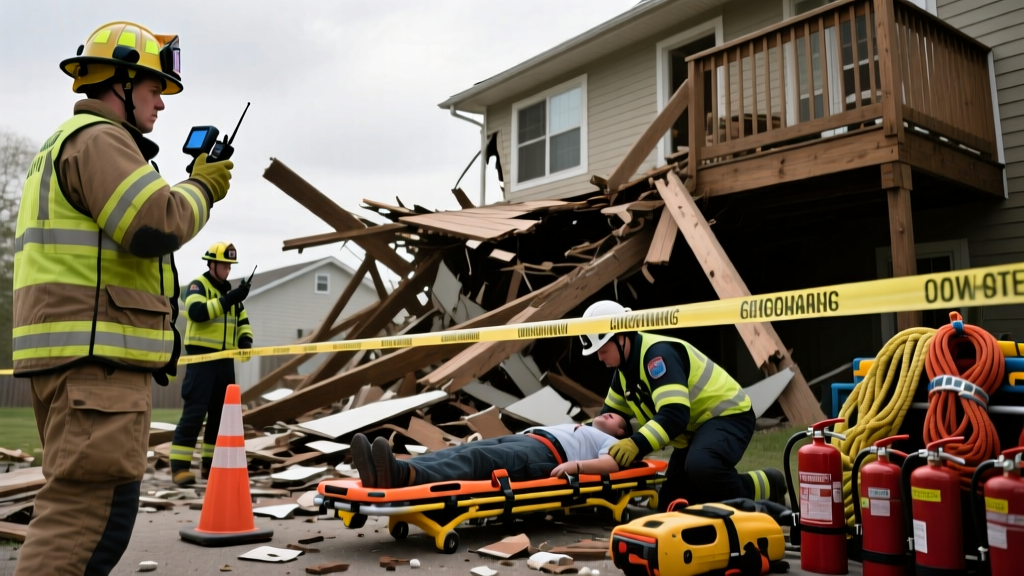
If your deck collapses—or you hear loud cracking, groaning, or sudden sagging—get everyone off it immediately. Do not wait to confirm danger. Move at least 20 feet away from the structure and account for all people and pets.
Immediate Actions
- Evacuate everyone—including pets—from the deck and adjacent areas (porch roofs, patios, windows below).
- Check for injuries without re-entering unstable zones; use voice calls first, then visual scan from a safe distance.
- Shut off nearby utilities if gas lines, electrical conduits, or irrigation pipes are exposed or damaged (e.g., cut-off valve near foundation).
- Mark the perimeter with rope or cones at least 15 feet out—deck debris can shift or drop unexpectedly for hours.
When to Call 911 / When to Call a Pro
Call 911 immediately if:
- Someone is trapped, unconscious, bleeding heavily, or unable to move;
- You smell natural gas (rotten egg odor) or see sparks/flickering lights near the collapse zone;
Call a licensed structural engineer or certified deck inspector within 24 hours if no injuries occurred but the deck failed under normal load (e.g., 3–4 adults, light furniture). According to the American Society of Civil Engineers’ 2022 Infrastructure Report Card, 44% of U.S. decks over 10 years old have undocumented fastener corrosion or ledger board separation—both silent precursors to sudden failure.
What NOT to Do
- Do not step onto or near collapsed decking—even partially intact sections may be stressed beyond capacity.
- Do not attempt DIY stabilization (e.g., propping with lumber or jacks); this risks further collapse and voids insurance claims.
- Do not let children or pets near the area—even after cleanup begins. Hidden nails, splintered framing, and unstable footings remain hazardous.
After the Emergency
Once cleared by first responders or engineers, begin documentation—not cleanup. Take photos from multiple angles (ground level and elevated vantage points), note time/date/weather, and record witness statements. Save all receipts for temporary fencing, debris removal, or emergency boarding.
| Item | Why It Matters |
|---|---|
| Photos/video of full collapse zone | Required by insurers to verify pre-existing conditions and failure mode |
| Copy of original permit & inspection records | Proves compliance—or reveals missing inspections per ICC-IRC 2021 Section R507 |
| Contractor license number & scope of prior work | Determines liability if recent modifications triggered failure |
| Weather log (rainfall, freeze-thaw cycles) for past 90 days | Moisture exposure accelerates joist rot—U.S. Forest Service estimates 68% of wood deck failures link to undetected decay |
How quickly can a deck fail without warning?
Most collapses occur in under 3 seconds once critical fasteners or connections fail. The National Association of Home Builders found that 72% of documented deck failures between 2018–2023 happened during routine use—not storms or overload—and 61% showed no visible signs of distress beforehand.
Was my deck up to code?
Not necessarily—even permitted decks can fall short. A 2023 study by the International Code Council revealed that 39% of inspected residential decks had at least one critical deviation from IRC R507, most commonly undersized ledger bolts or missing flashing. You can review local amendments via your deck permit checklist.
Can I rebuild the same deck?
Only after an engineer’s written clearance. Reusing existing footings or posts is rarely approved—soil displacement and hidden damage often require full replacement. Per the 2024 Residential Deck Construction Guide, 87% of rebuilds following collapse require deeper footings and upgraded lateral bracing.
Does homeowner’s insurance cover deck collapse?
It depends on cause. Sudden, accidental collapse is typically covered—but exclusions apply for wear-and-tear, lack of maintenance, or unpermitted work. File a claim within 72 hours and reference your deck insurance claim guide for photo requirements and adjuster negotiation tips.
How do I find a qualified deck inspector?
Look for ICC-certified Residential Building Inspectors (CBI) or engineers licensed in your state with deck-specific experience. Avoid general handymen or contractors offering ‘free assessments’—they’re not qualified to sign off on structural integrity. The American Society of Home Inspectors (ASHI) maintains a searchable directory updated quarterly.
What’s the biggest red flag before collapse?
“If the deck moves vertically more than 1/4 inch when two people jump in place—or if you hear hollow, drum-like sounds when tapping joists with a hammer—stop using it immediately. That’s advanced rot or connection failure.” — Dr. Lena Cho, Structural Forensics Lab, University of Florida, 2023
Deck collapse is rarely random—it’s the endpoint of progressive deterioration. Treat every creak, gap, or wobble as urgent. Schedule a professional evaluation if your deck is over 8 years old, especially if built before 2009 (pre-IRC R507 updates). For long-term safety, pair annual visual checks with a certified inspection every 3 years. Learn how to spot early decay in our deck rot identification guide.