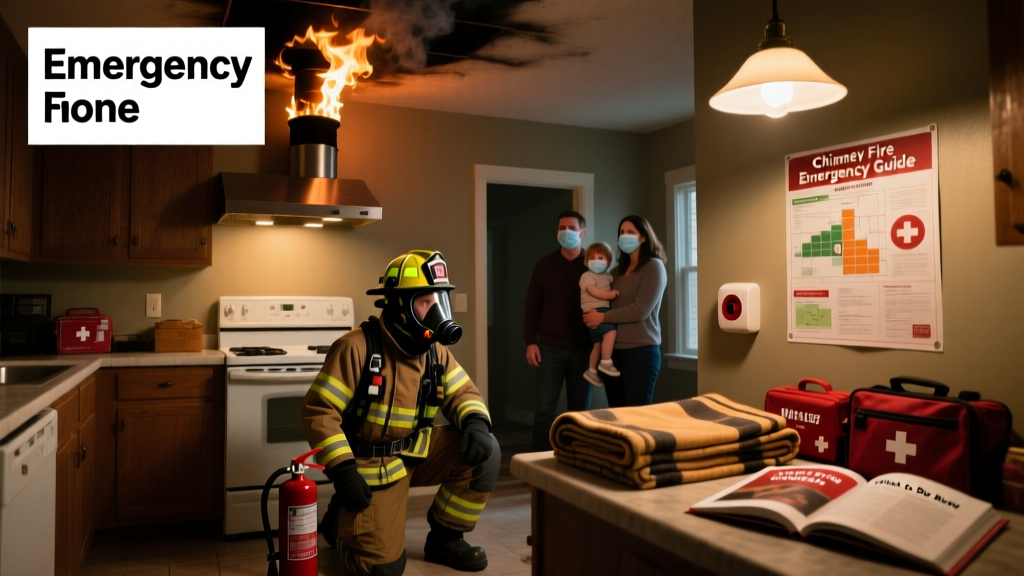
Smoke billowing from your roof or loud roaring sounds from the chimney mean you’re in an active chimney fire—this is not a routine maintenance issue. Evacuate everyone immediately, then call 911 from outside your home. Do not delay to grab belongings or assess severity.
Immediate Actions
- Get everyone out—including pets—and move at least 30 feet from the house.
- Call 911 from a safe location (not inside or near windows).
- If safe to do so, close the damper or air intake on your wood stove—but only if you can reach it without re-entering smoke-filled rooms.
- Use a Class A fire extinguisher only if flames are visible in the fireplace and fully contained—but never aim at the flue opening.
- Do not attempt to douse the chimney with water—it can crack masonry or cause steam explosions.
When to Call 911 / When to Call a Pro
Call 911 immediately if:
- You hear loud cracking, popping, or roaring sounds;
- Flames or dense smoke are visible at the chimney top or through cracks in the masonry;
- The chimney exterior feels hot to the touch or shows discoloration or warping;
- Smoke is entering living spaces—even after the fire appears out.
After firefighters confirm the fire is fully extinguished and the structure is safe, contact a CSIA-Certified Chimney Sweep within 24 hours for inspection. According to the Chimney Safety Institute of America’s 2022 Fire Report, 73% of chimney fires involve undetected creosote buildup that requires professional removal before reuse.
What NOT to Do
- Never use water, baking soda, or salt to “put out” a chimney fire—these can worsen structural stress.
- Don’t open doors or windows to “vent” smoke—this feeds oxygen to hidden flue fires.
- Avoid using the fireplace or stove again until cleared by a certified inspector.
- Don’t assume silence means the fire is out—creosote can smolder for hours inside flue liners.
After the Emergency
Once cleared to re-enter, document damage with photos and notes before cleanup begins. Firefighters will leave a report; request a copy. Then:
- Secure temporary tarp coverage over the chimney crown if rain exposure is likely.
- Bag and label all ash samples (if accessible and safe) for lab testing—creosote type affects repair strategy.
- Contact your homeowner’s insurance; most policies cover chimney fire damage but require proof of prior inspections.
- Schedule a Level 2 inspection (per NFPA 211-2023) before any repairs or relining.
| Inspection Level | Trigger | Required By |
|---|---|---|
| Level 1 | Routine annual check | NFPA 211 |
| Level 2 | After any operational change or event (e.g., chimney fire) | NFPA 211-2023 |
| Level 3 | When hidden damage is suspected (e.g., cracked flue tile) | CSIA Standard |
How long does a chimney fire usually last?
Most active chimney fires burn between 15 and 45 minutes—but internal smoldering can persist for 12+ hours. That’s why thermal imaging during post-fire inspection is non-negotiable.
Can a chimney fire spread to the attic or walls?
Yes—especially if the flue liner is cracked or missing. The U.S. Fire Administration reports that 22% of residential structure fires originating in chimneys involve ignition of adjacent framing or insulation.
What’s the #1 cause of chimney fires?
Creamy, tar-like third-degree creosote. It forms when wood burns too slowly or with high moisture content. According to the Insurance Institute for Business & Home Safety’s 2023 report, 87% of chimney fires linked to solid fuel heating involved uncleaned flues.
Will my insurance cover chimney fire damage?
Most standard policies do—if you’ve maintained records of annual cleanings and inspections. Missing documentation may trigger a claim denial. Keep receipts for chimney sweep services and Level 2 inspections for at least five years.
How soon can I use my fireplace again?
Not until a CSIA-certified technician signs off on both structural integrity and flue cleanliness. Rushing this step risks reignition—
“A single unremoved creosote pocket can ignite at 451°F, well below typical flue temps during normal operation.” — NFPA 211 Annex B, 2023 edition
Is a metal chimney liner ruined after a fire?
It depends. Stainless steel liners rated for high-temp use (UL 1777) often survive—but must be inspected for warping, pitting, or seam separation. Aluminum liners almost always fail and require full replacement.
Chimney fires escalate faster than most realize—don’t wait for visible flames to act. If you haven’t had a professional cleaning in the past 12 months, schedule one now at chimney-sweep-cost. Prevention isn’t optional—it’s your first line of defense.