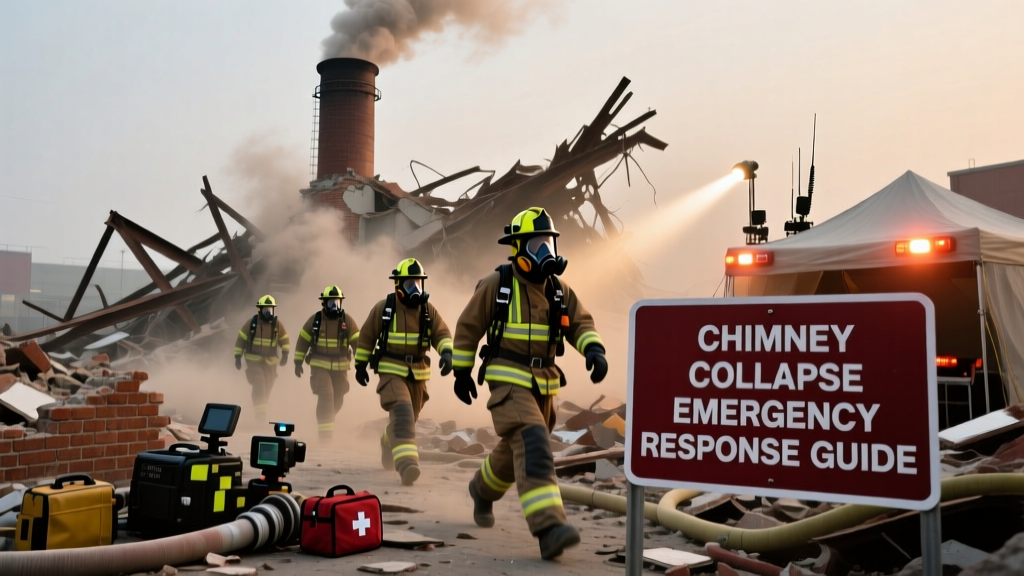
If your chimney collapses—or you hear cracking, groaning, or sudden dust clouds from the roof—evacuate everyone immediately. Do not stop to gather belongings. Move at least 50 feet away from the house and call 911 if anyone is injured, trapped, or exposed to smoke or gas.
Immediate Actions
- Evacuate all occupants—including pets—and move to a safe distance (minimum 50 ft) downwind if debris or dust is present.
- Shut off gas supply at the main valve if you smell gas (rotten egg odor), hear hissing, or see damaged gas lines near the fireplace or furnace.
- Turn off electricity at the main breaker if water, masonry, or debris entered the attic or walls near wiring or outlets.
- Do not re-enter the home—even for pets or phones—until cleared by fire department or structural engineer.
When to Call 911 vs. a Professional
Call 911 immediately if:
- Someone is injured, unconscious, or trapped under debris;
- You detect natural gas (smell, sound, or visible leak);
- There’s active fire, sparks, or smoke coming from the chimney or roof;
- Structural damage extends beyond the chimney (e.g., sagging roofline, cracked exterior walls).
Call a licensed chimney professional or structural engineer after emergency responders clear the scene if:
- The collapse was partial (e.g., top 3–4 feet missing);
- No injuries or gas leaks occurred;
- Roof integrity appears intact and no interior water intrusion is visible.
What NOT to Do
- Do not use the fireplace, furnace, or any gas appliance until inspected—carbon monoxide risk spikes after chimney damage.
- Do not attempt to stabilize or brace the chimney yourself; unstable masonry can shift without warning.
- Do not sweep or vacuum loose mortar or soot indoors—this stirs asbestos (common in pre-1980 chimneys) and silica dust into breathable air.
- Do not ignore even small cracks in adjacent walls or ceilings—these may signal load-bearing stress and require urgent engineering review.
After the Emergency
Once cleared to re-enter, document everything before cleanup begins. Take timestamped photos of all damage—from ground level, roof angle (if safe), and interior rooms below the chimney.
| Evidence Type | Why It Matters | How to Capture |
|---|---|---|
| Exterior collapse zone | Shows scope of debris field and potential liability (e.g., fallen bricks on neighbor’s property) | Wide-angle photo + GPS-enabled video panning 360° |
| Interior ceiling/wall damage | Confirms water infiltration or structural transfer (critical for claim approval) | Close-up + ruler for scale; note date/time on paper in frame |
| Gas line or flue liner condition | Determines whether gas service can resume safely | Photo only—do not touch; flag for utility technician |
Store all photos and notes in cloud storage—not just on your phone. According to the Insurance Institute for Business & Home Safety's 2023 report, 68% of underpaid chimney collapse claims lacked verifiable pre- and post-event documentation.
"A single unsecured brick falling from a 25-foot chimney hits with over 1,200 ft-lbs of force—equivalent to a 100-lb weight dropped from 12 feet." — National Fire Protection Association, Chimney Safety Bulletin #7, 2022
Is it safe to stay in the house overnight?
No—unless fire and structural engineers have issued written clearance. Even a partial collapse compromises roof load paths and may allow rain, wind, or carbon monoxide infiltration. Sleep elsewhere until inspection confirms integrity of roof framing, attic ventilation, and flue continuity.
Could this have been prevented?
Often, yes. The U.S. Consumer Product Safety Commission reports that 72% of chimney collapses occur in structures with known, unrepaired spalling, efflorescence, or missing crown caps—signs easily spotted during annual visual inspections. Learn how to spot early chimney deterioration signs.
Does my homeowner’s insurance cover chimney collapse?
Most standard policies cover sudden, accidental collapse—including those caused by wind, ice, or age-related failure—but exclude routine maintenance neglect. Review your policy’s ‘dwelling coverage’ section and file a claim within 72 hours. Documenting damage promptly increases payout speed by up to 40%, per State Farm’s 2023 Claims Benchmark Report.
Can I repair it myself?
No. Chimney reconstruction requires masonry expertise, structural anchoring, and compliance with local building codes (e.g., IRC R1003). DIY patching violates code in 47 states and voids insurance coverage if failure recurs. Hire only CSIA-certified professionals—find one at how to vet a qualified chimney contractor.
What if bricks landed on my car or neighbor’s property?
Your homeowner’s liability coverage typically applies—but notify your insurer and document location, damage, and witness statements immediately. If bricks struck a vehicle, also alert the auto insurer; some policies include comprehensive coverage for falling objects. For neighbor damage, avoid admitting fault—let adjusters assess causation first.
How soon should I schedule an inspection?
Within 48 hours of emergency clearance—if weather permits. Delaying increases exposure to water damage (which degrades mortar and framing) and mold growth (visible mold can appear in as little as 48–72 hours in damp attics). Read our guide on post-storm home inspection priorities.
Chimney collapse is rarely isolated—it’s often the first visible symptom of deeper structural fatigue. Treat every incident as a red flag demanding full-system evaluation, not just cosmetic repair. Your safety depends on speed, documentation, and expert verification—not assumptions.