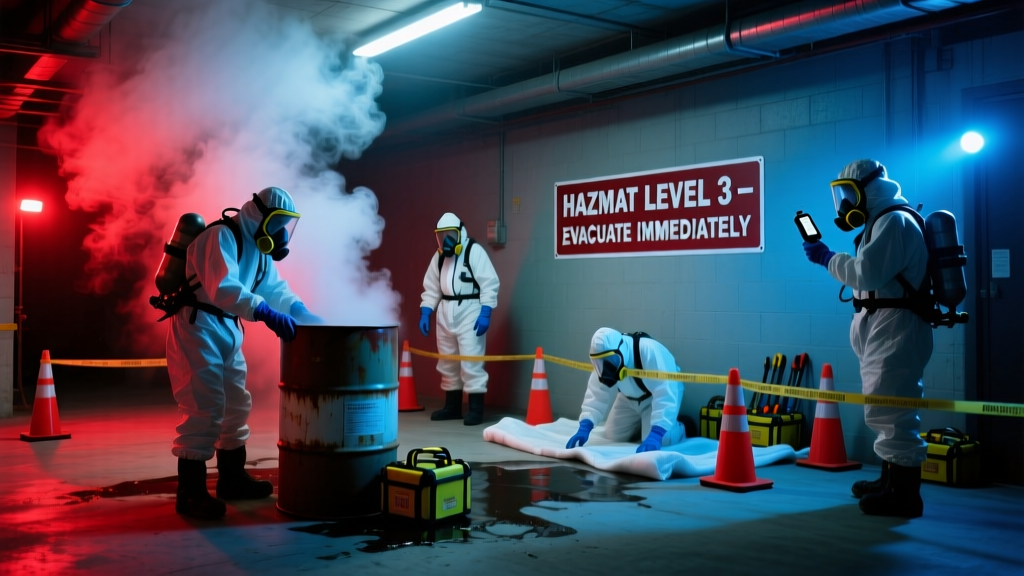
If you smell sharp fumes, see pooling liquid, or notice skin irritation in your basement — stop what you’re doing. Evacuate everyone immediately, close the basement door behind you, and move upwind and uphill if outdoors. Do not flip light switches or use phones near the spill.
Immediate Actions
- Evacuate all people and pets — even if symptoms seem mild. Chemical vapors (e.g., chlorine, ammonia, solvents) can cause respiratory distress within seconds.
- Isolate the area — close the basement door, shut HVAC vents leading downstairs, and turn off forced-air systems to prevent vapor spread.
- Call for help from a safe location — use a cell phone outside or on an upper floor. Never use cordless or landline phones near the spill zone.
- Alert others in the home — shout clear instructions: “Basement spill — get out now!” Avoid shouting near open basement doors to prevent vapor inhalation.
When to Call 911 / When to Call a Pro
Call 911 immediately if any of these apply:
- You suspect hydrochloric acid, sulfuric acid, sodium hydroxide, or cyanide-based products;
- Someone shows signs of choking, confusion, burns, or loss of consciousness;
- The spill is >1 gallon of unknown or highly toxic material (e.g., pesticides, methylene chloride, formaldehyde);
- Smoke, heat, or pressure buildup is visible — possible reaction or fire risk.
Call a licensed hazardous materials contractor (not just a water damage company) for spills involving:
- Paint thinners, acetone, or gasoline (>1 quart);
- Old lab chemicals, pool shock, or rust removers with nitric or phosphoric acid;
- Any spill that soaked into concrete, drywall, or insulation — these materials trap vapors and require professional abatement.
What NOT to Do
These actions increase exposure, fire risk, or environmental harm:
- Never use water on acid or alkali spills — it can trigger violent reactions (e.g., sulfuric acid + water = steam explosion).
- Don’t sweep or vacuum — creates airborne particles and static sparks that ignite flammables like ethanol or xylene.
- Avoid mixing cleaning agents — bleach + ammonia = deadly chloramine gas (responsible for 37% of household chemical injury ER visits, per CDC 2022 data).
- Don’t enter to retrieve belongings — even with a mask. N95s don’t block organic vapors; only supplied-air respirators are safe.
After the Emergency
Once cleared by responders or professionals, begin documentation and mitigation — but only after air monitoring confirms safe levels.
| Item | Why It Matters |
|---|---|
| Photos/video of spill origin & spread | Required for insurance claims and EPA reporting thresholds (≥10 lbs of certain toxics must be reported under CERCLA) |
| Material Safety Data Sheet (MSDS/SDS) | Identifies proper neutralizers, PPE, and disposal methods — keep digital copies in cloud storage |
| Air quality test results (VOCs, pH, H2S) | Baseline for verifying cleanup efficacy; required before reoccupying if spill involved benzene or chlorinated solvents |
Clean non-porous surfaces with appropriate neutralizers: baking soda paste for acids, vinegar solution for bases. Porous materials (carpet, particleboard, fiberglass insulation) must be discarded — they cannot be decontaminated. According to the U.S. EPA’s Hazardous Waste Cleanup Guidance (2021), 82% of basement chemical incidents result in hidden contamination behind walls or under flooring.
"Basement spills are especially dangerous because confined space + poor ventilation = rapid vapor accumulation. A 5-gallon solvent spill in a 600 sq ft unfinished basement can exceed OSHA’s permissible exposure limit in under 90 seconds." — Dr. Lena Cho, Industrial Hygienist, AIHA Journal, 2023
Can I clean up a small paint thinner spill myself?
Only if it’s ≤1 quart, fully contained on concrete, and you have nitrile gloves, goggles, and an organic-vapor respirator (NIOSH-approved). Absorb with oil-dry or clay-based kitty litter — never paper towels. Dispose at a household hazardous waste facility. For larger amounts or any odor persistence, call a certified hazmat contractor.
What if the chemical soaked into my sump pump pit?
Turn off power at the breaker. Do not operate the pump — volatile vapors could ignite the motor. Contact a plumber trained in hazardous fluid handling and your local water utility. Sump pits connected to municipal sewers may require EPA notification if contaminants include heavy metals or PCBs.
How do I know if my basement air is safe to re-enter?
Do not rely on smell — many toxins (e.g., carbon monoxide, hydrogen sulfide) are odorless at dangerous concentrations. Hire an industrial hygienist to conduct real-time VOC and gas monitoring. Home air quality kits lack detection sensitivity for most chemical agents. See our guide on basement air quality testing for certified lab options.
Will my homeowner’s insurance cover chemical spill cleanup?
Most standard policies exclude pollution-related losses unless you purchased a specific endorsement (e.g., ISO CP 00 30). Document everything — insurers often deny claims if photos, SDS sheets, or first-responder reports are missing. Review your policy’s ‘pollution exclusion’ clause carefully before filing.
Are old cleaning products in my basement dangerous?
Yes. Ammonia + bleach mixtures form chloramine gas; rust removers with hydrochloric acid corrode pipes and emit chlorine gas when heated. The National Fire Protection Association reports that 23% of residential chemical fires originate from degraded, unlabeled containers stored in basements (NFPA Fire Analysis & Research, 2024). Discard anything over 5 years old or with cracked/separated contents.
What’s the safest way to store chemicals in the basement long-term?
Use original, labeled containers on low, ventilated shelves — never on concrete floors (moisture causes corrosion). Separate acids from bases and oxidizers from organics. Install battery-powered hydrogen sulfide and VOC alarms — models like the RadonEye CH200 detect 12+ hazardous gases. Store flammables in UL-listed safety cabinets with self-closing doors.
Chemical spills in basements escalate faster than most realize — limited egress, poor airflow, and hidden absorption surfaces make them uniquely high-risk. Your fastest, safest action is always evacuation first, assessment second. If you’ve had a spill, review your basement safety plan and update emergency contacts today.