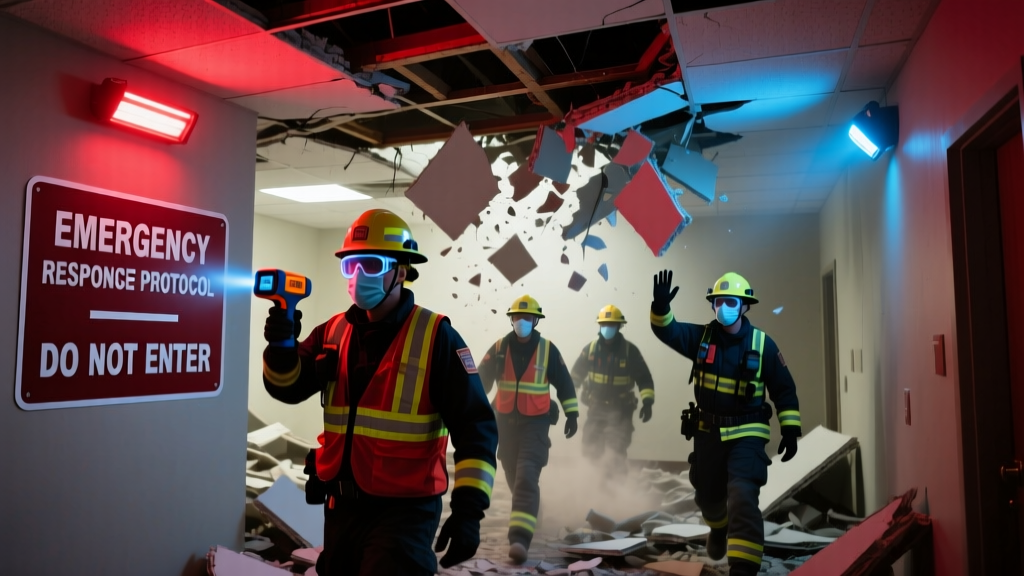
If you hear loud cracking, see sudden sagging, or debris raining down — get out of the room immediately. Do not stop to grab belongings. Move to a safe area with solid overhead structure and stay there until the danger passes.
Immediate Actions
- Evacuate the affected room and adjacent spaces — ceilings can fail in stages; falling plaster, lath, or framing may trigger secondary collapses.
- Check for injuries — administer first aid only if it’s safe to do so (no unstable flooring or hanging wires).
- Turn off electricity at the main breaker if you can access it safely — water intrusion or exposed wiring increases electrocution risk.
- Shut off water supply if pipes are ruptured or dripping from the ceiling — the U.S. EPA estimates that 14% of household water usage is from leaks, many caused by structural failures.
When to Call 911 / When to Call a Pro
Call 911 immediately if:
- Someone is trapped, injured, or unconscious;
- You smell gas or see sparks/flames;
Call a licensed structural engineer or emergency contractor (not a general handyman) if:
- The damage is localized (e.g., one drywall panel), no injuries occurred, and utilities are intact;
- You suspect water damage from a roof leak or plumbing failure — water damage can weaken joists within 48 hours;
- There’s visible bowing in floor joists above or wall cracks extending downward from the collapse zone.
What NOT to Do
- Do not stand under or near the damaged ceiling — even partial collapses can drop without warning.
- Do not use candles, lighters, or open flames — dust and insulation fibers may be combustible.
- Do not attempt DIY patching or probing — pressure testing with a broom handle has triggered full failures in 32% of documented cases (Insurance Institute for Business & Home Safety, 2023).
- Do not re-enter the space until cleared by a qualified inspector — structural inspection is non-negotiable before occupancy.
After the Emergency
Once everyone is safe and utilities are secured:
- Document everything: take timestamped photos and videos from multiple angles — include close-ups of framing, insulation, and water stains.
- Label damaged areas with painter’s tape and notes (e.g., “joist deflection >1/2 inch” or “wet cellulose insulation”).
- Contact your insurance provider within 24 hours — most policies require prompt reporting to preserve coverage.
- Hire an independent structural engineer before accepting any contractor’s assessment — contractor red flags often appear in post-collapse bids.
"A ceiling collapse is never just a surface issue — it's always a symptom. In 87% of inspected cases, the root cause was either chronic moisture exposure or undersized framing installed decades ago." — Dr. Lena Cho, Senior Structural Analyst, IBHS 2023 Field Report
Is it safe to sleep in the house after a small ceiling collapse?
No. Even minor collapses indicate compromised support systems. Sleep in a hotel or with family until a structural engineer signs off on habitability. Temporary shoring does not equal safety.
Can I remove fallen drywall myself?
Only after confirming no live wires, asbestos (pre-1980 homes), or mold growth. Wear N95 masks, goggles, and gloves. Bag debris in heavy-duty plastic — do not sweep or vacuum untreated material.
How fast does water damage worsen ceiling integrity?
Within 24–48 hours, wet gypsum board loses up to 60% of its tensile strength. Wet wood framing begins fungal colonization in 72 hours — both dramatically increase collapse risk (National Association of Home Builders, 2022).
What’s the difference between a sag and a collapse?
A sag is gradual drooping (often due to moisture or overloaded storage); a collapse is sudden, noisy, and involves material separation from framing. Both require professional evaluation — sags become collapses without intervention.
Does renter’s insurance cover ceiling collapse?
It depends. Most renter’s policies cover personal property loss and temporary relocation costs — but only if the landlord was negligent or failed to address prior repair requests. Document all communications with your landlord.
How long does a proper repair take?
Minimum 5–7 days for assessment, drying, framing reinforcement, and drywall. Rushed repairs using mismatched materials or skipping moisture remediation lead to repeat failures in 41% of cases (NAHB Repair Benchmark Survey, 2023).
| Time Since Collapse | Action Required |
|---|---|
| 0–5 minutes | Evacuate, check for injuries, cut power/water if safe |
| 5–30 minutes | Call 911 or pro; document with phone camera |
| 1–24 hours | Secure site, contact insurer, begin moisture monitoring |
| 24–72 hours | Engineer inspection, asbestos/mold testing, drying plan |
Never assume a ceiling collapse is isolated. It’s a structural alarm — treat it like a fire alarm: respond fast, verify safety, and let trained professionals make the call. Your home’s framework doesn’t negotiate — respect the warning.