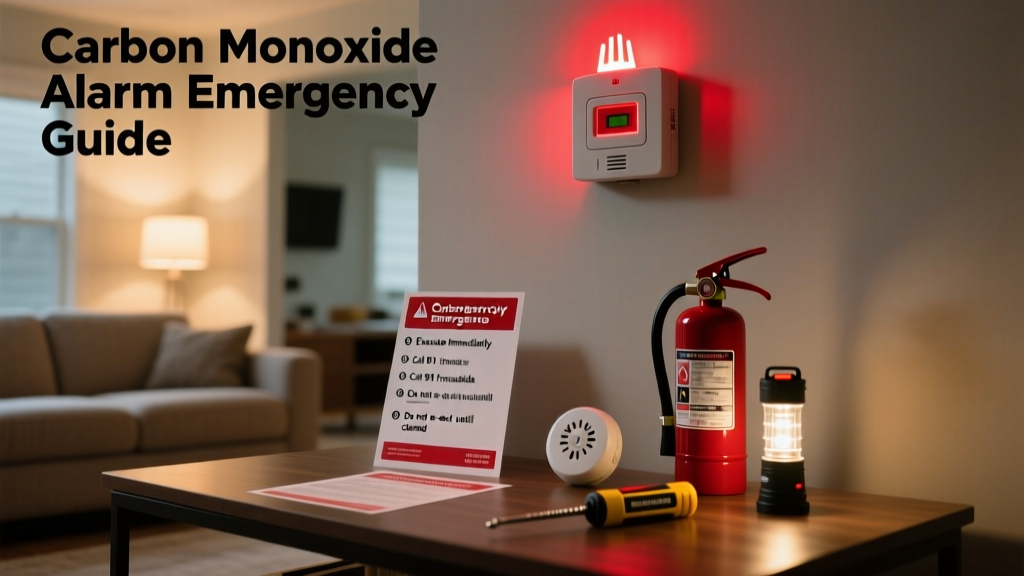
If your carbon monoxide (CO) alarm sounds — do not ignore it. CO is odorless, colorless, and can cause unconsciousness or death in minutes. Immediately move everyone outdoors or to fresh air — even if no one feels ill.
Immediate Actions
- Evacuate everyone — including pets — to fresh air outside or a neighbor’s home. Do not stop to gather belongings.
- Call 911 or your local emergency number from outside or a safe location. Tell them you suspect carbon monoxide exposure.
- Do not re-enter the building until cleared by emergency responders or a qualified professional.
- Account for all people and pets. Note symptoms like headache, dizziness, nausea, confusion, or shortness of breath — share these with responders.
When to Call 911 / When to Call a Pro
Call 911 immediately if:
- Anyone is experiencing symptoms (even mild ones),
- The alarm is sounding continuously (not chirping),
- You’re unsure whether the alarm is real or false — treat it as real.
After emergency responders clear the scene, call a licensed HVAC technician or certified CO inspector within 24 hours to locate and fix the source. According to the U.S. Consumer Product Safety Commission (CPSC, 2022), faulty heating systems cause nearly 40% of non-fire CO incidents in homes.
What NOT to Do
- Never ignore or disable the alarm — even if you smell nothing or feel fine.
- Don’t use gas stoves, ovens, generators, or grills indoors — ever — to heat or cook during power outages.
- Don’t try to find the leak yourself. CO spreads invisibly; opening windows doesn’t eliminate risk fast enough.
- Don’t assume battery replacement fixes the issue — a persistent alarm may signal dangerous CO buildup.
After the Emergency
Once cleared to re-enter, document everything for insurance and safety follow-up:
| Item | Why It Matters |
|---|---|
| Alarm model & serial number | Required for recall checks and manufacturer support |
| Photos of alarm display & location | Helps technicians assess placement and environmental factors |
| Names/titles of responding personnel | Needed for incident reports and insurance claims |
| Written clearance note from fire department | Proof of safety for landlords, insurers, or code officials |
Replace CO alarms older than 5–7 years — most manufacturers specify lifespan in the user manual. The National Fire Protection Association (NFPA 72, 2023) requires CO alarms on every level of the home and outside sleeping areas.
How long does CO stay in a room after the source is off?
CO dissipates slowly — even with windows open, it can take 4–8 hours to drop to safe levels without mechanical ventilation. Never rely on ‘airing out’ alone. As Dr. Robert L. Bessette, toxicologist and former CDC CO response lead, states:
"Carbon monoxide binds to hemoglobin 240 times more tightly than oxygen. That means symptoms can worsen rapidly — and recovery isn’t instant, even after fresh air exposure."
Can CO alarms give false alarms?
Yes — but rarely. Common causes include expired sensors (most last 5–7 years), high humidity near bathrooms, or chemical fumes from paint thinners or solvents. If the alarm chirps once every minute, it’s likely low battery. If it beeps 4 times then pauses, it’s detecting CO — treat it as urgent. See our carbon monoxide alarm beeping guide for pattern decoding.
Where should CO alarms be installed?
Mount on walls at least 5 feet above the floor (CO mixes evenly with air, unlike smoke) — never in dead-air corners, behind furniture, or within 6 inches of ceiling corners. Install one on each floor, especially near bedrooms and near attached garages. For multi-story homes, see our CO alarm placement guide.
What medical tests confirm CO poisoning?
Blood carboxyhemoglobin (COHb) testing is definitive — best done within 4 hours of exposure. Pulse CO-oximeters are common in ERs, but venous blood gas analysis remains the gold standard. Delayed neurological symptoms can appear days later, so follow up with a physician even after mild exposure.
Does opening windows help during an alarm?
Opening windows provides minimal immediate relief. CO concentrations don’t drop quickly enough to prevent harm — evacuation is always faster and safer. A study published in Indoor Air (2021) found natural ventilation reduced CO levels by only 15–30% over 30 minutes in typical homes — far too slow for acute exposure.
Should I install battery-only or hardwired CO alarms?
Hardwired alarms with battery backup offer the highest reliability — they won’t fail during power outages when CO risks (e.g., generator use) peak. Per UL 2034 standards, all new residential CO alarms must have end-of-life warnings and sealed lithium batteries in tamper-resistant units. Learn more in our best CO alarms comparison.
CO exposure is preventable — but only if you act decisively the moment that alarm sounds. Keep alarms tested monthly, replaced on schedule, and never bypass safety protocols. Your quick action today could save lives tomorrow.