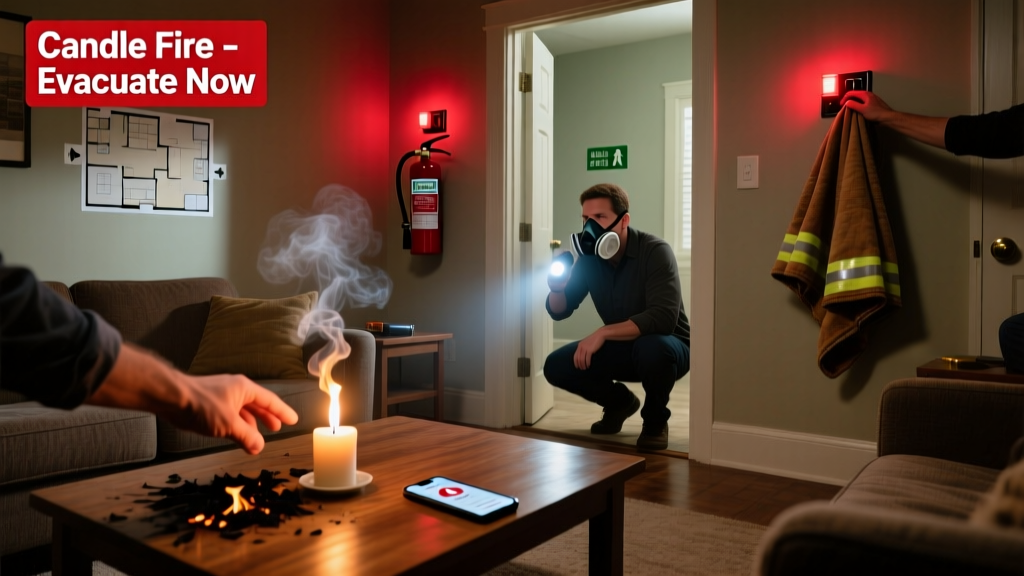
Stop, drop, and cover your mouth — then act. If a candle ignites nearby combustibles (curtains, paper, bedding), your first move is to smother the flame *only if safe to do so*. Never lean in. If smoke fills the room or flames spread beyond the candle holder, evacuate immediately and close doors behind you.
Immediate Actions
- Assess risk in under 3 seconds: Is the flame contained in the holder? No spreading? No smoke? If yes, proceed to step 2. If no, evacuate now.
- Smother with a metal lid or baking sheet: Slide it over the candle — never use glass (can shatter) or plastic (melts). Hold for 15 seconds to ensure full extinguishment.
- Use a Class ABC fire extinguisher only if trained: Aim at the base, sweep side-to-side. Don’t spray directly into molten wax — it can splatter burning fuel.
- Evacuate if flame touches anything else: Even a 2-inch lick of flame on a curtain requires immediate exit. According to NFPA’s 2023 report, 74% of candle fires that cause fatalities involve ignition of nearby furnishings.
When to Call 911 / When to Call a Pro
Call 911 immediately if:
- Flames are taller than the candle container,
- Smoke is thick or gray/black (indicates incomplete combustion and toxic gases),
- You hear crackling or popping from walls or ceilings (possible structural involvement).
Call a certified fire restoration specialist (not just a cleaning company) if:
- Smoke odor lingers after ventilation for >24 hours,
- Walls or ceilings show discoloration or blistering paint,
- You detect soot residue on HVAC vents or light switches — this signals airborne particulate infiltration.
What NOT to Do
These actions escalate risk or delay escape:
- Don’t blow on the flame — oxygen feeds fire; blowing spreads embers onto nearby fabric or paper.
- Don’t pour water on wax fires — molten wax floats on water and splatters burning fuel up to 6 feet away.
- Don’t re-enter a room after evacuation — even if flames appear out, carbon monoxide levels can reach lethal concentrations in under 90 seconds.
- Don’t use flour, baking soda, or salt unless it’s a *small, contained* stovetop grease fire — these are ineffective on candle wax and may aerosolize fuel.
"Candles cause an estimated 7,600 home fires annually — and 85% occur in living rooms, bedrooms, or hallways where people underestimate proximity risks." — U.S. Fire Administration, Home Candle Fire Report 2022
After the Emergency
Once you’re safely outside and 911 is notified:
- Do not re-enter until cleared by fire officials — thermal layering means upper air can exceed 1,000°F even if floor feels cool.
- Photograph all damage before cleanup begins: take wide-angle shots of rooms and close-ups of soot patterns on walls and outlets.
- Document everything in writing: time of fire, materials involved (e.g., "scented soy candle in ceramic holder, ignited sheer polyester curtain 18 inches away"), and who responded.
- Contact your insurer within 24 hours — many require preliminary documentation before dispatching adjusters.
| Risk Factor | Mitigation Action | Time Required |
|---|---|---|
| Unattended candle | Use battery-operated LED alternatives in high-risk zones (LED candles safety guide) | Instant |
| Candle within 12" of combustibles | Install non-flammable barrier (e.g., tempered glass shield rated for 500°F) | 5 minutes |
| Wax pool >½" deep | Trim wick to ¼" before each lighting; limit burn time to 4 hours max | 10 seconds |
| No working smoke alarm in room | Test alarms monthly; replace batteries yearly; upgrade to photoelectric + CO combo units (smoke alarm types comparison) | 2 minutes |
Can I reuse a candle holder after a fire?
Only if it’s non-porous (stainless steel, tempered glass, ceramic) and shows no warping, cracks, or melted glaze. Discard any holder that held a candle that ignited nearby items — microscopic wax residue can reignite under heat. Inspect with a magnifying glass and wipe with isopropyl alcohol before reuse.
How long does candle smoke stay toxic?
Polycyclic aromatic hydrocarbons (PAHs) from paraffin candles persist in dust and HVAC filters for up to 72 hours. The EPA recommends HEPA vacuuming *before* wiping surfaces — dry wiping redistributes particles. Ventilate for 48+ hours with cross-breezes, not just open windows.
Is it safe to sleep after a small candle fire?
No. Carbon monoxide binds to hemoglobin faster than oxygen — symptoms like headache or drowsiness may indicate exposure. Seek medical evaluation if you experienced coughing, eye irritation, or confusion during or after the incident. Blood carboxyhemoglobin testing is definitive (CO poisoning symptoms checklist).
What kind of fire extinguisher should I keep near candles?
A 2.5-lb Class ABC unit with a metal nozzle (not plastic) mounted within 3 feet of common candle locations — e.g., beside the bedstand or mantel. Recharge after *any* use, even partial discharge. Avoid miniature keychain models — they lack sufficient agent volume to suppress flaming upholstery.
Why did my candle suddenly flare up?
Most flares result from wick mushrooming (carbon buildup) or draft exposure. A 2021 UL study found 68% of unexpected candle flares occurred when wicks exceeded ¼" length or when candles burned longer than manufacturer-recommended time. Always trim before lighting and avoid placing near AC vents or doorways.
Should I file a report with CPSC?
Yes — especially if the candle or holder failed catastrophically (e.g., container cracked, wick detached, metal base warped). Submit via SaferProducts.gov. The CPSC uses these reports to identify hazardous patterns — over 112 candle-related recalls were issued between 2019–2023.
Fire doesn’t wait for perfect conditions — it exploits distraction, proximity, and delay. Keep extinguishers accessible, test alarms weekly, and treat every candle like a live wire. Your fastest reaction isn’t grabbing a towel — it’s stepping back and deciding, in under three seconds, whether to act or exit.