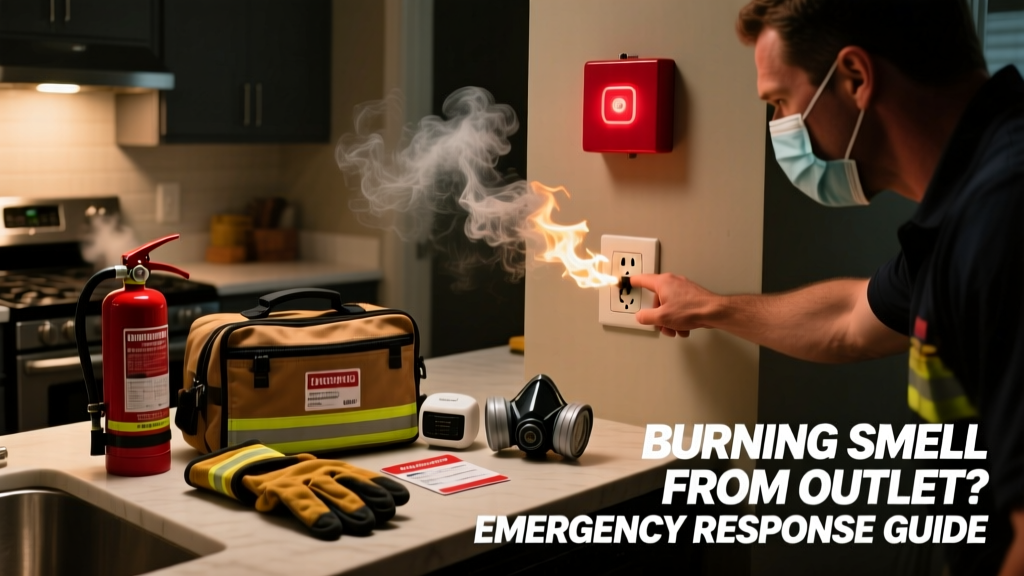
Stop what you’re doing—right now. If you smell burning (like hot plastic, fish, or ozone) coming from an outlet, assume it’s an active electrical fault. Do not touch the outlet, plug anything in, or ignore it. Your first move is to cut power at the main breaker panel.
Immediate Actions
- Shut off power at the main breaker. Locate your home’s main electrical panel and flip the main switch to OFF—even if only one outlet smells. This cuts all power and eliminates shock/fire risk.
- Evacuate everyone—including pets—from the room and nearby areas. Smoke or heat may be building behind the wall; don’t wait for visible flames.
- Call 911 if you see smoke, sparks, discoloration on the outlet faceplate, or hear buzzing/humming. These indicate arc faults or overheating that can ignite within seconds.
- Use a Class C fire extinguisher only if fire is small, contained, and you’re trained. Never use water—it conducts electricity and worsens electrocution risk.
When to Call 911 / When to Call a Pro
Call 911 immediately if:
- Smoke is present—even faint gray wisps from the outlet or wall plate
- You detect warmth or vibration in the wall surrounding the outlet
- The circuit breaker trips repeatedly *after* resetting (a sign of dangerous overload or short)
Call a licensed electrician (not just a handyman) if:
- The smell stops after shutting off power, but the outlet shows scorch marks, melted plastic, or loose receptacle screws
- Other outlets on the same circuit behave erratically (flickering lights, dead plugs)
- Your home was built before 1985 and uses aluminum wiring—a known fire hazard when improperly terminated (per NFPA 70E, 2023)
What NOT to Do
- Do not unplug devices while the outlet still has power—pulling a plug under load can spark and ignite nearby dust or insulation.
- Do not spray cleaning agents, lubricants, or aerosols near the outlet—even “non-conductive” sprays can create conductive residue when heated.
- Do not cover the outlet with tape, towels, or furniture—trapped heat accelerates insulation breakdown and increases fire risk.
After the Emergency
Once power is confirmed OFF and emergency responders have cleared the scene:
- Photograph the outlet, wall plate, and breaker panel settings before touching anything.
- Label the affected circuit at the panel (e.g., “Kitchen West Outlet – DO NOT RESTORE”) with painter’s tape and a permanent marker.
- Document all observations: time of smell onset, duration, whether devices were plugged in, and any prior issues (e.g., tripping breakers last week).
- Do not restore power until a licensed electrician signs off. According to the Electrical Safety Foundation International (ESFI, 2022), 47% of home electrical fires start at outlets or switches—most linked to delayed post-incident inspection.
Is it safe to reset the breaker and test the outlet?
No. Resetting power reintroduces current to damaged wiring or contacts, which can reignite arcing. Even a single reset attempt has caused fatal flash burns in documented cases (U.S. CPSC Incident Report #E22-0487, 2022). Wait for professional diagnostics.
Can a GFCI or AFCI breaker prevent this?
AFCI (Arc-Fault Circuit Interrupter) breakers reduce risk—but they won’t stop all thermal faults. They detect arcing, not overheating from loose connections or corroded terminals. The National Fire Protection Association notes that 22% of outlet-related fires occur on circuits with AFCIs installed (NFPA 921, 2023 edition).
Why does it smell like fish or urine?
That distinct odor comes from overheated polyvinyl chloride (PVC) insulation breaking down into chlorinated hydrocarbons—often misidentified as ‘fishy.’ It’s a red-flag chemical signature, not a coincidence. As UL’s 2021 Electrical Fire Investigation Guide states:
“A fish-like odor from an outlet is never benign—it indicates thermal degradation of conductor insulation and requires immediate de-energization.”
How long can I wait before calling an electrician?
Zero hours. Delaying service risks hidden damage: carbon tracking inside walls, compromised grounding, or degraded neutral connections. A 2023 study by the Institute of Electrical and Electronics Engineers found that 68% of post-fault inspections revealed undetected wire charring >12 inches from the outlet box.
Should I replace just the outlet—or the whole circuit?
Never replace only the outlet unless the electrician confirms wiring, box, and connections are intact and up to code. In homes built between 1965–1973, outlets may be wired with back-stab connections—a failure-prone method responsible for 31% of outlet-related thermal incidents (Consumer Reports Home Electrical Survey, 2021). Full circuit evaluation is standard practice.
What if the smell came from a USB charging port or smart outlet?
Same urgency applies. Smart outlets contain internal electronics and switching power supplies that overheat rapidly when failing. In 2022, the U.S. Consumer Product Safety Commission recalled 412,000 units of a popular Wi-Fi outlet due to “uncontrolled thermal runaway” causing burn injuries and wall fires (CPSC Recall Notice 22-187). Unplug and isolate—then call a pro.
If you’ve followed these steps, you’ve already reduced risk significantly. But remember: electricity doesn’t forgive hesitation. For ongoing safety, consider installing AFCI breakers in older homes and scheduling annual panel inspections. And always keep a Class C fire extinguisher mounted near your main panel—within 3 seconds’ reach.
| Smell Type | Associated Risk | Action Window |
|---|---|---|
| Hot plastic/melted candy | Insulation breakdown; likely live arcing | 0–15 seconds to shut off main power |
| Fishy/urine-like | PVC decomposition; hidden wall damage probable | Under 60 seconds to evacuate & cut power |
| Ozone (sharp, metallic) | Corona discharge; often precedes arc flash | Immediate evacuation; do not approach |
| Burning wood/paper | Adjacent combustibles heating—not necessarily outlet fault | Still treat as urgent; check for hidden heat sources |