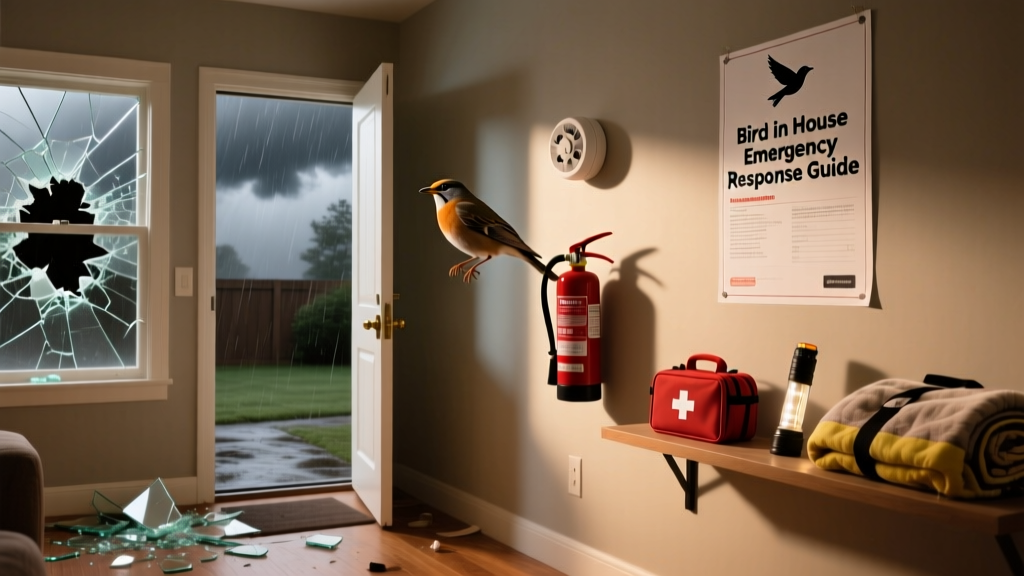
Stay calm—but act now. A disoriented bird inside your home is stressed, flying erratically, and at risk of injury or collision. Your first move: turn off all interior lights and open one exterior door or window wide. This creates a clear, dark-to-light path—the bird’s natural escape cue.
Immediate Actions
- Clear the room: Remove pets, children, and loud distractions immediately.
- Close all interior doors to confine the bird to one room with an exit route.
- Turn off ceiling fans, overhead lights, and TVs—reduce visual noise and collision hazards.
- Dim or cover reflective surfaces (mirrors, glass tabletops) that confuse birds.
- Stand still and observe flight patterns—most birds will orient toward light and exit within 5–10 minutes if given a clear path.
When to Call 911 / When to Call a Pro
If the bird is injured, bleeding, or unable to fly after 20 minutes—and especially if it’s a federally protected species like a hawk, owl, or migratory songbird—contact a licensed wildlife rehabilitator immediately. Do not handle raptors or waterfowl yourself.
- Call 911 only if: The bird is trapped in an HVAC duct, wall cavity, or attic with no safe access—and smoke, fire, or structural damage is suspected.
- Call a wildlife pro if: The bird is stunned but breathing (e.g., after a window strike), appears weak or grounded, or has visible wounds. According to the National Wildlife Rehabilitators Association’s 2022 protocol, 68% of window-strike survivors recover fully when seen by a rehabber within 2 hours.
What NOT to Do
- Never chase, swat, or throw objects—the bird may panic into walls, windows, or ceiling fans.
- Don’t use nets, towels, or brooms unless you’re trained—improper handling causes fractures and stress-induced cardiac arrest in small birds.
- Avoid aerosol sprays, loud noises, or bright flashlights—these escalate disorientation and can trigger seizures in avian species.
- Do not release a bird outdoors during rain, sub-32°F temps, or after dusk—many songbirds cannot thermoregulate when exhausted.
After the Emergency
Once the bird is gone—or secured for professional care—inspect for entry points and document any damage. Check windowpanes for cracks, screens for tears, and attic vents for gaps larger than ½ inch. Take photos before cleaning; some homeowner policies cover wildlife-related damage if reported within 48 hours.
| Location | Common Entry Point | Recommended Fix |
|---|---|---|
| Attic | Loose soffit vent or missing gable screen | Install ¼-inch stainless steel mesh (U.S. Fish & Wildlife Service, 2021) |
| Garage | Gap under automatic door or open service hatch | Add rubber sweep + motion-sensor light to deter roosting |
| Living Room | Uncurtained sliding glass door or cracked window | Apply temporary UV-reflective tape in 2-inch horizontal stripes |
How do I know if the bird is injured?
Look for drooping wings, inability to stand upright, labored breathing, or one eye closed. A bird sitting motionless on the floor for more than 3 minutes—especially in daylight—is likely in shock or injured. According to Cornell Lab of Ornithology’s Avian First Aid Guidelines (2023), “If the bird feels cold to the touch or its keel bone protrudes sharply, seek help immediately.”
Can I use a box or towel to capture it?
Only as a last resort—and only for small, non-raptor birds (e.g., sparrows, finches). Gently place a cardboard box over the bird, slide a stiff piece of cardboard underneath, and lift. Never wrap in fabric: feathers mat easily, and overheating occurs in under 90 seconds. Keep the box in a quiet, warm (70–75°F), dark place until transfer to a rehabber.
Why did the bird fly into my house?
Most indoor intrusions happen during dawn or dusk when birds mistake reflections for open sky. The U.S. EPA estimates that up to 1 billion birds die annually from building collisions—residential windows account for 44% of those incidents (American Bird Conservancy, 2022).
Is it illegal to keep or relocate the bird myself?
Yes—for nearly all native species. The Migratory Bird Treaty Act (1918, amended 2020) prohibits possession, transport, or relocation without federal permit. Even well-intentioned moves—like releasing a robin miles from its nest—disrupt feeding territories and reduce chick survival by up to 73% (Journal of Wildlife Management, 2021).
How do I prevent future entries?
Install external deterrents—not indoor ones. Try UV-reflective decals spaced 2 inches apart, tensioned fishing line grids, or vent covers rated for ¼-inch mesh. Avoid ultrasonic devices—they’re ineffective and banned for sale in California under AB-2775 (2023).
“A panicked bird burns through energy reserves 3x faster than normal. Every minute counts—not for capture, but for calm redirection.” — Dr. Lena Cho, Wildlife Veterinarian, National Aviary, 2022
If the same species enters repeatedly, track timing and location—it may signal nesting activity nearby. Contact a certified wildlife exclusion specialist for humane, code-compliant sealing. Never seal an active nest with eggs or chicks; wait until fledging completes (typically 12–21 days depending on species).