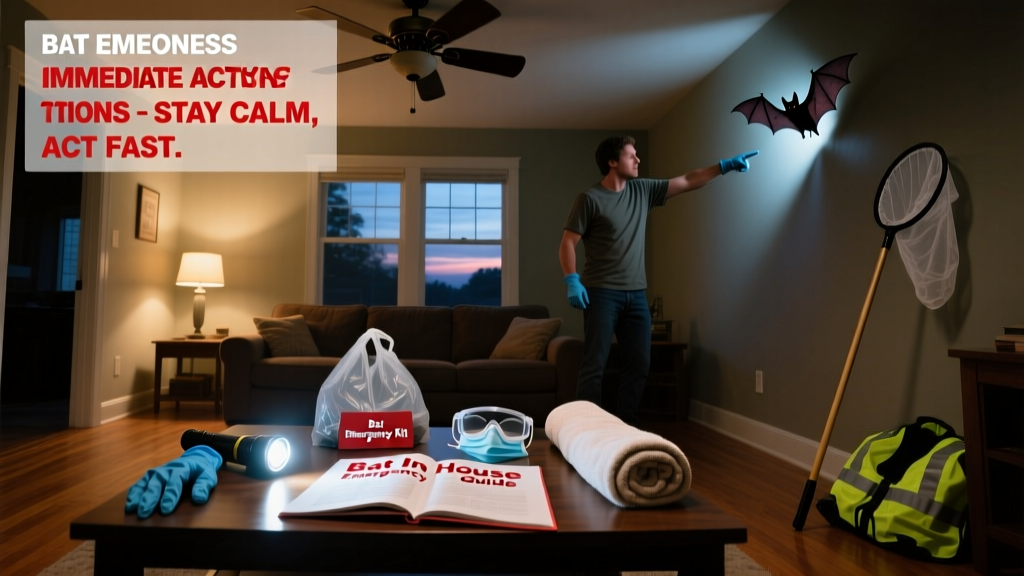
Stay calm—but act now. Bats in living spaces pose immediate rabies risk; even healthy-looking bats carry the virus in 6–12% of tested specimens (CDC, 2023). Your first move: isolate the room and close all interior doors.
Immediate Actions
- Keep distance: Stay at least 6 feet from the bat—never corner or chase it.
- Secure the area: Close doors to adjacent rooms. Open windows and exterior doors in the affected room only.
- Turn off ceiling fans and lights: Reduce air movement and visual stress—bats navigate via echolocation, not sight.
- Wait 15–20 minutes: Most bats will exit on their own if an unobstructed path to the outdoors exists.
- If grounded: Place a small cardboard box or inverted wastebasket over it, then slide stiff paper underneath to trap it gently—do not touch.
When to Call 911 / When to Call a Pro
Call 911 immediately if:
- A bat has touched or bitten any person or pet—even without visible wound.
- A bat was found in a room with a sleeping person, unattended child, or someone impaired (e.g., intoxicated, cognitively disabled).
- You suspect rabies exposure and it’s after hours—ERs must initiate post-exposure prophylaxis (PEP) within 24 hours.
Call a licensed wildlife professional (not pest control) for:
- Bats roosting in attics, walls, or chimneys (signs: guano piles, oily stains, squeaking at dusk).
- Multiple bats indoors or repeated entries over 48 hours.
- Structural gaps larger than ⅜ inch—bats squeeze through openings smaller than a dime.
What NOT to Do
- Never handle a bat bare-handed—even dead ones can transmit rabies via mucous membranes or open cuts.
- Don’t use insecticides, smoke, or repellents—they’re ineffective and may drive bats deeper into walls.
- Don’t release a captured bat outdoors yourself—only trained professionals should test for rabies if exposure is possible.
- Don’t ignore attic droppings: A single colony of 100 bats produces ~20 lbs of guano monthly—risking histoplasmosis spores when disturbed (NIOSH, 2022).
After the Emergency
Once the bat is gone or secured, document everything before cleanup begins. Take timestamped photos of entry points, guano locations, and structural gaps. Seal openings only after confirming no bats remain inside—sealing live bats causes wall infestations and odor issues.
| Item | Check | Next Step |
|---|---|---|
| Entry point | Measure gap size & location (e.g., “½” gap under garage door trim”) | Use caulk, hardware cloth (¼” mesh), or copper mesh—see full sealing guide |
| Guano presence | Is it dry? Crumbly? Near insulation? | Hire certified biohazard cleaners if >1 sq ft or in ductwork |
| Pet exposure | Did dog/cat attempt contact? Any scratches? | Contact vet within 2 hours—rabies PEP for pets differs from humans |
Can I get rabies from just being in the same room as a bat?
Yes—if you were asleep, unconscious, or unable to detect a bite or scratch. The CDC recommends PEP in these cases because bat teeth are tiny and wounds may go unnoticed. According to the CDC’s 2023 Rabies Surveillance Report, 70% of human rabies cases in the U.S. since 2000 involved unrecognized bat exposures.
How long can a bat survive trapped inside a house?
Up to 24–48 hours without food or water—but they’ll seek exits immediately. If not found within 12 hours, assume it’s hidden in walls, soffits, or drop ceilings. Never wait more than 24 hours to contact a wildlife specialist.
Are ultrasonic devices effective against bats?
No. Independent testing by the University of Florida’s Wildlife Ecology program (2021) found zero deterrent effect—bats ignored frequencies up to 120 kHz. These devices waste money and delay real solutions like exclusion and sealing.
Do bats attack people?
Almost never. Bats are not aggressive and actively avoid humans. What looks like ‘diving’ is usually echolocation-based navigation or pursuit of insects near you. Their flight paths often appear erratic but are highly controlled.
Should I vaccinate my pets against rabies if bats are common here?
Yes—and it’s legally required in most U.S. states. Even indoor-only cats face risk: bats enter homes through open windows or chimneys. A 2022 AVMA survey found 41% of rabid domestic animals had no known bat contact—suggesting undetected exposure.
What if the bat tested positive for rabies?
Your local health department will coordinate PEP for exposed people and pets. Human PEP involves 4 vaccine doses over 14 days (plus rabies immune globulin on day 0). Start treatment immediately—don’t wait for test results, which take 24–72 hours.
“Rabies is 100% fatal once symptoms appear—but 100% preventable with timely PEP. Every minute counts after potential exposure.” — Dr. Ryan Wallace, CDC Rabies Team Lead, 2023
After securing safety, inspect your home’s perimeter: check soffits, roof vents, chimney caps, and window screens. Prevent recurrence with year-round vigilance—not just during summer swarming season. For permanent exclusion strategies and certified wildlife operators in your county, see our bat exclusion services directory.