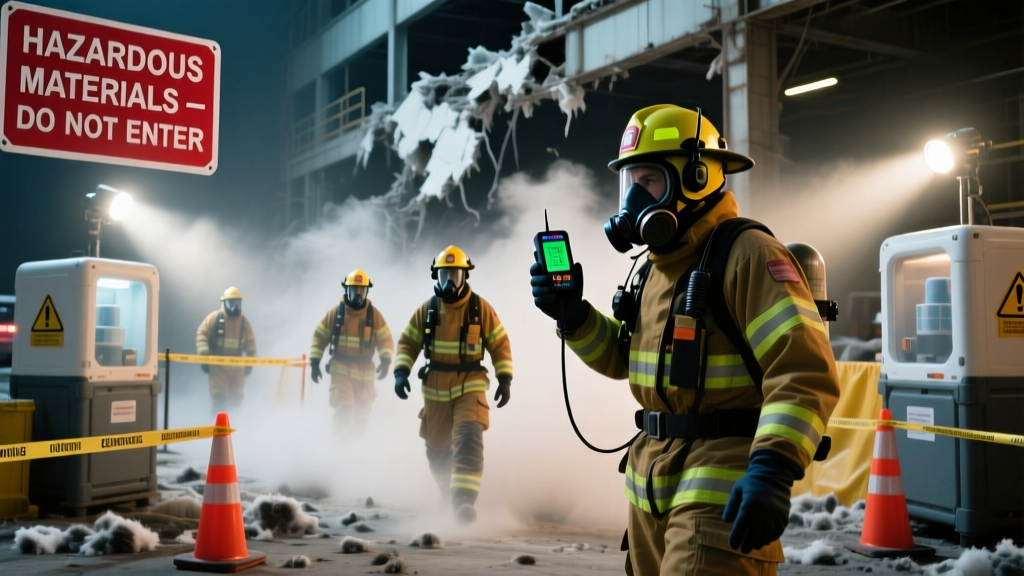
Stop moving. Do not walk through or near the area. If you see dusty debris from insulation, pipe wrap, or ceiling tiles—especially in buildings built before 1981—assume it contains asbestos and act within seconds.
Immediate Actions
- Evacuate everyone from the affected area immediately—no exceptions, even for pets.
- Close doors and HVAC vents to the zone; shut off forced-air systems to prevent fiber spread.
- Wash exposed skin with soap and cool water (do not scrub); remove outer clothing and seal in a plastic bag.
- Move to fresh air outdoors, upwind if possible, and stay there until cleared by professionals.
When to Call 911 / When to Call a Pro
If someone is showing respiratory distress—wheezing, coughing, shortness of breath—or has inhaled visible dust during demolition or renovation, call 911 immediately. Do not wait for symptoms to worsen.
For confirmed or suspected asbestos disturbance without acute symptoms, contact a licensed asbestos abatement contractor within 2 hours. According to the EPA’s Asbestos Emergency Response Act Guidance (2022), uncontrolled release into occupied space requires professional assessment before re-entry.
- Call 911 if: respiratory distress, chest pain, or accidental inhalation during active work
- Call a certified abatement pro if: dusty debris found in attic, basement, or around old ductwork; suspect material was sanded, drilled, or broken
What NOT to Do
- Never use a vacuum cleaner—even HEPA models—on suspected asbestos dust (it will blow fibers into the air).
- Do not sweep, dust, or wipe surfaces with dry cloths.
- Avoid turning on fans, AC, or exhaust systems that could circulate fibers.
- Don’t attempt DIY removal, testing, or cleanup—this violates OSHA regulation 29 CFR 1926.1101.
After the Emergency
Once evacuated and safe, document everything: take photos from outside the zone, note time/date, and list who was present. Keep sealed clothing bags labeled with date and location. Do not re-enter until clearance is issued by an accredited industrial hygienist.
The U.S. EPA estimates that over 70% of asbestos-related exposures occur during untrained cleanup attempts—not during initial disturbance. That’s why containment and documentation are non-negotiable first steps.
"One minute of unprotected exposure to airborne asbestos fibers can deliver a lifetime dose. The priority isn't 'how much' was released—it's whether fibers became respirable." — Dr. Elena Ruiz, NIOSH Asbestos Exposure Unit, 2023
How long does asbestos stay airborne?
Fibers can remain suspended for 48–72 hours in still air—but longer if disturbed again. HVAC operation or foot traffic extends suspension dramatically. Air monitoring must run for at least 24 hours post-containment before clearance.
Can I test the material myself?
No. Home test kits are unreliable and risk further aerosolization. Only labs accredited by the National Voluntary Laboratory Accreditation Program (NVLAP) can validate samples—and those require collection by trained personnel per ASTM D7205-21.
What if it’s just one cracked tile?
Even small damage matters. A single 12"x12" vinyl-asbestos floor tile may contain 1–5% chrysotile. If broken, sanded, or dry-scraped, it releases measurable fibers. Seal the area with heavy-duty polyethylene and duct tape, then call a pro—don’t delay.
Is asbestos dangerous if it’s not crumbling?
Intact, undisturbed asbestos-containing material (ACM) poses minimal risk. But any abrasion, drilling, sanding, or water damage compromises its matrix. Per the asbestos testing costs guide, visual inspection alone cannot confirm stability.
Do I need medical testing after exposure?
Not immediately—but record the incident with your primary care provider. Chest X-rays or pulmonary function tests are only recommended years later if symptoms develop. The latency period for asbestosis or mesothelioma ranges from 10–50 years. Track exposure details using the exposure log template.
What about my HVAC system?
If the disturbance occurred near ductwork or vents, assume contamination. Turn off the system and cover registers with plastic sheeting and tape. A certified HVAC specialist must inspect and clean ducts before reuse—standard cleaning won’t remove embedded fibers.
| Activity | Fiber Release Risk | Required PPE |
|---|---|---|
| Drilling into ACM pipe wrap | Extreme | Powered air-purifying respirator (PAPR), Class III suit |
| Sanding popcorn ceiling | Critical | Half-mask respirator with P100 filters, disposable coveralls |
| Walking past intact tile | Negligible | None (if undisturbed) |
| Cleaning dust with broom | High | Not permitted—requires wet-wipe + HEPA vacuum protocol |
Re-entry requires written clearance from a third-party industrial hygienist—not the abatement contractor. For help finding certified professionals, consult the state-certified abatement contractors directory. Never resume work or occupancy without documented air clearance at <0.01 fibers per cubic centimeter (f/cc)—the EPA’s strictest standard for re-occupancy.