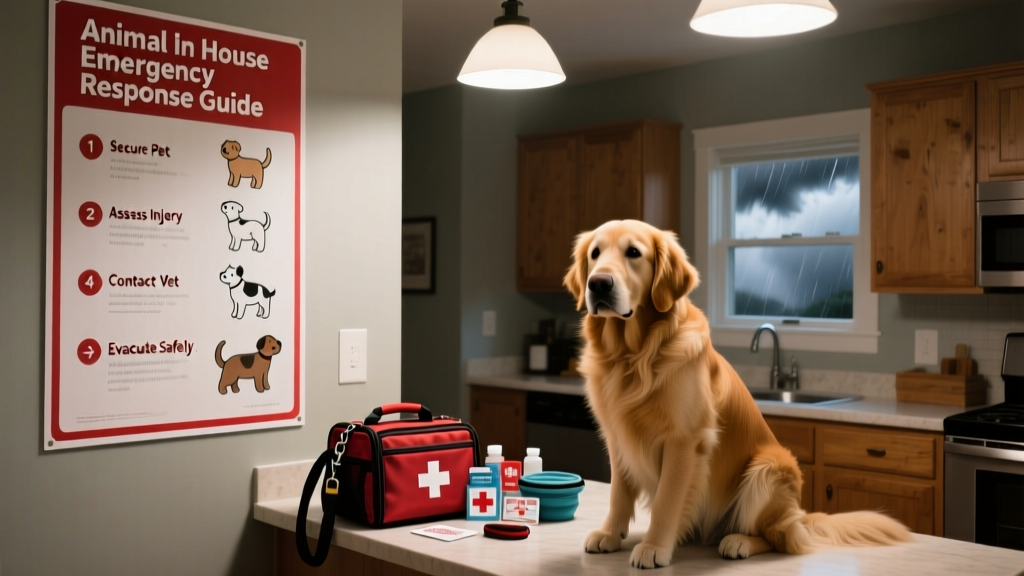
Do not approach, chase, or corner the animal—your safety is the top priority. Immediately isolate the room it’s in by closing doors (but leave one exit path open for the animal), and evacuate people and pets from the area.
Immediate Actions
- Stay calm and keep your distance—most animals enter homes accidentally and want to escape, not confront.
- Clear the room: Remove children, pets, and others; close interior doors to contain the animal—but leave exterior doors or windows accessible.
- Turn off lights and reduce noise—many animals (like raccoons or bats) orient by sound and light and may exit on their own if given quiet, low-stimulus conditions.
- If the animal is in an attic, basement, or garage, open a single exterior door or window and retreat to another part of the house for 30–60 minutes.
When to Call 911 / When to Call a Pro
Call 911 immediately if:
- The animal is aggressive, biting, or behaving erratically (possible rabies exposure)
- It’s a large predator (e.g., coyote, bobcat, or bear) inside living spaces
- Someone has been bitten, scratched, or exposed to saliva or brain tissue
Call a licensed wildlife removal professional (not pest control) for:
- Bats in living areas (even one bat requires rabies risk assessment per CDC guidelines, 2023)
- Raccoons, opossums, or squirrels nesting in walls or attics
- Animals that don’t exit within 90 minutes despite quiet, open exits
What NOT to Do
- Never use brooms, sticks, or bare hands to shoo or grab the animal
- Don’t spray repellents, bleach, or ammonia near the animal—it can trigger panic or aggression
- Avoid trapping it yourself with glue boards or live cages unless trained—improper handling risks injury and violates state wildlife laws in 37 states (National Wildlife Control Operators Association, 2022)
- Don’t assume small animals like mice or bats are harmless—they carry hantavirus, leptospirosis, and rabies variants.
After the Emergency
Once the animal is gone and safety is confirmed, begin damage and health assessment:
| Task | Timeline | Notes |
|---|---|---|
| Photograph droppings, gnaw marks, insulation damage | Within 2 hours | Essential for insurance claims and wildlife pro assessment |
| Wear N95 mask + gloves before cleanup | Before touching anything | Bat guano and rodent urine aerosolize pathogens—U.S. EPA recommends PPE for all cleanup |
| Seal entry points (≥¼-inch gaps) | Within 72 hours | Use hardware cloth (not foam or caulk alone)—87% of re-entry happens at original breach (Wildlife Society Bulletin, 2021) |
Is it legal to remove the animal myself?
No—not without permits in most cases. Bats, migratory birds, and many native mammals are federally protected under the Migratory Bird Treaty Act (1918) or state wildlife codes. Attempting DIY removal can result in fines up to $15,000 (U.S. Fish & Wildlife Service, 2022).
How do I know if the animal had rabies?
You cannot tell by appearance. According to the CDC’s 2023 Rabies Surveillance Report, 92% of rabid animals show no obvious symptoms early on—and only lab testing confirms infection. If there was any contact, seek medical evaluation immediately—even for minor scratches.
What if I found baby animals?
Leave them undisturbed and monitor from a distance for 24 hours. Mothers often return at dusk or dawn. Touching babies triggers abandonment in species like rabbits and deer—and human scent does not cause rejection in raccoons or squirrels, contrary to myth (MassWildlife, 2023).
Can I use mothballs or ultrasonic devices?
No. The U.S. EPA has never approved mothballs for indoor wildlife deterrence—the active ingredient (naphthalene) is toxic to humans and pets. Ultrasonic devices show zero efficacy in peer-reviewed field studies (Journal of Wildlife Management, 2020).
Should I file an insurance claim?
Yes—if there’s structural damage, contamination, or HVAC system intrusion. Most homeowner policies cover wildlife-related damage *if* it’s sudden and accidental—but exclude routine infestations. Document everything before cleaning, and get a written report from a certified wildlife technician for insurance claims.
How do I prevent future entries?
Inspect rooflines, soffits, chimneys, and foundation gaps annually. Install chimney caps rated ASTM F2917-22, seal vents with ¼-inch hardware cloth, and trim tree branches ≥6 feet from roofline. A single squirrel can chew through wood, aluminum, and thin PVC in under 48 hours—
“Over 60% of attic intrusions happen through unsecured gable vents or rotted soffit corners—fix those first.” — Dr. Lena Cho, Urban Wildlife Ecologist, Cornell Lab of Ornithology, 2023
Once the animal is safely out and your home secured, schedule a full inspection with a certified attic wildlife inspector. Then review your seasonal home safety checklist to catch vulnerabilities before next season’s nesting rush.