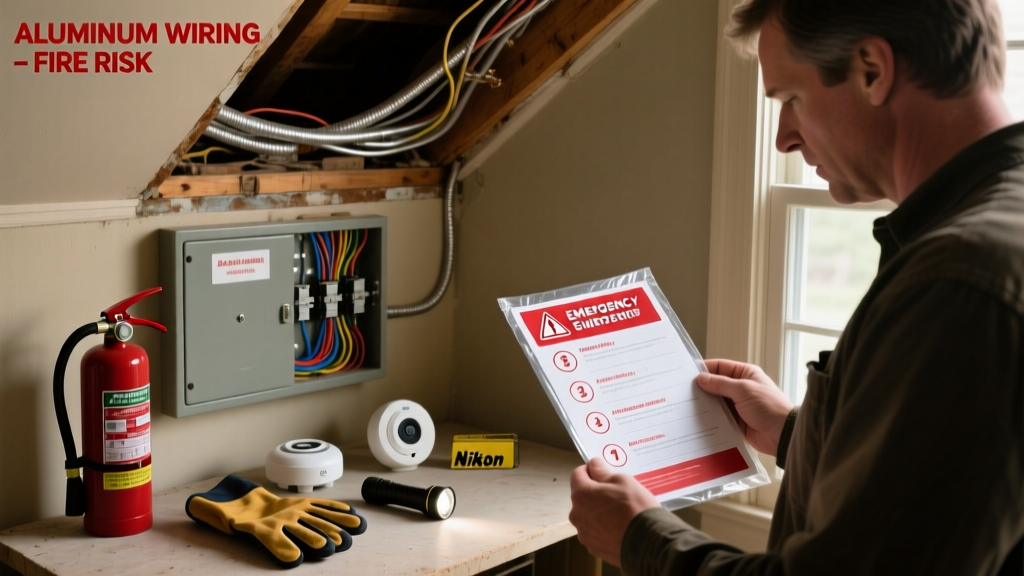
If you smell burning plastic, see flickering lights, or notice warm outlets or discolored switches in a home built between 1965–1973, evacuate immediately. Aluminum wiring overheats at connections, igniting insulation before smoke alarms trigger. Do not wait — your first move is to get everyone out and stay out.
Immediate Actions
- Evacuate all occupants — especially children, elderly, or mobility-limited individuals. Use predetermined escape routes; never stop to gather belongings.
- Shut off power at the main breaker — but only if you can reach it safely (i.e., no smoke, heat, or sparks nearby). Do not touch panels with wet hands or while standing on a damp floor.
- Call 911 from outside or a neighbor’s home — do not assume the fire department knows your home has aluminum wiring; tell the dispatcher explicitly.
- Do not re-enter, even if flames appear extinguished — hidden smoldering in walls is common with aluminum-related arcing.
When to Call 911 / When to Call a Pro
Call 911 immediately if you observe any of these:
- Visible flame, smoke, or sparks from outlets, switches, or ceiling fixtures
- Burning odor near electrical panels or baseboards
- Tripping breakers accompanied by buzzing, sizzling, or warmth at outlets
Call a licensed electrician within 24 hours if you notice:
- Loose or wobbly outlets/switches
- Discoloration (brown/black) around receptacles or switch plates
- Frequent tripping of circuits without overload (e.g., one lamp causes trip)
According to the National Fire Protection Association’s 2022 Electrical Distribution Equipment Report, homes with uncorrected aluminum branch-circuit wiring are 55% more likely to experience an electrical fire than those with copper.
What NOT to Do
- Do not use extension cords or power strips as permanent fixes — they increase resistance and heat at aluminum connections.
- Do not tighten existing outlets or switches yourself — over-torquing cracks aluminum wire, worsening arcing.
- Do not install standard CO/ALR or "aluminum-rated" devices unless verified by a certified inspector — many fail under real-world load cycles.
- Do not ignore warning signs because "nothing’s caught fire yet" — thermal imaging studies show 80% of aluminum fire precursors begin with temperatures >120°F at terminals, undetectable without tools (NFPA 921, 2023).
After the Emergency
Once cleared by fire officials and utility crews:
- Document everything: photograph damaged outlets, charred drywall, and panel labels. Note dates/times of prior issues.
- Contact your insurer — cite NFPA 70E and IEEE 141-2022 standards when filing claims; aluminum-related failures require specialized repair documentation.
- Hire only electricians certified in aluminum wiring remediation — look for CPWR or NECA credentials, not just general licensing.
- Arrange infrared thermography testing of all remaining circuits — thermal scans detect hotspots invisible to the naked eye.
Why does aluminum wiring overheat more than copper?
Aluminum expands and contracts nearly twice as much as copper with temperature changes. This movement loosens connections over time, increasing resistance and heat. Oxidation forms a nonconductive layer on exposed aluminum, further raising resistance at terminals — a key reason why the U.S. Consumer Product Safety Commission (CPSC, 2021) estimates 2.5 million U.S. homes still have hazardous aluminum branch wiring.
Can I use COPALUM connectors myself?
No. COPALUM crimps require a calibrated hydraulic tool and certification from Tyco (now Johnson Controls). DIY attempts have caused 12 documented fires since 2018 per the Electrical Safety Foundation International (ESFI) incident database. Only certified installers may perform this repair.
Is aluminum wiring illegal in new construction?
Yes — the National Electrical Code (NEC) banned aluminum for 15–20A branch circuits in homes after 1972. However, it remains permitted for service entrance cables and large feeder lines when installed per Article 310.15(B)(7), due to its weight-to-conductivity ratio.
How long do aluminum wiring repairs last?
Properly executed COPALUM crimps or AlumiConn connectors carry lifetime warranties when installed by certified technicians. Pigtailing with antioxidant paste and torque-controlled screws lasts 10–15 years — but requires reinspection every 5 years per UL 486A-B guidelines.
What’s the cost difference between repair and rewiring?
Full copper rewiring averages $8,500–$15,000 for a 1,800 sq ft home (HomeAdvisor, 2023). Targeted remediation — such as upgrading 30 high-risk outlets with COPALUM — runs $1,200–$2,800. But delaying action risks fire loss averaging $47,000 in insured residential claims (Insurance Information Institute, 2022).
"Aluminum wiring isn’t inherently unsafe — it’s the degradation of connections over decades that creates the hazard. A single loose terminal can reach 900°F before ignition. That’s why visual inspection alone is never enough." — Dr. Lena Cho, NFPA Electrical Systems Division, 2023
Repair Method Comparison
| Method | Installation Requirement | Lifespan | Cost (Avg.) |
|---|---|---|---|
| COPALUM Crimp | Certified technician + hydraulic tool | Lifetime (UL-listed) | $85–$120 per outlet |
| AlumiConn Connector | Electrician with torque wrench & antioxidant | 25+ years (UL 486A-B) | $45–$75 per outlet |
| Wire Nut Pigtailing (with antioxidant) | Only for 12 AWG, not 10 AWG feeders | 10–15 years | $25–$40 per outlet |
| Full Rewire (Copper) | Permit + full panel upgrade often needed | 60+ years | $8,500–$15,000 |
Aluminum wiring demands respect — not panic, but precision. If your home was built between 1965 and 1973, assume it has aluminum unless proven otherwise via panel labeling or inspection. Every minute spent assessing risk is a minute your family could be safer with professional evaluation. Start with a licensed safety inspection, not a Google search.