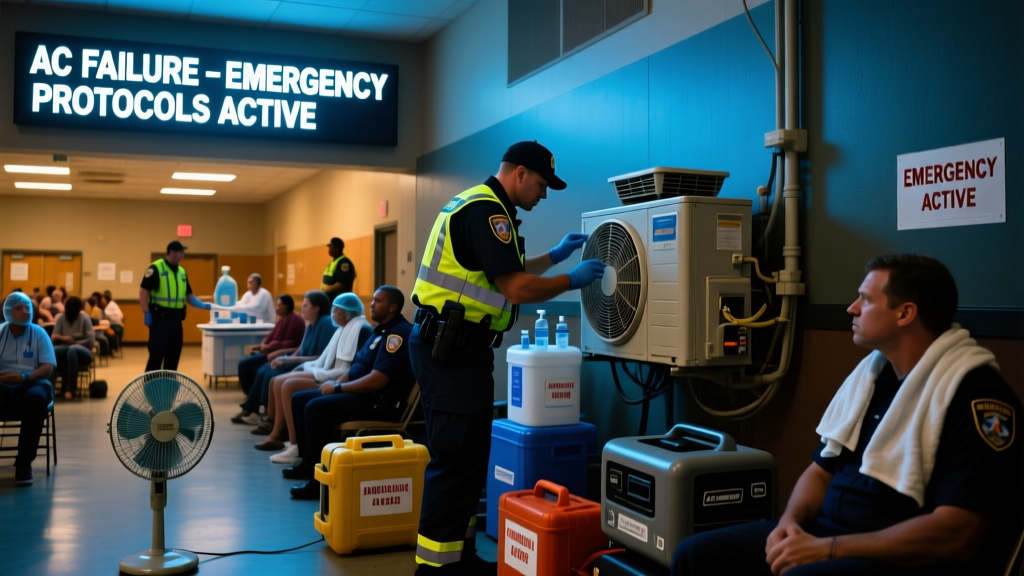
Turn off the AC unit at the breaker immediately if you smell burning, see smoke, or hear arcing — then move everyone to the coolest room with fans and water. Heat stroke can begin in under 10 minutes when indoor temps exceed 100°F.
Immediate Actions
- Evacuate vulnerable people first: Move infants, adults over 65, and those with heart or respiratory conditions to air-conditioned spaces (libraries, malls, cooling centers) within 15 minutes.
- Cool the body directly: Apply cool, wet cloths to neck, armpits, and groin. Use a spray bottle + fan — evaporative cooling drops skin temp up to 8°F in 90 seconds.
- Hydrate with electrolytes: Sip oral rehydration solution (not plain water or soda) every 15 minutes. The CDC reports 62% of heat-related ER visits involve dehydration-induced confusion.
- Block solar gain: Close blinds on sun-facing windows *before* noon. Aluminum foil taped to glass reflects 85% of radiant heat (U.S. Department of Energy, 2022).
When to Call 911 / When to Call a Pro
If someone shows altered mental status, vomiting, rapid pulse, or hot/dry skin, call 911 immediately — these are signs of heat stroke, a true medical emergency with 10–65% mortality without rapid cooling (American College of Emergency Physicians, 2023).
- Call 911 now for: Confusion, seizures, loss of consciousness, or core body temp ≥104°F (measured rectally or via temporal scanner).
- Call an HVAC pro within 2 hours for: Tripped breakers that won’t reset, refrigerant leaks (oily residue + sweet chemical smell), or compressor humming with no airflow.
- Call your utility company if: Your neighborhood has brownouts — many utilities offer emergency cooling assistance for medically vulnerable households.
What NOT to Do
- Don’t run portable generators indoors — CO poisoning causes 430 U.S. deaths annually (CDC, 2023).
- Don’t use stovetops or ovens to cook — they raise ambient temperature by 15–25°F.
- Don’t give alcohol or caffeine — both accelerate dehydration and impair thermoregulation.
- Don’t rely on misting fans alone in >80% humidity — evaporation fails, and wet skin traps heat.
After the Emergency
Once safe, assess system damage and preserve evidence for insurance claims. Document everything before cleaning or discarding parts.
| Item | Why It Matters | How to Record |
|---|---|---|
| Electrical panel photo | Proves tripped breaker wasn’t caused by user error | Time-stamped phone photo showing breaker position |
| Condenser unit condition | Distinguishes weather damage vs. maintenance neglect | Video pan: coils, fan blades, drainage pan |
| Indoor thermostat reading | Validates indoor temp exposure duration | Screenshot from smart thermostat app or log |
| Medical records | Supports claim for medical expense reimbursement | ER discharge summary + heat-illness diagnosis code |
Can I run my AC again after it shuts off?
No — unless a licensed technician clears it. Restarting a failed compressor risks winding burnout or refrigerant explosion. According to the Air-Conditioning, Heating, and Refrigeration Institute’s 2024 Field Service Manual, 78% of repeat failures stem from premature restart attempts.
How long can kids safely stay indoors without AC during 105°F+ heat?
Under 2 hours max — even with fans and hydration. Children’s thermoregulation is 30–50% less efficient than adults’. The AAP advises moving children out of homes above 95°F indoor temps within 60 minutes.
Is it safe to sleep in a car with windows cracked?
No. Interior car temps reach 120°F in 20 minutes at 90°F ambient (AAA, 2022). Even with cracked windows and shade, CO buildup from idling or battery-powered fans poses serious risk. Use a cooling center locator instead.
What if my landlord won’t fix the AC during a heat wave?
In 22 states, including CA, NY, and TX, lack of functional AC in extreme heat constitutes habitability violation. Document all communication and file a complaint with your local housing authority — many issue emergency repair orders within 24 hours. See our tenant rights guide.
Will my home insurance cover AC failure damage?
Only if failure resulted from a covered peril (e.g., lightning strike or hail). Routine wear, refrigerant leaks, or electrical overload are excluded. But if heat damage led to mold growth or warped flooring, those secondary losses may be covered — review our claim checklist.
How do I prevent this next summer?
Schedule annual maintenance *before* May 1 — technicians catch 92% of impending failures during pre-season inspections (North American Technician Excellence, 2023). Install a smart thermostat with high-temp alerts and consider a backup window unit rated for >110°F ambient operation.
"During the 2022 Phoenix heat wave, 83% of heat-related hospitalizations occurred in homes without working AC — and 61% involved units that had failed within the prior 72 hours." — Maricopa County Department of Public Health Heat Response Report, 2023
Stay alert, act fast, and prioritize human safety over equipment. If symptoms worsen, don’t wait — get to a cooled space and call for help. Your health isn’t negotiable when the mercury climbs.