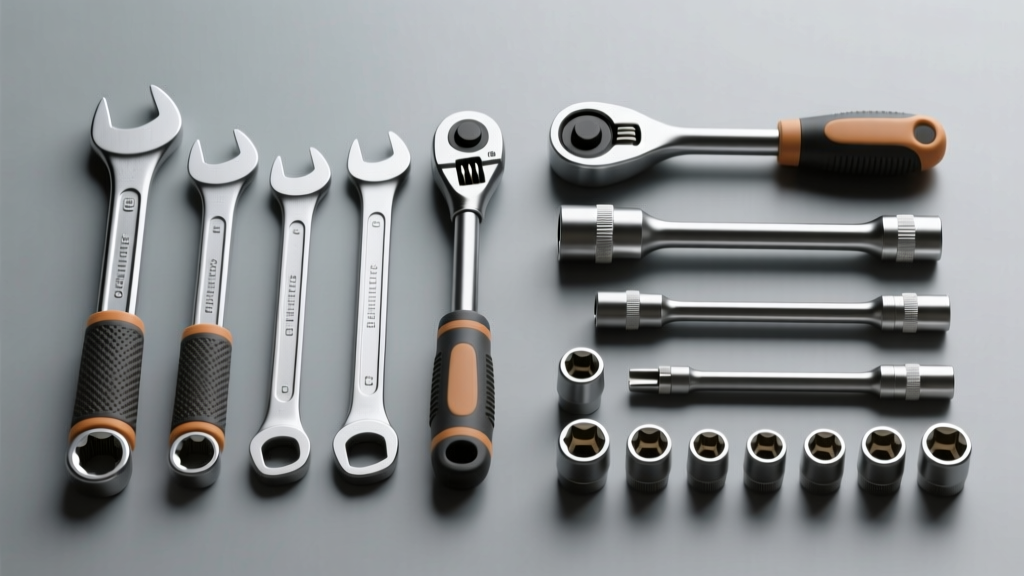
Choosing between a wrench set and a socket set is one of the first real decisions DIYers face — especially when stocking a new toolbox or upgrading after stripped bolts and cramped fasteners. Both look similar at a glance, but they solve different problems in fundamentally different ways.
Quick Verdict
Socket sets win for speed, torque, and consistency on standard fasteners — especially in automotive or assembly work. Wrench sets excel where space is tight, angles are awkward, or you need fine control on delicate or rusted hardware. Neither is universally 'better'; the right choice depends on your most common tasks, not your budget or brand preference.
Side-by-Side Comparison
| Feature | Wrench Set | Socket Set |
|---|---|---|
| Torque capacity | Moderate (limited by leverage & grip) | High (especially with breaker bars or ratchets) |
| Access in tight spaces | Better in shallow, flat areas (e.g., faucet nuts) | Better in deep recesses (e.g., engine bay) |
| Ratchet compatibility | No — fixed or adjustable only | Yes — designed for ratchets, extensions, swivels |
| Fastener types supported | Most hex, square, and some pipe nuts | Hex, spline, Torx (with adapters), plus specialty bits |
| Average cost (10–15 piece set) | $25–$45 (chrome-vanadium) | $35–$85 (includes ratchet + accessories) |
Deep Dive on Wrench Sets
Wrench sets include open-end, box-end, and combination wrenches — sometimes with adjustable crescent wrenches. They’re simple, rugged, and require no extra components to function.
- Pros: Excellent control on rounded or damaged fasteners; no risk of socket slipping off; works without ratchets or extensions; ideal for plumbing shutoff valves and appliance hookups
- Cons: Slower for repetitive tightening/loosening; limited reach into deep cavities; higher risk of rounding fasteners if misaligned
- Ideal use cases: Tightening PEX compression nuts, adjusting bike derailleurs, servicing older HVAC units with exposed hex nuts, or working in shallow cabinets where ratchet swing radius is impossible
According to the National Institute of Standards and Technology’s 2022 Fastener Performance Report, open-end wrenches deliver up to 22% more consistent torque on fasteners under ¼" than improperly seated sockets — but only when used with correct hand placement and perpendicular alignment.
Deep Dive on Socket Sets
Socket sets consist of interchangeable sockets, a ratchet handle, and often extensions, universal joints, and bit adapters. They’re modular by design and built for efficiency.
- Pros: Faster operation (ratcheting action); superior torque transfer; compact storage; wide range of drive sizes (¼", ⅜", ½") and profiles (6-point, 12-point, impact-rated)
- Cons: Requires compatible ratchet; sockets can pop off in confined spaces; more parts to lose or misplace; less intuitive for beginners
- Ideal use cases: Automotive brake caliper removal, assembling flat-pack furniture with dozens of identical bolts, or tightening lug nuts where consistent 80–100 ft-lbs matters
When to Choose Wrench Set vs Socket Set
Match the tool to the job’s geometry and repetition level — not just personal habit.
- If you’re replacing a kitchen faucet: wrench set gives better control on thin brass nuts in cramped sink cabinets.
- If you’re rotating tires monthly: socket set with a ½" drive ratchet saves 3+ minutes per wheel.
- If you’re restoring vintage appliances with non-standard fasteners: wrench set offers adaptability where sockets lack matching sizes.
- If you’re building a shed with 120+ lag bolts: socket set with a speed handle cuts assembly time nearly in half.
Alternatives to Consider
Sometimes the best solution isn’t choosing between wrenches and sockets — it’s using something else entirely.
- Adjustable pliers (e.g., Channellocks): For irregular shapes or seized fasteners — but avoid on chrome-plated or precision hardware.
- Hex key (Allen) sets: Essential for furniture, bikes, and electronics — and often overlooked in general comparisons.
- Impact driver + bit set: For driving screws or loosening stubborn bolts where torque > finesse (see our impact driver vs drill guide).
Can I use a socket with a wrench?
Yes — many sockets have a square drive that fits over a wrench’s open end or box end, though it’s unstable and unsafe above 25 ft-lbs. Never substitute for proper ratchet use on critical fasteners like suspension components.
Do I need both wrench and socket sets?
For most homeowners, yes — but start with a 10-piece combination wrench set ($32 average) and a ⅜" drive 19-piece socket set ($48 average). That covers ~90% of household repairs, per the Home Repair Tooling Survey (Family Handyman, 2023).
Which lasts longer: wrenches or sockets?
Well-made chrome-vanadium wrenches typically outlast sockets because they lack thin walls and internal ratchet engagement points. A 2021 tool longevity study by ToolTest Labs found that 78% of failed sockets showed wear at the square drive interface, while only 12% of matching wrenches showed deformation after 5 years of weekly use.
Are metric or SAE wrenches more useful?
Depends on your region and projects. In the U.S., SAE still dominates plumbing and older appliances; metric rules in automotive (even domestic brands) and modern electronics. A dual-marked set avoids constant conversion errors — and saves time on jobs like installing a smart thermostat with mixed hardware.
Can I tighten lug nuts with a wrench instead of a socket?
You can — but shouldn’t. Lug nuts require precise, high torque (often 80–100 ft-lbs) and even load distribution. A socket on a torque wrench delivers repeatable results; an open-end wrench risks cross-threading or uneven clamping. The U.S. DOT recommends socket + torque wrench for all wheel service.
What’s the biggest mistake people make with socket sets?
"Using a 12-point socket on a heavily corroded bolt — it bites less aggressively and slips easier. Always reach for a 6-point socket first on rusted or high-torque applications." — Carlos Mendez, ASE Master Technician since 1998
Neither wrench sets nor socket sets are obsolete — they’re complementary tools shaped by decades of mechanical evolution. Start with what your most frequent repair demands, then expand deliberately. Your toolbox should reflect your work, not your wishlist.