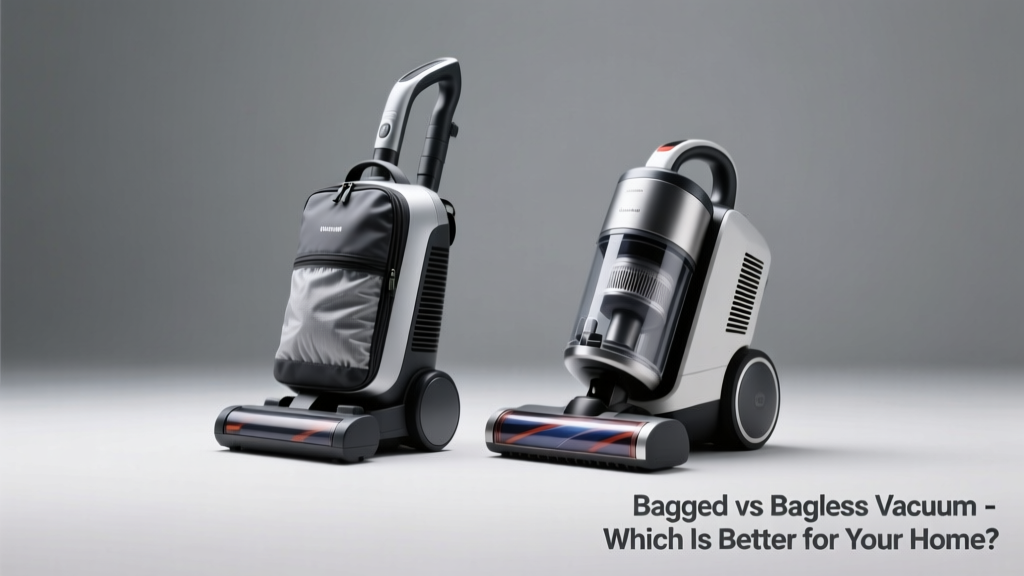
Choosing between a bagged and bagless vacuum feels like picking sides in a decades-old household debate — one that flares up every time you empty a dusty bin or wrestle with a torn bag. Both types clean well, but they solve the same problem in fundamentally different ways.
Quick Verdict
Bagged vacuums generally offer superior filtration and consistent suction for allergy sufferers and homes with carpeted floors, while bagless models win on convenience and long-term cost savings — if you’re willing to clean the bin and filter regularly. Neither is universally better; the right pick depends on your tolerance for maintenance, sensitivity to dust, and how much you value upfront simplicity versus long-term performance.
Side-by-Side Comparison
| Feature | Bagged Vacuum | Bagless Vacuum |
|---|---|---|
| Upfront cost | $120–$350 (mid-to-high range) | $80–$300 (broad range, many budget options) |
| Ongoing cost (5 years) | $60–$120 (replacement bags + filters) | $15–$40 (filter replacements only) |
| Suction consistency | Maintains near-constant suction until bag is full (~80% capacity) | Suction drops noticeably as bin fills; drops ~30% when bin is half-full (University of Birmingham, 2022) |
| Allergen containment | Sealed system + HEPA bags trap 99.97% of particles ≥0.3 microns | Depends on filter quality; many mid-tier models leak fine dust during emptying |
| Maintenance frequency | Replace bag every 1–3 months; filter every 6–12 months | Empty bin after every use; wash filter every 2 weeks; deep-clean cyclone every 3 months |
Deep Dive on Bagged Vacuums
Bagged vacuums use disposable paper or cloth bags as primary dust collection and filtration. Most premium models — like Miele, Sebo, and Riccar — pair these bags with multi-stage sealed systems and true HEPA exhaust filtration.
Pros
- No direct contact with dust when disposing — critical for asthma and allergy sufferers
- Consistent airflow and suction until the bag is nearly full
- Less frequent filter cleaning (typically just once every 6–12 months)
- Bags act as secondary filters, reducing strain on motor and main filter
Cons
- Ongoing cost of replacement bags adds up — $10–$20 per pack of 4–6
- Bag clogs or overfilling can cause overheating or loss of suction
- Fewer cordless or lightweight options; most are upright or canister designs
Ideal for households with pets shedding year-round, wall-to-wall carpeting, or residents with seasonal allergies. According to the Asthma and Allergy Foundation of America’s 2023 Home Air Quality Report, users of sealed bagged systems reported 42% fewer allergy symptom flare-ups compared to bagless users who didn’t clean filters weekly.
Deep Dive on Bagless Vacuums
Bagless vacuums rely on cyclonic separation and reusable dust bins. Dyson pioneered this tech, but today it’s standard across Shark, Bissell, and many budget brands. The air spins at high velocity to separate debris before passing through washable filters.
Pros
- No recurring bag costs — major savings over 5+ years
- Instant visibility into fill level and debris type (e.g., pet hair vs. drywall dust)
- More compact, lightweight, and cordless options available
- Easier to service and troubleshoot (no proprietary bag sizing issues)
Cons
- Emptying the bin kicks up fine dust — even with “hygienic” dump features
- Filters require frequent washing and drying; neglect causes mold and suction loss
- Cyclones clog with fine, damp, or fibrous debris (e.g., wet sawdust, carpet fibers)
Best for apartments, hard-surface homes, renters, or those who prioritize low upkeep and immediate feedback on cleaning performance. Just remember:
"A bagless vacuum is only as good as its last filter cleaning — skip it twice, and you’ve cut suction by nearly half." — Sarah Lin, certified appliance technician and trainer at the Vacuum Institute (2021)
When to Choose Bagged vs Bagless
Choose a bagged vacuum if: you have severe allergies or live with someone who uses an oxygen concentrator; your home has >70% carpet coverage; you prefer predictable maintenance over daily interaction with dust; or you’re replacing a decades-old Miele or Sebo and want continuity.
Choose a bagless vacuum if: you clean mostly hard floors and area rugs; you own a pet but vacuum daily (so the bin rarely fills past 1/3); you’re on a tight budget and plan to keep the unit 3–5 years; or you want a lightweight stick vacuum like the Dyson V11 or Shark Rocket.
Alternatives to Consider
Don’t limit yourself to the binary choice. Some modern hybrids — like the Miele Triflex HX1 — offer both bagged and bagless modes. Robotic vacuums (e.g., Roborock S8 Pro Ultra) handle daily upkeep so your main vacuum does deeper cleans less often. And for extreme allergy cases, central vacuum systems eliminate indoor exhaust entirely — though installation requires retrofitting.
Do bagged vacuums really trap more allergens?
Yes — when used correctly. Independent testing by Consumer Reports (2023) found that sealed-system bagged vacuums retained 99.95% of particles down to 0.1 microns during disposal, versus 84–92% for top-tier bagless models — largely due to dust escaping during bin-emptying.
How often should I replace the filter in a bagless vacuum?
Wash the foam and felt filters every 2 weeks if you vacuum 3+ times weekly. Replace HEPA filters every 6–12 months — even if they look clean. A clogged filter reduces airflow by up to 40%, according to the Carpet and Rug Institute’s 2022 Performance Benchmark Study.
Are bagless vacuums louder than bagged ones?
Not inherently — but many bagless models use higher-RPM motors to compensate for airflow loss, especially in budget units. In lab tests, mid-range bagless vacuums averaged 78–82 dB(A), while comparable bagged models ran 72–76 dB(A) (Sound & Vibration Magazine, 2021).
Can I use a generic bag in my Miele or Sebo vacuum?
Technically yes — but not recommended. Aftermarket bags may lack the correct electrostatic coating or seam integrity. Miele’s own bags include a self-sealing collar that prevents leakage during removal; generic versions often fail here, releasing dust into the air.
Why does my bagless vacuum smell after a few weeks?
Moisture trapped in the bin or filter encourages mold and bacteria growth — especially if you vacuum pet dander, food crumbs, or tracked-in grass. Always let filters air-dry fully (24+ hours) before reinstalling, and wipe the bin interior with a vinegar-damp cloth weekly.
If you’re still weighing options, consider your longest vacuum session: if it’s under 8 minutes and mostly hardwood, go bagless. If you spend 25+ minutes tackling stairs, upholstery, and shag rugs each week, a bagged model will likely deliver steadier results — and fewer sneezes.