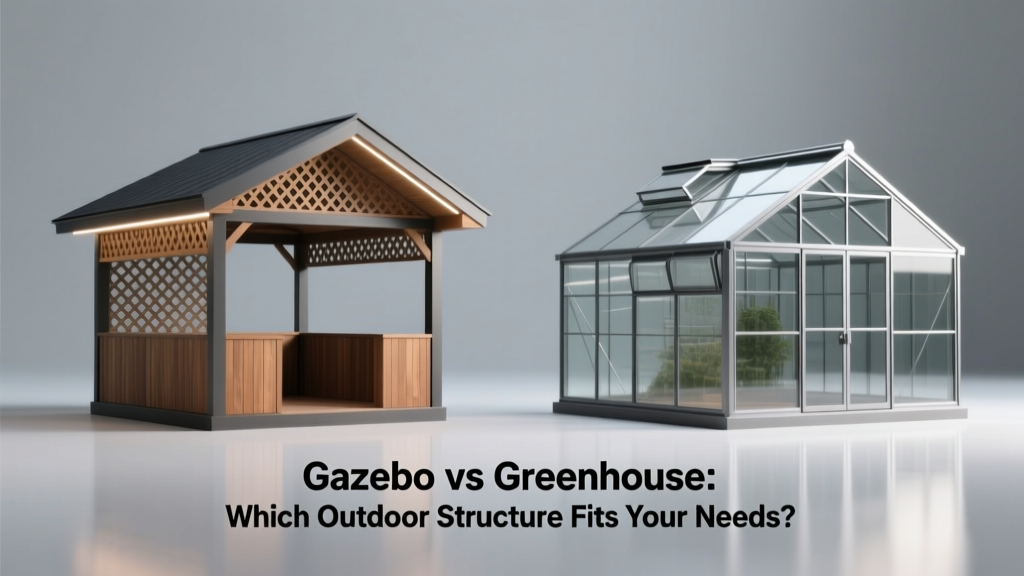
You’re standing in your backyard, picturing something new: shade and summer cocktails? Or tomato vines climbing trellises by March? Both gazebos and greenhouses occupy outdoor space, look inviting, and cost thousands—but they solve entirely different problems. Confusing them leads to costly regrets.
Quick Verdict
A gazebo is for people who want sheltered outdoor living; a greenhouse is for people who want controlled plant production. Neither is "better" universally—it depends on whether your priority is human comfort or plant growth. If you need both, consider a hybrid design—or two separate structures. According to the National Gardening Association’s 2023 survey, 68% of greenhouse owners use theirs year-round for seed starting and overwintering, while only 12% of gazebo owners report using theirs for anything beyond occasional shade or entertaining.
Side-by-Side Comparison
| Feature | Gazebo | Greenhouse |
|---|---|---|
| Primary purpose | Outdoor leisure & shelter | Plant propagation & climate control |
| Average cost (8'×10') | $2,400–$6,800 (wood/metal) | $3,200–$12,500 (polycarbonate/glass) |
| Build time | 2–5 days (prefab); 2–4 weeks (custom) | 3–10 days (kit); 4–12 weeks (custom glazing) |
| Year-round usability | Limited in snow/ice; no heating standard | Yes—with supplemental heat, ventilation, and shading |
| Permit requirements | Rarely required under 120 sq ft (varies by municipality) | Often required—especially for foundations, electrical, or plumbing |
Deep Dive on Gazebo
Gazebos are freestanding, open-sided (or partially screened) structures with a roof—traditionally octagonal or hexagonal, though square and rectangular models dominate today’s prefab market. They prioritize aesthetics, airflow, and integration with patios or decks.
Pros
- No need for foundation footings in many jurisdictions if under 120 sq ft and less than 6' tall
- Easy to screen, shade, or add lighting for evening use
- High resale value appeal—HGTV’s 2022 Home Value Report notes gazebos boost curb appeal more than sheds or pergolas
Cons
- Minimal insulation—unusable below 40°F without portable heaters (and even then, condensation risk rises)
- Not designed for humidity control; wood framing can rot faster in damp coastal climates
- Zero structural capacity for hanging grow lights, irrigation lines, or vertical trellising systems
Best for: Backyard entertainers, retirees wanting shaded reading nooks, homeowners in USDA Zones 7–10 with mild winters, or those adding value before listing. Not ideal if you’ve already built raised beds but lack space to start seeds indoors.
Deep Dive on Greenhouse
A greenhouse is an enclosed, transparent or translucent structure engineered for light transmission, temperature retention, and humidity management. Modern versions use twin-wall polycarbonate (R-value ~1.5), automated vents, and thermostatically triggered fans—not just glass panes and hope.
Pros
- Extends growing season by 6–10 weeks in spring/fall (University of Vermont Extension, 2021)
- Enables propagation of tender perennials like citrus, orchids, and figs in colder zones
- Can integrate hydroponics, drip irrigation, and CO₂ enrichment for commercial-scale yields
Cons
- Requires active management—ventilation failure on a 75°F sunny day can cook seedlings in under 90 minutes
- Higher insurance liability: glass breakage, wind uplift, and snow load failures account for 23% of small-structure insurance claims (ISO Claims Database, 2022)
- Low visual appeal unless clad in cedar or integrated into landscape architecture
Best for: Serious gardeners, homesteaders, educators running school gardens, or anyone aiming to grow food year-round. A greenhouse won’t host your daughter’s birthday party—but it might feed her family next winter.
When to Choose Gazebo vs Greenhouse
Choose a gazebo if:
- You spend >15 hours/week outdoors but rarely touch soil
- Your yard has full sun exposure but zero frost-free months
- You rent—or plan to move within 3 years (most gazebos are relocatable)
Choose a greenhouse if:
- You’ve killed three basil plants trying to start them on a windowsill
- Your local extension office offers greenhouse workshops—and you attended two
- You need to propagate native pollinator species for habitat restoration projects
One real-world example: A Portland, OR homeowner installed a 10'×12' aluminum gazebo for summer BBQs, then added a 6'×8' lean-to greenhouse against the south wall of their garage—using shared electricity and water lines. That combo delivered both function and flexibility without overbuilding.
Alternatives to Consider
Before committing to either, assess these middle-ground options:
- Cold frames: Low-cost ($85–$320), seasonal, ground-level protection for hardening off seedlings
- Pergolas: Less shelter, more architectural accent—ideal for vine-covered shade with minimal footprint
- Sunrooms: Heated, insulated, code-compliant additions that blur indoor/outdoor lines—but cost 3× more than most greenhouses
Can I convert a gazebo into a greenhouse?
Technically yes—but rarely cost-effective. Retrofitting requires replacing open sides with insulated glazing, adding thermal mass (e.g., concrete floor), installing vents and thermostats, and reinforcing the frame for snow load. Most professionals advise starting fresh: “You’ll spend 70% of a new greenhouse budget just to make a gazebo minimally functional for plants,” says landscape architect Lena Torres in Garden Structures Quarterly, Spring 2023.
Do greenhouses require a building permit?
Yes—most municipalities require permits for any structure over 100 sq ft or with electrical/plumbing. In California, even unheated greenhouses need energy compliance documentation under Title 24. Always check with your local planning department before ordering materials.
How much maintenance does each require?
Gazebos need annual wood sealant (if cedar or redwood), gutter cleaning, and screen patching. Greenhouses demand quarterly glazing inspection, vent lubrication, thermostat calibration, and algae scrubbing from interior surfaces. The U.S. EPA estimates that neglected greenhouse condensation contributes to 14% of residential mold complaints in humid regions.
Which holds value better long-term?
Neither adds appraised square footage—but gazebos consistently score higher in buyer surveys. Zillow’s 2023 Outdoor Living Report found 61% of buyers viewed gazebos as “desirable extras,” versus 33% for greenhouses. However, greenhouses deliver measurable ROI in food savings: University of New Hampshire researchers calculated $1.82 saved per $1 invested in a backyard greenhouse over five years (2022 study).
Can I use both structures together?
Absolutely—and increasingly common. Think: greenhouse for seed starting and cuttings, gazebo for potting up, labeling, and relaxing after harvest. Just ensure at least 10 feet of separation to avoid shading the greenhouse’s southern exposure. Some designers now specify matching timber species and roof pitches so both feel like intentional parts of one outdoor system.
“A greenhouse without observation is just a hot box. A gazebo without intention is just furniture with a roof.” — Dr. Aris Thorne, Horticultural Engineer, Cornell CALS, 2022
If your goal is to grow food, support pollinators, or extend your gardening season, the greenhouse earns its space—even if it means sacrificing a corner of lawn. If your goal is to host friends, read under dappled light, or create a quiet retreat, the gazebo delivers daily joy with far less upkeep. Match the tool to the task, not the trend.