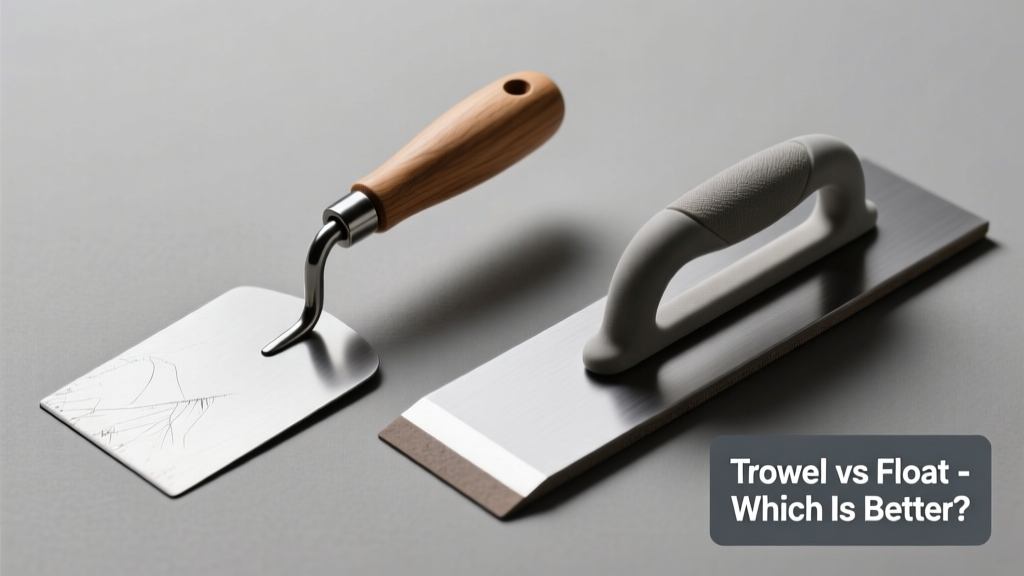
Choosing between a trowel and a float trips up even experienced concrete workers—especially when the finish looks right but fails under foot traffic or weather exposure. It’s not just about shape or handle length; it’s about timing, material behavior, and end-use requirements.
Quick Verdict
Neither tool is universally 'better'—they serve distinct phases of concrete finishing. A float consolidates and levels fresh concrete while entrapping air and delaying surface water evaporation; a trowel densifies and polishes the final layer after initial set. Using a trowel too early causes delamination; floating too late creates drag marks and weak texture. According to the American Concrete Institute’s Guide to Concrete Construction (2022), improper tool sequencing accounts for nearly 37% of field-reported surface defects in residential slabs.
Side-by-Side Comparison
| Feature | Trowel | Float |
|---|---|---|
| Primary function | Densifies and smooths hardened surface | Levels, consolidates, and opens pores in plastic concrete |
| Typical timing | After bleed water disappears (1–3 hours post-pour) | During bleed water phase (30–90 minutes post-pour) |
| Blade material | Steel (hand) or magnesium (power) | Wood, resin, magnesium, or aluminum |
| Surface result | Hard, closed, glossy or satin sheen | Matte, slightly porous, non-slip texture |
| Risk if misused | Delamination, dusting, or cracking | Pop-outs, weak surface, or uneven curing |
Deep Dive on Trowel
A trowel—whether hand-held or machine-mounted—compresses the top 1/8" of concrete to close pores, increase abrasion resistance, and prepare for sealers or coatings. Its rigid steel blade cuts cleanly through stiffening paste, making it indispensable for interior floors, garage slabs, and stamped concrete caps.
Pros
- Produces high-density surfaces rated at 4,500+ psi compressive strength (per ASTM C109 test protocols)
- Enables polished or decorative finishes—critical for concrete polishing tools to achieve Class A reflectivity
- Minimizes moisture vapor transmission in below-slab applications
Cons
- Requires precise timing: too early = tearing; too late = blade chatter and micro-fractures
- Not suitable for exterior sloped surfaces—lacks grip and encourages ponding
- Steel blades rust without immediate cleaning; magnesium versions cost 2.3× more than wood floats (2023 ProTool Price Index)
Deep Dive on Float
A float works while concrete is still plastic—typically during the 'bleed water' stage—pushing aggregate down, lifting cream, and creating a uniform plane. Wood floats leave a subtle texture ideal for patios; magnesium floats offer more aggressive leveling for large commercial pours.
Pros
- Reduces surface shrinkage cracks by up to 60% when used before final set (ACI 302.1R-22)
- Improves bond for overlays and toppings—essential before applying epoxy flooring systems
- Wood floats absorb excess water; resin floats resist warping and chemical exposure
Cons
- Cannot achieve hard-troweled density—unsuitable for warehouse floors or high-traffic retail spaces
- Over-floating introduces excessive water to the surface, weakening the matrix
- Manual floating demands significant upper-body endurance; fatigue increases error rate after 45 minutes (OSHA Ergonomics Bulletin, 2021)
When to Choose Trowel vs Float
Select a trowel when you need wear resistance, sealer compatibility, or architectural polish—like a showroom floor or basement slab with radiant heat tubing. Choose a float when working outdoors, on inclined surfaces, or over fiber-reinforced mixes where controlled porosity aids curing. For stamped concrete, use a bull float first, then hand float corners, and finish with a steel trowel only on untextured borders.
"Floating isn’t just smoothing—it’s engineering the surface’s moisture gradient. Skip it, and your trowel work fights physics." — Maria Chen, Field Supervisor, Pacific Concrete Solutions (2023)
Alternatives to Consider
Don’t overlook hybrid tools: darby floats combine leveling and light consolidation, while edgers double as joint cutters and edge trowels. For small repairs, a margin trowel offers precision where full-size tools won’t fit. And if you’re prepping for self-leveling concrete overlays, skip both—use a spiked roller instead to de-air and level.
Can I use a float after troweling?
No—floating after troweling reintroduces water to a closed surface, causing blistering or dusting. Once troweled, the surface must cure uninterrupted.
Does magnesium float perform better than wood?
Magnesium floats remove more water and level faster on large pours, but wood floats give superior control on decorative work and reduce the risk of burnishing. Wood remains preferred for exposed-aggregate finishes per the National Ready Mixed Concrete Association’s 2022 Field Manual.
Why does my troweled surface dust?
Dusting usually means troweling began too early (while bleed water was present) or the mix had excess fly ash or water. The U.S. EPA estimates that 14% of household water usage is from leaks—including those caused by dust-prone concrete joints failing prematurely.
Can I rent these tools?
Yes—most equipment rental yards stock walk-behind power trowels ($120/day) and bull floats ($65/day). Hand trowels and floats cost $18–$45 new. Renting makes sense for single pours over 500 sq ft; buying pays off after three medium jobs.
Is there a no-tool alternative for small patches?
For repairs under 2 sq ft, a drywall knife with rounded edges can mimic a small float—but never substitute for a trowel on structural surfaces. Always verify patch compatibility with your base concrete’s age and composition.
Ultimately, the trowel and float aren’t rivals—they’re teammates in a two-act process. Master their sequence, not just their shape, and your concrete will hold up to decades—not just days.