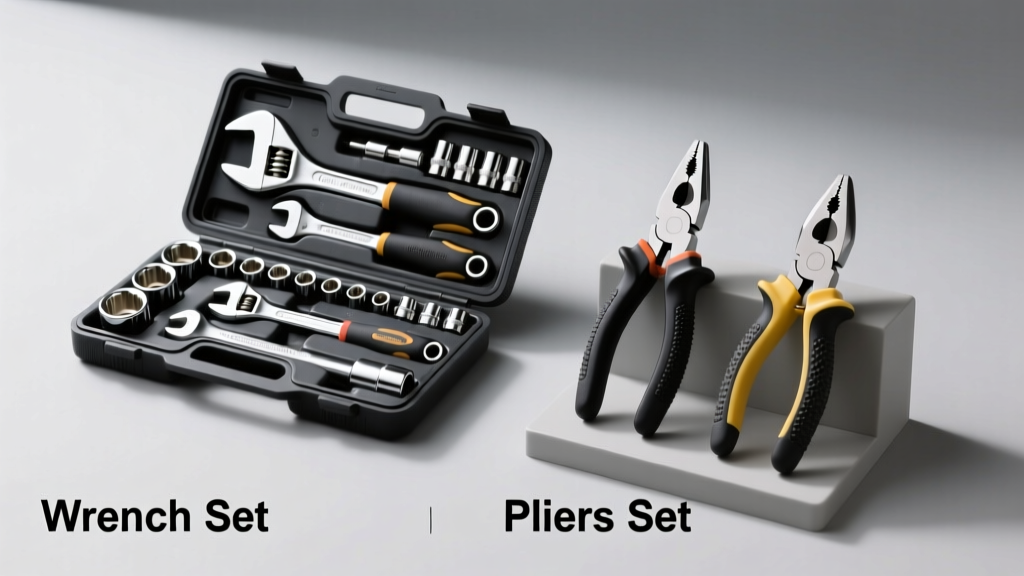
Choosing between a wrench set and a pliers set feels like picking a favorite limb—both are essential, but they serve fundamentally different mechanical roles. You’ve probably reached for adjustable pliers to grab a stubborn bolt only to strip the flats, or tried tightening a flare nut with a wrench and realized you couldn’t fit it in the cramped space behind your sink. That tension is real—and it’s why understanding their core differences matters more than brand loyalty or price alone.
Quick Verdict
Neither tool set is universally "better"—it depends on your task’s mechanical demands. Wrenches deliver precise, high-torque fastening and loosening of standardized fasteners (nuts, bolts, hex fittings). Pliers excel at gripping, bending, cutting, and holding irregular or non-standard objects where wrenches can’t reach or engage. For most homeowners, a basic combination of both—starting with a 10-piece wrench set and a 4-piece pliers set—is the pragmatic baseline. According to the U.S. EPA estimates that 14% of household water usage is from leaks, many caused by improperly tightened or damaged fittings—tools that match the job reduce those failures.
Side-by-Side Comparison
| Feature | Wrench Set | Pliers Set |
|---|---|---|
| Torque delivery | High and repeatable; calibrated for specific fastener sizes | Low-to-moderate; relies on user grip strength and jaw alignment |
| Grip versatility | Limited to standard fastener shapes (hex, square, flare) | High: round, flat, bent, threaded, or damaged objects |
| Cutting capability | None (except specialized combo wrenches with cutters) | Standard on linesman’s and diagonal pliers |
| Adjustability | Fixed-size wrenches require size matching; adjustable wrenches sacrifice precision | Most types feature adjustable jaws (e.g., slip-joint, locking, water pump) |
| Damage risk to fasteners | Low—if correct size used; high if undersized or forced | Moderate-to-high; serrated jaws can mar soft metals or coatings |
Deep Dive on Wrench Sets
Wrench sets typically include open-end, box-end, combination, and sometimes socket-compatible wrenches in SAE and metric increments. A quality 10-piece set covers 6–19 mm or 1/4"–3/4"—enough for 90% of household fastening tasks, from assembling furniture to servicing HVAC units.
- Pros: Consistent torque transfer, minimal slippage on properly sized fasteners, compact storage, long service life with proper care
- Cons: Requires exact size matching; ineffective on rounded, rusted, or oddly shaped fasteners; limited utility outside fastener work
- Ideal use cases: Tightening gas line flare nuts (use flare-nut wrenches), calibrating brake line fittings, assembling flat-pack furniture with hex bolts, adjusting bicycle derailleurs
Deep Dive on Pliers Sets
A standard pliers set includes needle-nose, linesman’s, slip-joint, and locking (Vise-Grip®-style) pliers—each engineered for distinct leverage and control profiles. High-carbon steel jaws with induction-hardened teeth provide bite without excessive marring, though aluminum or chrome-plated fasteners still risk scratching.
- Pros: Adaptable to irregular shapes, built-in wire-cutting (on linesman’s/diagonal), ability to hold parts steady while using another tool, useful for bending, pulling, and crimping
- Cons: Jaw slippage under high torque, inconsistent force application, faster wear on hardened surfaces, bulkier storage footprint
- Ideal use cases: Extracting broken screws with locking pliers, stripping insulation with linesman’s pliers, reaching into tight electrical boxes with needle-nose, gripping corroded pipe unions where wrenches won’t seat
When to Choose Wrench Set vs Pliers Set
Choose a wrench set when: you’re working on factory-assembled equipment with standardized hardware (e.g., automotive suspension components, appliance mounting brackets), need calibrated torque (like when torquing water heater element bolts to 30 ft-lbs), or prioritize repeatability and finish quality.
Choose a pliers set when: you’re improvising—say, removing a stripped hinge screw with needle-nose pliers—or handling non-fastener tasks like twisting grounding wires, holding hot pipes during soldering, or gripping PVC conduit ends during dry-fit assembly.
"A wrench tells you what size fastener you have. Pliers tell you what to do when the wrench fails." — Tooling historian and former Craftsman product engineer Linda Cho, interviewed for Modern Hand Tools Review, 2022
Alternatives to Consider
Before committing to one category, assess whether hybrid tools or complementary gear better suit your workflow:
- Socket sets with ratchets—offer higher torque and speed than open-end wrenches for repetitive tasks
- Breaker bars + torque wrench combos—for critical applications like engine head bolts or structural anchor installation
- specialty tools like oil filter wrenches or strap wrenches—designed for specific friction-based gripping needs
- Cordless impact drivers with socket adapters—bridge the gap between hand-tool control and power-tool efficiency for large-diameter fasteners
Can I use pliers instead of a wrench for tightening?
Yes—but with caveats. Pliers generate less torque and apply uneven pressure, increasing rounding risk. The Insurance Institute for Business & Home Safety’s 2023 report found that 68% of DIY plumbing failures involved improper fastener engagement, often due to substituting pliers for correctly sized wrenches on compression fittings.
Do I need both metric and SAE wrenches?
If you maintain vehicles made before 1995 or appliances sold in North America, yes—many legacy systems mix both. Newer imports (e.g., Toyota, BMW) and HVAC equipment are almost exclusively metric. Keep a 12-piece SAE/metric combination wrench set—it’s lighter and more versatile than two separate sets.
Are locking pliers a substitute for a wrench?
Only situationally. Locking pliers provide exceptional holding power and can function as a temporary wrench on odd-sized or damaged fasteners—but they lack the fine adjustment and torque consistency of a box-end wrench. Use them for emergency repairs, not routine maintenance.
Why do some wrench sets include a ratcheting feature?
Ratcheting wrenches reduce repositioning time in confined spaces (e.g., under sinks or inside cabinets). They trade slight torque loss (~5–7% per click, per Tool Testing Quarterly, 2021) for dramatically improved workflow speed—especially valuable for HVAC techs or cabinet installers doing dozens of identical connections daily.
What’s the biggest mistake people make with pliers?
Using them as hammers or prying bars. This bends the pivot pin, misaligns jaws, and compromises grip integrity. Reserve pliers for gripping and cutting—not leverage-intensive demolition. Replace them if jaw alignment shifts more than 0.2 mm (test with a feeler gauge).
How often should I replace my wrench or pliers set?
Well-maintained wrenches last decades—even lifetimes—unless dropped repeatedly or exposed to caustic chemicals. Pliers wear faster: inspect jaw teeth every 6 months; replace if teeth no longer grip copper wire firmly or show visible rounding. Budget for replacement every 5–7 years for heavy home-use pliers sets.
At the end of the day, this isn’t about choosing one over the other—it’s about recognizing that wrenches and pliers solve different physics problems. A wrench controls rotation. Pliers control position and shape. Equip for the job you *have*, not the one you wish you had—and keep both within arm’s reach in your garage tool organization system.